
I am making my profile paper about an airplane wing. To explain the principle of a wind tunnel, I want to explain Bernoulli’s law. I just don’t know how to explain this. People who have not studied beta subjects should also understand it. Can you help me? ( I am in pre-university secondary education )



Answer
Very nice angle, you should indeed always take the background of your audience into account when explaining phenomena.
Bernoulli’s law relates pressure, velocity and height in a liquid or gas. In essence, Bernoulli’s law can be reduced to Newton’s second law: F=ma: to accelerate something you need a force (and to lift something in the gravitational field too).
Let’s look at a horizontal airflow and let’s follow a small packet of air in that airflow moving from point a to point b (assuming there is no turbulence in the flow). Suppose that the speed of that air parcel in point b is greater than in point a: this means that the parcel between a and b has accelerated and this is only possible if a force acts on it (according to Newton’s second law). That force can only come from a pressure difference: in point a, the pressure must be greater than in point b.
So in summary: because the pressure in a is greater than in b, the parcel accelerates in its movement from a to b and its velocity in b is greater than in a. This is Bernoulli’s essence.
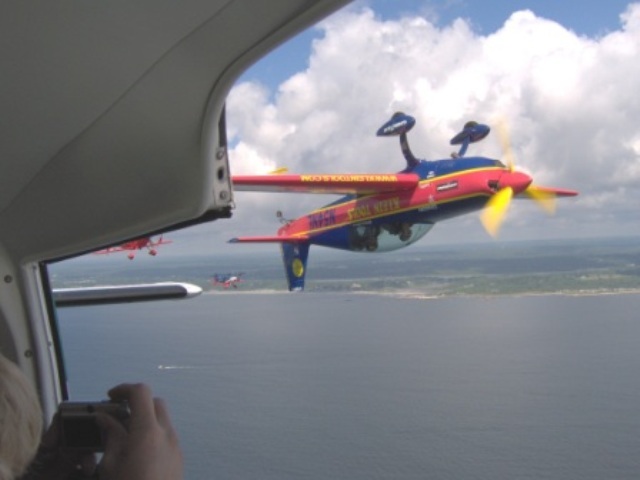
Now to the airplane wing. You can find quite a few explanations based on the shape of the wing. The shape of the airfoil is of secondary importance, what is important is what is called the angle of attack: this is the angle the wing makes with the airflow. Otherwise, an airplane would never be able to fly upside down or a paper airplane (which has flat wings) would not be able to fly. Because of that angle of attack, the air will mainly collide with the underside of the wing: you get an air build-up under the wing and thus an increase in pressure relative to the top. According to Bernoulli, the speed of the air at the top of the wing will then be greater than at the bottom.
You can do some nice experiments to illustrate this: a sheet of paper that you hold on one side and that folds down due to its weight can be lifted by blowing over it, a ping pong ball can keep the in a stable balance by pushing it with a blowing up the hairdryer, you can look up movies of sports matches where the ball follows a curvilinear path as a result of the ball spinning…
You have to pay attention, fluid dynamics is a complex matter and Bernoulli as explained above is greatly simplified. Turbulence will often occur and then the description is much more complicated. Fortunately, these effects are similar to Bernoulli, so they will never interfere with the fun of your experiments.

Answered by
Prof Walter Lauriks
Physics Acoustics

Old Market 13 3000 Leuven
https://www.kuleuven.be/
.