
Even in dry weather
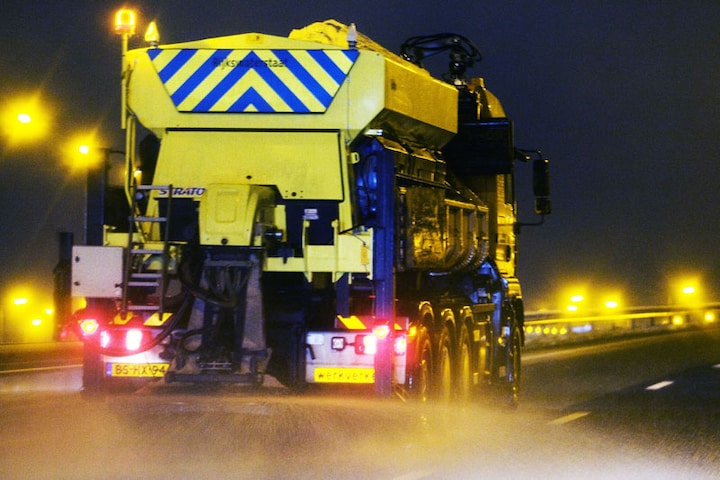
The first night frost of this season was accompanied by the first de-icing salt on the roads last week. Although it was not so much wet and slippery in large parts of the country, there was still a lot of sprinkling. For some this is a mystery: sometimes the conditions still seem harmless, but the spreaders are already happily spreading it. This is why.
Although salt was sprinkled for completely different reasons last summer, this usually only happens for one reason: risk of slipperiness. Prevention is the magic word here. Spreading is done to prevent slipperiness, not to remove slipperiness that has arisen. Unless the circumstances demand it, such as with persistent snowfall.
To determine whether slippery roads should be prevented, Rijkswaterstaat uses the ‘slippery reporting system’ for the national roads. If this indicates that there is a chance of slipperiness, then the slipperiness coordinators will check: what is the weather forecast? And is there still salt on the road? If the answer to both of these questions also gives rise to spreading, the spreading decision will be made. Within two hours, the total of 577 gritters available to Rijkswaterstaat can then ensure that all national roads are gritted.
The slipperiness reporting system and local roads
The slipperiness reporting system works on the basis of sensors in the road surface and measurement points at 330 locations along the national roads. It shows the temperature of the road surface and looks at measurable things, such as the humidity and the wind. The KNMI’s weather forecasts are also being monitored in order to be able to report a chance of slipperiness. Rijkswaterstaat divided the country into twelve areas, which roughly correspond to the provinces. Each area is examined to see if there is reason to spread.
In principle, this slipperiness reporting system is only used to determine the spreading requirement on national roads. Since a road manager is responsible for safe road conditions and provinces and municipalities respectively manage provincial or local roads, they determine whether gritting takes place there. The provinces partly have their own methods for this, and municipalities in turn often adjust the spreading decision to the choices made by the province. In addition, many municipalities also have an anti-slippery plan, because they have to use their ‘own people’ to sprinkle and therefore want to make agreements about this.
Sprinkle in dry weather
Rijkswaterstaat has contracts with contractors for gritting who are available day and night. In municipalities, municipal employees are often charged with gritting – and they often have to take their working hours into account. You will therefore regularly see that night frost is sprinkled in built-up areas on the evening before, which in principle does not occur on the major roads outside.
For the national roads, Rijkswaterstaat determines as late as possible whether gritting is actually necessary, in order to prevent unnecessary gritting. However, if in doubt, always sprinkle, because safety is paramount. That also explains why there is sometimes spreading, even though the circumstances don’t seem to call for it. For example when it is cold but dry. It can happen that the humidity is so high that fog banks can form. When that fog comes into contact with the cold asphalt, it immediately freezes. This can lead to so-called condensation slipperiness.
This brings us back to the magic word ‘precention’. You generally prevent slippery roads, you don’t fix it immediately. In case of doubt, it is therefore mainly sprinkled. Because at the municipal level, the gritting decision is often taken prematurely due to the availability of personnel, there is more room for doubt. According to Jan Rients Slippens, senior anti-ice advisor at Rijkswaterstaat, during the first night frost last week you saw that relatively more was spread on local roads than on national roads. After all, they could only later decide that it was not necessary here and there.

The national roads are sprinkled by contractors and they do this throughout the Netherlands within two hours after a sprinkle decision.
– Thanks for information from Autoweek.nl