
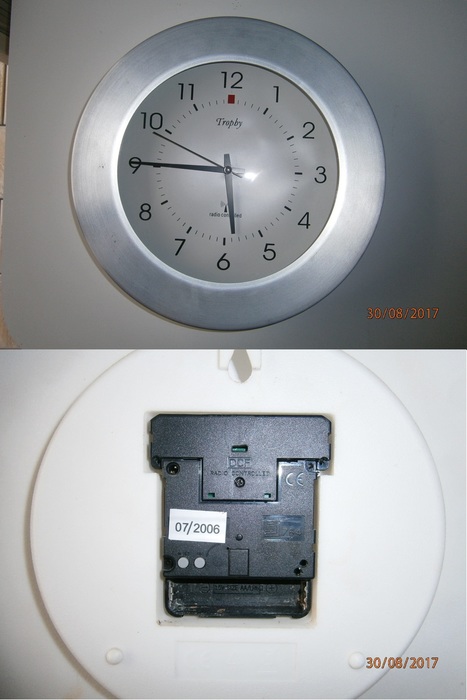
I received a radio-controlled wall clock that works on a battery (1x type AA/1.5V). Once the battery is in the clock, the second hand will start and both hands will rotate rapidly until 00:00. Then the time ‘stops’ for a few minutes. I assume that a check is then made via DCF for the correct time. Then the second hand starts again and both hands turn quickly to the correct time. Since a few days I notice that the clock is starting to run slower (about 1 min/hour). Although I like the function of the 2 buttons on the back
Answer
Best,
As for the function of the buttons, I can’t help you.
As far as how the clock works, yes.
An ordinary digital timepiece uses an accurate clock generator (base clock to adjust 1 second) which is very accurate. The circuit compensates for variations in the supply voltage.
In a DCF receiver this is (sometimes) not the case. This is also not necessary because the clock regularly synchronizes itself with the radio signal sent by the DCF transmitter.
However, the DCF transmitter sends out a very weak signal. There are many cases where the signal is affected by external parameters (presence of other electrical appliances, thickness of walls, weather conditions, etc.).
It is therefore possible that the reception of the DCF signal is disturbed. The clock no longer synchronizes. The internal oscillator can depend on the supply voltage (of the battery voltage) (the sensitivity of the DCF receiver also depends on this).
So make sure there are no disturbing devices nearby (and just about everything interferes with the DCF signal). Also check that your clock is not separated from the outside world by thick walls or metal walls. Insert a new battery (a battery is empty when the voltage drops below 1.1 volts. Sometimes 0.9v is taken, but that depends from device to device).
Most clocks synchronize once every 24 hours. Within 24 hours, the clock should not expire more than 1 second. If that is more, it is best to replace the clock.
Excessive humidity in the room where the clock hangs can also cause major deviations.
Sincerely.
Answered by
ing Marc Roggemans
microcontrollers

http://www.thomasmore.be
.