
The battery as an exchange heart
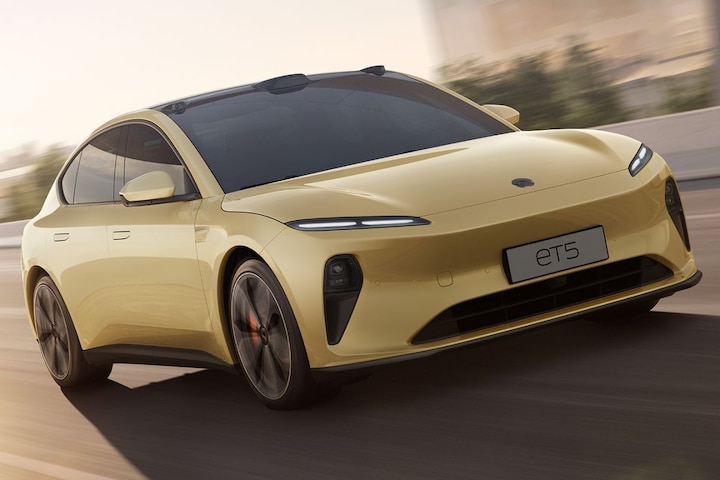
Nio is storming Europe with its Battery as a Service, where the battery is interchangeable and financed separately. That was done before and it failed. President Lihong Qin explains in conversation with AutoWeek why he thinks it will now be a success.
The story about the creation of the relatively new brand Nio is almost cute. Chinese businessman and billionaire William Li stands on his balcony in Shanghai one day in 2012, with his wife sitting behind him with their newborn baby on their lap. Li suddenly realizes that he can barely see the buildings ahead because of the smog and decides that little Li deserves a cleaner future. Everyone else might buy an electric car, but when you’re worth eleven billion dollars, you improve yourself by starting the world. Li decides to set up an EV brand, rounds up investors and his business partner Lihong Qin and hits the nail on the head. In 2016, the brand will be launched with the EP9, a super sports car with 1 mW of power. More mundane models soon follow. Last year Nio took his first steps in Europe, namely in Norway, and now it is the turn of the Netherlands, among others. During the European launch, AutoWeek will speak exclusively with Lihong Qin about his plans and motivation.

“Investing in electric cars is now quite common, but ten years ago you needed guts to do so,” recalls Qin. “Tesla had yet to build its first Model S and everyone was concerned about range, high costs and infrastructure. Our boldest estimate was that between 2030 and 2050 the proportion of EVs would be 95 percent, the most conservative estimate was 30 percent. The latter is pretty close to the reality of the moment. We calculated that electric cars would become big business in both extremes.”
EV expensive and loading inconvenient
Li and Qin conducted a market survey among 80,000 respondents, in which one of the questions was what keeps people from driving electric. Qin: “More than 90 percent mentioned the high price, but that is not in the car, but in the battery. The second most frequently mentioned objection was the inconvenience of loading. So two dead ends that stood in the way of success for EVs. We decided to break through these impasses with exchangeable shared batteries.”

Nio at the presentation in early October in Berlin.
Changing batteries is not instead of, but in addition to charging, explains Qin. “That’s a lesson we learned from a previous battery swap project, Better Place. With us, the customer chooses whether to change or load. But as long as there are no fast chargers that charge your car in a few minutes, a ‘battery swap’ is the fastest way.” But the switch technique also offers very different possibilities, explains Qin. “We have built an entire business model around it. If a range of roughly 150 km is sufficient throughout the year, it is a shame and too expensive to carry around a much larger battery pack. For the few times a year that you want more range for a long journey, you temporarily take a larger battery.”
Higher residual value
The system also provides a higher residual value, says Qin. “The average lifespan of a battery pack is considerably shorter than that of the car. Suppose my body can last a hundred years, but my heart only thirty. Then wouldn’t I also benefit from a change heart? An HV battery, regardless of brand, will last between eight and ten years. A car for at least fifteen years. That means the first Model 3s used are worth little more because of their dying batteries. Installing a new battery in a Tesla costs between €30,000 and €40,000. You never earn that back with trade-in. You don’t have that problem with our exchange system. Furthermore, at Nio you use a shared pool of batteries, so that they are used more efficiently and evenly and the raw materials used are used more profitably.” Qin says he has calculated that 17 percent fewer raw materials are needed for the same number of kilometers in this way. “Less pollution and less costs. And on top of that, because the batteries remain the property of Nio, we can collect them for recycling more easily and efficiently at the end of their life.”
Fewer raw materials
If it all turns out so well, you might think that other brands will also become interested in Nio’s concept. “We are willing to share our knowledge with them,” says Qin. “We are very open, always have been. There have already been some discussions in this area. After all, we also benefit from it, because the more brands use it, the faster the infrastructure can grow.”
.
– Thanks for information from Autoweek.nl