
New connection will open at the end of 2024

With the completion of the Rhineland Route, the eventful and especially long history that preceded the construction of this infrastructural tour de force comes to an end. The new connection between Katwijk, via the A44, and the A4 near Leiden will be completed in its entirety in mid-2024, but is already regarded as the most advanced road construction in the Netherlands.
The Rijnlandroute not only makes an important contribution to the accessibility, quality of life and economic development of the region around Leiden, but also to underground construction in the Netherlands. When making decisions about the construction of the Rijnland Route, Rijkswaterstaat, the province and municipalities certainly did not take any chances. There is no other road in the Netherlands for which so many alternatives and variants have been devised in recent decades.
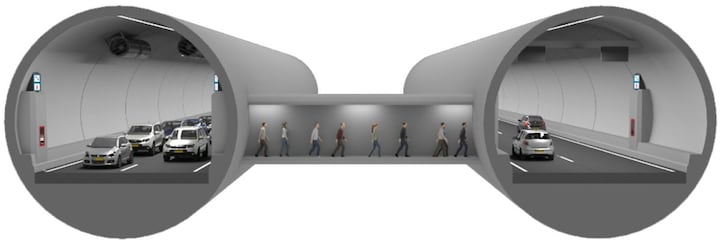
First plan for Rhineland Route as early as 1958
The first draft proposals for the Rijnland route can already be found in the Rijkswegenplan from 1958. All that time there was constant protest from local residents, but due to the ever-increasing traffic jams on the N206, the Ir. G. Tjalmaweg, the business community from the north of South Holland lobbied for at least as long for better traffic flow on the east-west connection. The question is why, after decades of pleading with local residents, the Provincial Council still decided to carry out such an expensive project. Because according to the 2014 budget, the partly deepened, partly tunnelled route would already cost an amount of 931 million euros, but after inflation adjustment and the settlement of a number of unforeseen setbacks, this amounted to more than a billion.
Traffic flow around Leiden and Katwijk
Marjolein Vellekoop is spokesperson for the Rijnlandroute on behalf of the province of South Holland. “Traffic pressure throughout the Holland Rijnland region and especially around Leiden and Katwijk had increased so much in recent years that a replacement alternative had to be found to solve the daily bottlenecks on the existing N206,” she argues. “With this new route we are building on the economic strengthening of the region and we are investing in the accessibility and quality of life of the area. The road solves bottlenecks and guarantees traffic flow in the Holland Rijnland region, particularly around Leiden and Katwijk. For traffic in the north-south direction, the A4 and A44 motorways offer sufficient capacity for the expected increase in traffic over the next twenty years.”
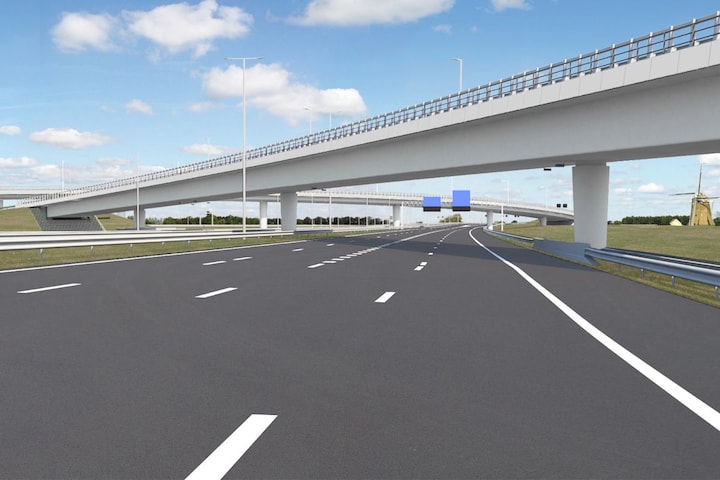
Corbulotunnel is the showpiece
The architectural showpiece of the new Rijnlandroute is the Corbulo tunnel, 2.5 kilometers long and 30 meters deep. The name of the tunnel refers to the Roman general who in 47 AD ordered the construction of a canal that connected the mouths of the Maas and the Rhine in the Dutch delta. Parts of that canal remained in use until about the year 270. “Because of its many river tunnels, the Netherlands has a long tradition of sunken tunnels, but in this case a bored tunnel was chosen that was developed in Germany,” says Helmut Berkhout, the Rijkswaterstaat contract manager who was responsible for outsourcing the extensive work. “We deliberately did not opt for a sunken tunnel, because then we would have had to work above ground for months, while a landscape integration was chosen that was as little burdensome as possible for nature and for the local residents.”
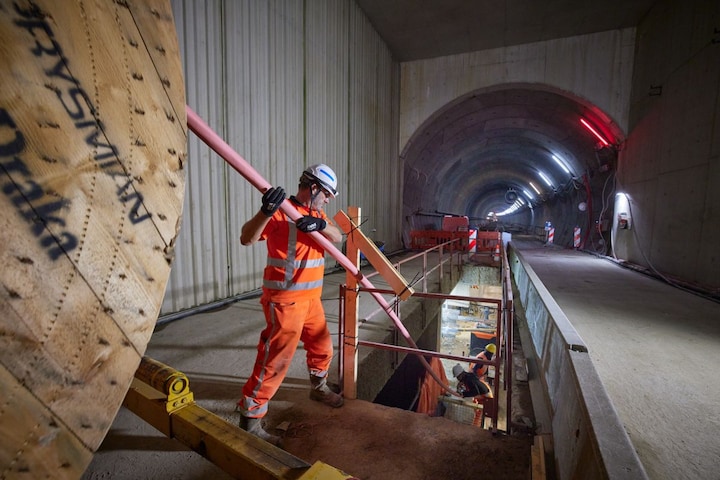
Drilling the first tunnel tube took 6 months
In August 2019, the gigantic tunnel boring machine, adorned with the traditional female name Gaia (the primeval mother of the ancient creation story), started its underground journey. “For bored tunnels you have to look for that specialist expertise in the Alpine countries, because it is not available in the Netherlands,” says Berkhout. “Drilling the first tunnel tube took six months. The hundred-metre-long tunnel boring machine was then transported back to the starting shaft to drill the second tunnel tube, which had to be completed in almost half the time. We had to drill under the Rijn-Schie Canal, under two monumental buildings and houses, a swimming pool, under the The Hague-Leiden railway line and a high-voltage pylon. You can do all kinds of calculations on that, but that was quite exciting at times,” laughs Berkhout. “During the drilling, about sixty people worked continuously 24/7, because you don’t want subsidence to occur due to sudden pressure differences. 2,240 rings were used per tunnel tube, so that a total of almost 16,000 concrete segments of 9,000 kilos each were pushed forward, picked up with vacuum grippers and placed in the tunnel shaft behind the eleven-metre drilling head. Seven segments each formed a ring against which the drill shield pushed itself forward at a speed of 58 millimeters per minute. The tunnel boring machine covered about ten to fifteen meters a day in this way.”

For decades, the Rhineland Route was not a priority
When asked why it took so long for the province to give the green light for its construction, Berkhout replies: “For decades, the process was not a priority for political The Hague, or the costs were not looked up to. As with all major road construction projects with differing interests, it was anything but easy to reach a compromise that was widely supported on the Rhineland Route. At the beginning of 2016, the two route decisions and the provincial integration plan were approved by the Council of State. Naturally, many parties were involved in the planning process, but there were also strong supporters and opponents of the various alternatives, which meant that quite a lot of objections had to be dealt with.”
Why won’t Rijnlandroute open until the end of 2024?
At first glance, the Corbulo tunnel already seems ready to be put into use in the short term – as originally planned – but due to a few unforeseen setbacks, the completion of the Rhineland route has to be postponed for two years. “It was indeed the intention that the Rijnlandroute would be completed at the end of 2022, but due to a serious fire on the construction site in June 2022, the completion of the tunnel will take considerably longer than originally planned. As it stands now, the work will be completed sometime at the end of 2024,” continues Berkhout. “Just as the car industry also ran into problems due to the war in Ukraine and the prolonged corona lockdowns, many parts and machines destroyed by the fire were also difficult to deliver. A few hundred meters of line lighting, 130 cameras, intelligent switches, installation boxes, system components and many other building materials needed to complete the tunnel were lost in the fire.”
Extensive testing
This caused additional problems because systems also had to be tested again, explains Berkhout. “The security cameras had already been tested, but when we wanted to order new cameras, the tested cameras were no longer available. This means that all cameras – the delivery of which took a long time – must be tested again together with all other safety cameras to see whether they are compatible with all other safety systems in the tunnel. Only when all of this has been extensively tested can the permit be applied for from the municipality of Leiden.”
Air quality
According to the province, the assembly and connection of all systems will take until the end of next year. “There are about 54 sub-installations in the tunnel, all of which are tested separately, for example to check whether the tunnel image is being passed on properly to the traffic control center or to check whether all systems can still work together,” explains Helmut Berkhout. “For example, if an air quality meter measures that too much exhaust gas or smoke remains in the tunnel, the fans must start running automatically to blow the smoke away. There are still a number of safety systems that you have not just tested in a few days.”
– Thanks for information from Autoweek.nl