
Originality is exceptional. Whatever you come up with, someone else was usually ahead of you. It is beautiful and daring, the Tesla Cybertruck, but except in the pickup genre, its appearance is not a revolution. The angularity was in the air, think of the Ioniq 5 and now the Kia EV9, the Toyota Bz4X or the new Range Rover – and Land Rover has of course been on that wavelength since 1948.
The Tesla team under Franz von Holzhausen draws from other sources. Think seventies and eighties. Think stacks of dazzling Bertone concepts. Think Lamborghini Countach. Think the first BX. The Renault Supercinq. Coincidentally, they were all designs by Marcello Gandini, who was therefore one of the most important designers of the past century. It is not without reason that Holzhausen mentions him by name. Gandini excelled in designs where each line is, or seemed to be, the shortest connection between points A and B. That gave them their strong and dynamic character. Another strong representative of the better linearity was the brand of bricks, and Volvo persevered for a long time. The crowning glory of the brand’s Bauhaus period was the fantastic 850 in the early 1990s.
What strikes all these cars is the sometimes stylish, sometimes exuberant combination of innovation and healthy austerity. No matter how the tone of voice turns out, you get peace of mind. The clear line, the term coined by graphic designer Joost Swarte, gives cars profile and character. It was necessary. In recent decades, car design was too often seduced by an unlimited fantasy that made shapes too complex and therefore unrecognizable. See for example the new Hyundai Kona, excellent car further; maze of wonderful twists, folds and lines. Look at Citroën, DS, the BYD interiors, the previous Toyota C-HR. The Lexuses can also do something with their hourglass grilles and sometimes haphazard lines. The eye no longer knows where to look. That had to be simpler. The senses are already exposed to so many stimuli. Round or square, Beetle or Wave, you have to create comprehensible shapes. The core must be simple. The buyer wants an overview. He looks for the car he can remember, not a baroque sculpture.
Musk has already changed course with the stripped-down interiors that are now being imitated by everyone for good reason. With the cyber monster he takes that simplification principle to the extreme. He looks like an angry child’s drawing that got out of hand. In profile, the Cybertruck skips four corners compared to normal pickups. That from hood to windshield, that from windshield to roof, from roof to rear window and from rear window to loading platform. The entire superstructure is a triangle. In this radical form, that graph is an extremely rare take, even among supercars. The closest we come is Gandini’s brilliant Stratos Zero concept with its hand-axe-like roofline or the Citroën Karin concept of 1980 with its all-round glass in the shape of a three-dimensional pyramid, and probably slightly better all-round visibility than Tesla’s stainless steel pointed hat with its gigantic dead corners.
As we know, buyers are not deterred by this. And I agree with Musk: The future should look like the future. Although that future with the Cybertruck has an ambiguously retro flavor. It also reminds you of old sci-fi, of the bizarre four-wheelers Total recall. On the other hand; that history is also still the future.
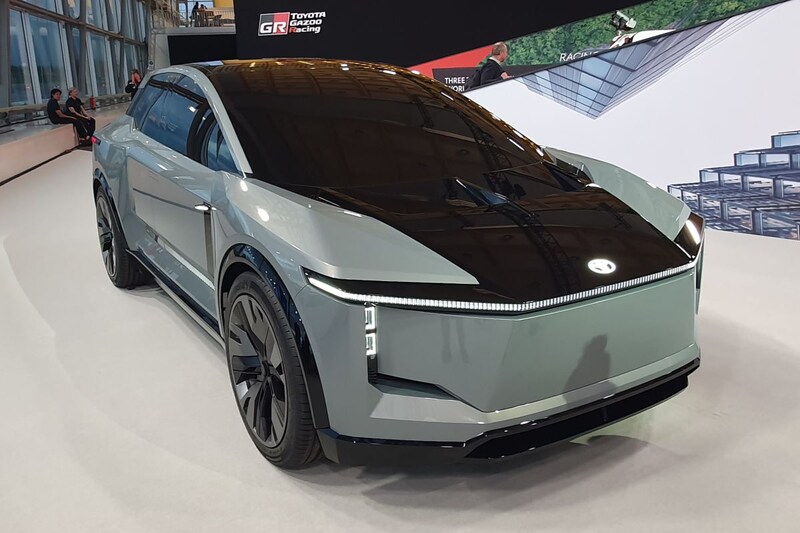
Toyota is now also taking interesting steps towards rethinking the straight line. The brand organizes an annual meeting for the automotive press about current and future developments within the group, the Kenshiki Forum. Beyond the commercial intentions, this is an interesting and useful event for those who like to stay informed, with real specialists who provide real answers. At the last Kenshiki edition in Brussels, a concept of an intended new crossover stole my heart. The FT3e is a kind of soft Bauhaus, a softer, sweeter Cybertruck for the normal person of tomorrow. The door seams cut into the flanks with tight verticals. I saw an external display in the front doors, so tech. The rear light section forms a kind of windowsill under the rear window. No labyrinth of inimitable curves or diagonals; the eye finds a horizon. Fantastic. At Lexus I saw a second beautiful concept one stand further away, the LF-ZC. Upon closer inspection of that car you might think; what do you mean simple? The front is an inimitable three-dimensional origami work of art in steel, the flanks give a postmodern twist to the existing Lexus style with a higgledy-piggledy relief. But the beltline runs tightly horizontally, and again the load-bearing lines front and rear are staunchly vertical. These few simple basic lines make the complex design appear orderly and clear. They simply create order in the multitude, beautifully. Bring on that cyber style. And I would like to have a cyber little one in the style of that monster, Elon, soon. Will it be a hit, bet? People long for overview.
– Thanks for information from Autoweek.nl