
Similarity makes sense
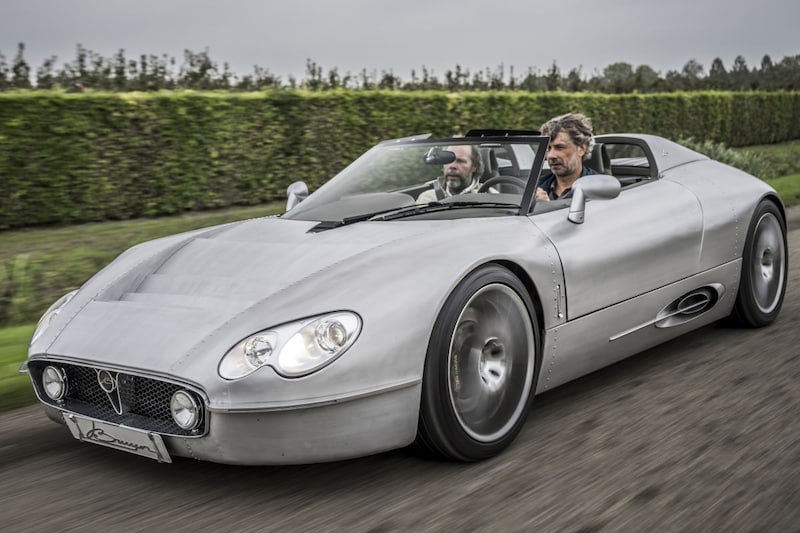
We know Maarten de Bruijn as the man who ensured the reincarnation of Spyker at the end of the last century. He then focused on other projects, even building boats. Now De Bruijn is back with a new car, the DeBruyn Ferox V8, which is very reminiscent of… the Spyker. In conversation with the designer, constructor and especially entrepreneur, we ask how that works. There is no escaping the fact that the name Spyker is mentioned regularly.
A watery sun shines when we drive onto the unpaved path that leads to the Noordenhoek estate, in a meander of the Linge river. Do we even have to be here? The entered address looks like a stable. And a little further, behind the trees, we see a country house. Nothing indicates that we should be here for sports cars, but the navigation system stands firm. Rightly so. An acquaintance walks towards us through the gravel: Maarten de Bruijn. The man behind the initial renaissance of Spyker and then the Silvestris speedboats is now back with a new car. The blood creeps where it can’t go. Together with Niek van Exel and Wouter van Everdingen, De Bruijn started deBruyn Cars in 2021. During Wheels at the Palace, the competition at Soestdijk Palace last summer, we were introduced to product number one for the first time: the deBruyn Ferox V8.
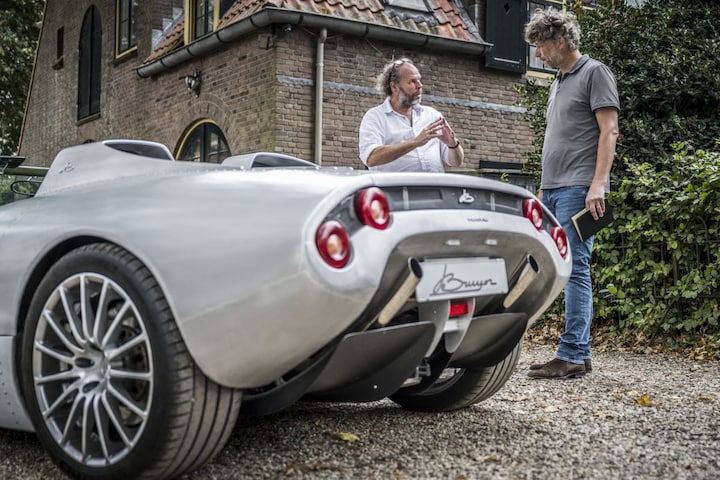
Maarten de Bruijn in conversation with Cornelis Kit about the deBruyn Ferox V8
What we initially mistake for a stable turns out to be a sleek space inside where De Bruijn creates his cars. In addition to the prototype that we saw in the palace garden in September, a Ferox is under construction; the first customer car. Unlike the prototype, which is still equipped with a 4.2-liter Audi V8 – De Bruijn still had one lying around – the production car has an in-house modified Corvette V8, the 6.2-liter LT1. Here on the estate, Maarten de Bruijn seems to be living a boyhood dream. At least, when that dream consists of running your own car brand. He gets started with enthusiasm: “Many disciplines come together in a car. That’s so cool. It’s aesthetic, it’s dynamic and it’s acoustic, because it also has to sound good. All those elements come together. And that makes a car so cool. You can convert an existing car, as Singer does by making the most beautiful 911, but then you still start with someone else’s car. I want to go back to the source. That’s how I started Spyker, with my own Dutch sports car. One hundred percent own.”
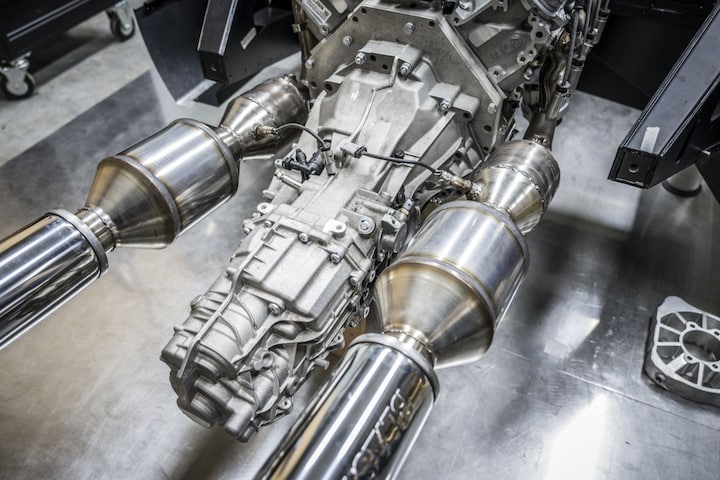
A Getrag gearbox behind a Corvette block.
Why not electric?
In 2005, De Bruijn left Spyker and focused on a new project, speedboats of the more exclusive kind, but in the meantime the itch continued. And although Spyker is a thing of the past, there is no taboo on mentioning that name, on the contrary. “I wasn’t done with the Spykers yet, I couldn’t put it behind me yet. And the Spyker was not completed after I left. That’s why I started to make the ultimate car one more time. I was in the middle of the development process when I met Wouter. Wouter was immediately very enthusiastic and brought along two friends, one of whom – Niek van Exel – is now the other partner. Niek is active in e-mobility and immediately called for the sports car to become electric. That became difficult for a while. I think electric is fine for traffic from A to B, but this is different. This is not a means of transportation. This is fun, this is a toy. If you really want to drive a car, you need a combustion engine. Ultimately, Niek became convinced and we made a plan.”
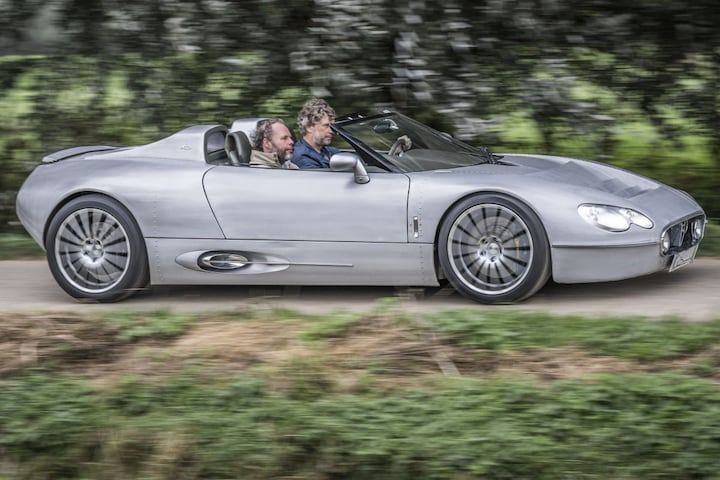
Why does the Ferox look like a Spyker?
It doesn’t take much imagination to recognize a Spyker in the deBruyn Ferox. What’s up with that? “The Ferox does indeed look like my Spyker, but nothing is transferable. When I started building the boat, everyone said ‘It’s just like a Spyker, the interior is exactly the same’. I can’t help it, this is inside me. Anyway, everything is different with the Ferox. It is better constructed, it is more efficient, it is lighter, it consists of fewer parts. Logically, there are more than twenty years in between. I started with the original idea again, but with the knowledge and skills of today.”
Also spoke with AMG
Today’s knowledge and skills also imply a modern engine. And according to the current downsize trend, that quickly becomes a more compact machine for comparable performance, especially if the car is also lighter than before. Yet the Ferox has a V8 again. Isn’t that contradictory? “In Europe you can only get small engines with big turbos, but we want a naturally aspirated engine. Then you quickly arrive at the crate engines from General Motors. GM builds those engines for whoever wants them. We did speak with AMG/HWA. That had a wonderful engine for us, but it is still a step too far, especially too expensive. And to then also meet the emission requirements, things would escalate completely financially. This is more manageable with the Corvette engine, although we still adapt it completely to our wishes. We are building the front of the engine differently, the bottom is different and at the rear we have our own flywheel with pressure group. The latter to better match the Getrag six-speed manual transmission that we use. We also adjust the air inlet at the top. The exhaust is an interesting challenge. You start with an emission part, then an acoustic part and at the end of course an aesthetic part. It does require some of our engineering skills, but the engine now has 500 hp and 650 Nm and also meets the Euro 6b emissions standard. In order to get to know that engine under practical conditions, we purchased a Corvette in which GM also used this V8.”
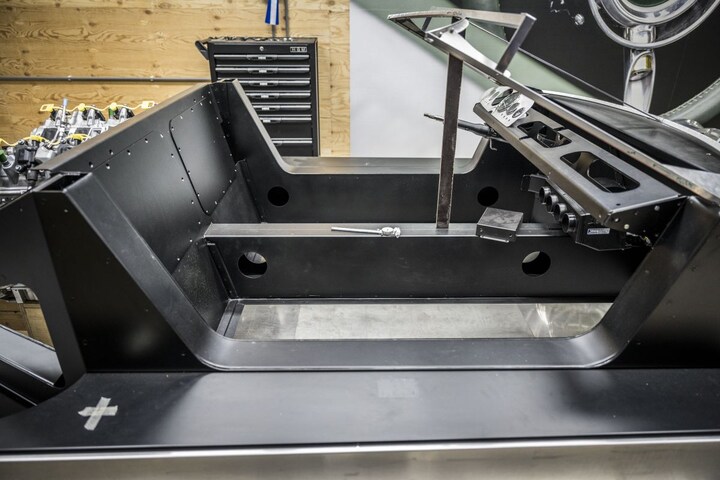
The chassis of the deBruyn Ferox V8 weighs only 100 kilos.
Ferox weighs only 1,050 kilos
Such a big engine is of course great fun, but what when the first corners loom? “The Ferox weighs only 1,050 kg. 500 hp and 650 Nm are more than enough. It is precisely that low weight that makes the car naturally light-footed. That makes it fun. The car does not have electric seat adjustment or a glove compartment that opens electrically, which is not necessary. The Ferox V8 is significantly lighter than the Spyker. We have wheels of our own design; they are lighter than what is available on the market. That is also necessary, because if you were to work with standard components, the unsprung mass would be too high compared to the rest of the car. Now we have improved the proportions, which means that those ‘ballet shoes’ are better able to follow the road surface and find grip. A wheel that is too heavy takes on a life of its own and must be dampened with shock absorbers, which in turn would also be too heavy. And if you make the shock absorbers and springs too heavy, the car will react to the wheel. You would end up in a vicious circle.”
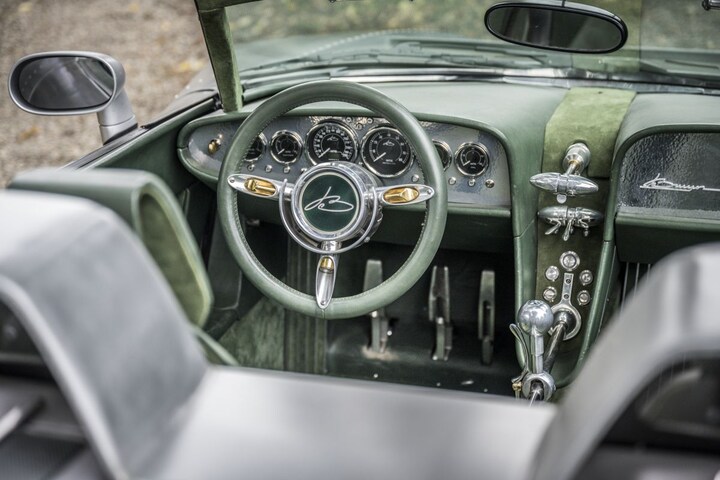
Same focus as Spyker
If you have the freedom to start from a blank sheet of paper, why do you end up doing something that is very similar to what you have done before? “I consciously opted for the same design as at the time at the Spyker. Imagine if the engine were now in the front, then I would have to start all over again. That gives a completely different dynamic with different properties. And I think that a sports car in the design we have here is so cool. I see it just like a motorcycle. You sit in the middle with your motorcycle. The motorcycle gets space and you get two seats. The rest is suspension and a carriage plus some mechanics. Taking large items with you is not possible. No, it’s a sports car. The engine in the middle gives a nice balance. The car, as it were, shrinks around you. The center of gravity is exactly between you and your passenger. The wheels thus become, as it were, an extension of your senses. You and the car share the same center of gravity, so the car does what you would do. That contributes to the driving experience. The car fits you like a glove. I therefore absolutely wanted to continue with the same concept.”
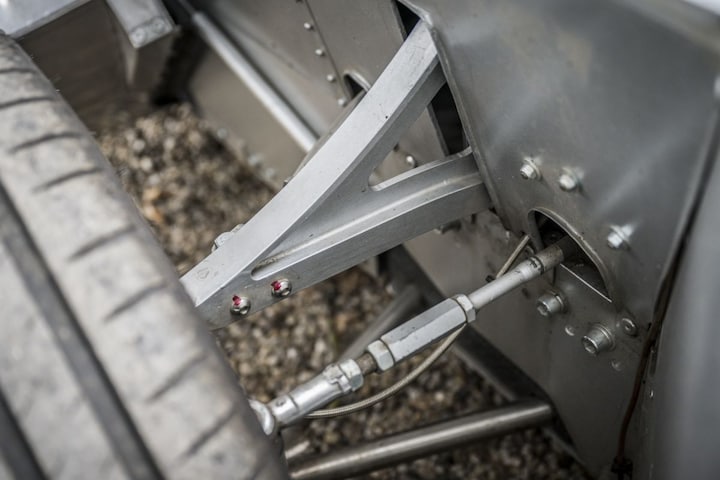
More experience with aluminum
The basic concept is therefore broadly similar to that of the Spyker. However, we are now almost a quarter of a century later, so what is the biggest difference, the biggest leap that has been made? “That’s the weight. I could have reduced that with the Spyker, but due to time pressure I was unable to do so. The aluminum chassis of the Spyker is welded. Aluminum was a fairly new material in the automotive industry at the time; a handful of car manufacturers had just started doing it. Audi and Ferrari also suffered, only Lotus stuck. The adhesive connection comes from the aircraft industry, nice and high-tech, but there was no experience yet as to how that adhesive would hold up in the long term under the influence of brine. I thought that was too big a risk at the time. There is now a lot of experience in this area and the adhesives have also been further developed. I started gluing the boats and applied for a patent on the process. Now the chassis of the car is glued and that saves weight. The chassis weighs only 100 kg, while it is 30 percent stiffer and also much more dimensionally accurate. The Ferox also consists of far fewer parts than the Spyker. Partly because of this, every car has the same size within a tolerance of half a millimeter. This allows us to work more accurately and better control road behavior. Everything is just stiffer and lighter.”
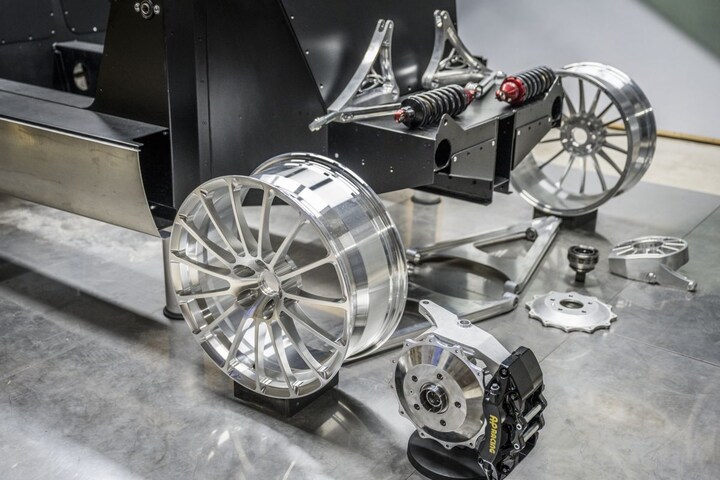
The wheels are also our own design.
No limited slip differential, no four-wheel drive, the Ferox had to be as pure as possible
We increasingly see sports cars with four-wheel drive. Has this also been considered for the Ferox? “No. That technology requires too much space and is heavier. Rear-wheel drive is much purer and makes the car more neutral. With four-wheel drive the fun becomes less. For that reason the car does not have a limited slip differential. The car is simply nice and analog. There are no electronic aids: you have to do it yourself. That’s what it’s about. Compared to the prototype, the production version does have a slightly longer wheelbase. And compared to the Spyker, the wheel geometry has a different design. The Spykers were still too tricky and too nervous for me. The Ferox is much more forgivable and therefore easier to manage. Its simple maneuverability is actually a form of active safety. We did not complete the first meters with the prototype, the shake-down, on a test track, but here at the back of the estate: in the meadow. If we were to take to the road in this area, it would attract too much attention and we do not have a test track nearby. The advantage of the bumpy pasture is that we were able to quickly encounter imperfections. On a flat circuit, the car moves smoothly over the asphalt without any problems, because springs and dampers do not have to do much. But here in the bumpy grass, pain points already become apparent at much lower speeds. In this way we have arrived at a basic design that has of course been further perfected on the asphalt.”
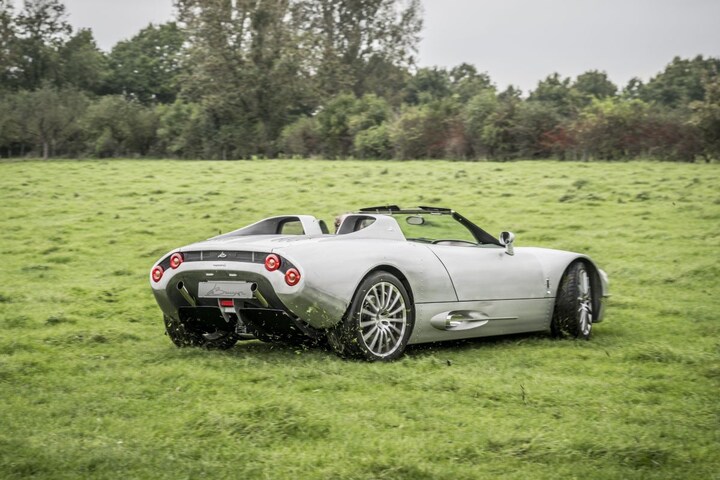
The deBruyn Ferox V8 in action in the bumpy pasture.
Ten to fifteen cars per year
A factory on an estate, testing in the meadow. What are the ambitions? “It should not become a megalomaniac event. This year we want to build four cars together and then ten to fifteen per year. We want to keep it compact here, but still build just enough cars so that you are present in the world. It must remain exclusive, but if you only build a few per year, then you are actually invisible. And if you go too big, you just have to wait and see what the outcome is for the car and for the customer. You often see companies that grow too big too quickly and then collapse because the investment is too heavy. That’s a shame. I want to continue with this at least until 2035, when I will be 70.”
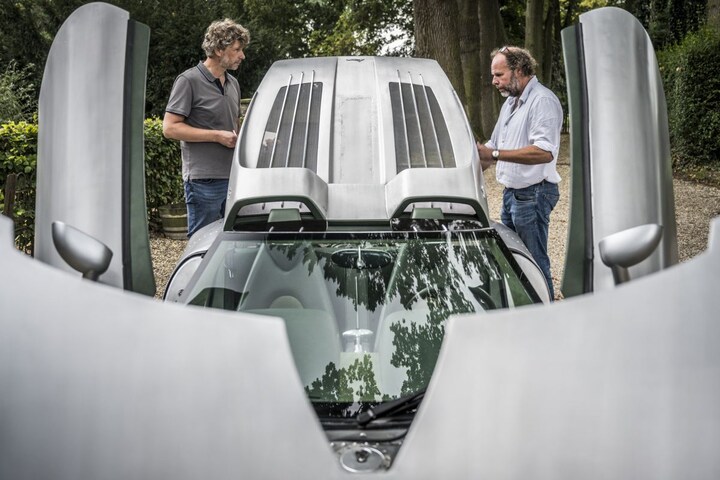
The deBruyn Ferox V8 has gull-wing doors.
This story was previously published in GTO 4 2023.
– Thanks for information from Autoweek.nl