
Ken Divjak – Our man in Flanders
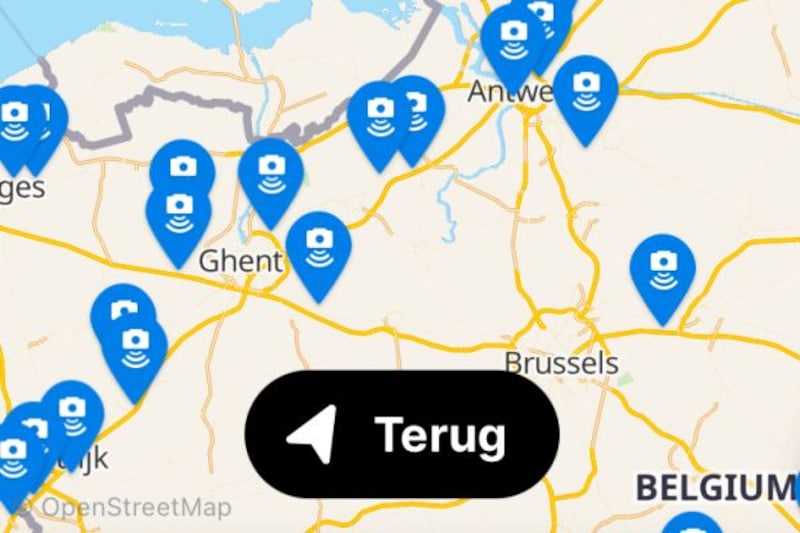
In this new section, Onze Man in Flanders highlights the contrasts in terms of mobility between the Netherlands and Belgium. Today: the question whether or not speed camera apps are banned south of Breda?
Dutch drivers have a good reflex: at the border crossing with Belgium, the flash apps have to be turned off (and the shock absorbers set to comfort, but that’s for another time). But is that actually necessary? Are warning apps such as Flitsmeister, Waze and Coyote effectively banned in Belgium?
Allowed in Belgium
The answer to that question is no, flister apps are not banned in Belgium. In fact, unlike in France, for example, they are allowed to indicate the exact location of mobile speed and police checks, as well as of fixed speed cameras. Route checks are also neatly arranged and are kept reasonably up to date. This applies both to average speed measurements that are added, but also to section checks that are switched off temporarily or for a longer period of time. Their number has increased in recent years, especially in Belgium, both on highways (where you are allowed to drive 120 km/h) and on Flemish regional roads (where 70 km/h is permitted). In Wallonia you are still allowed to drive 90 km/h outside built-up areas.
The most popular speed camera app in Belgium is not Flitsmeister or Coyote, but Waze. That subsidiary of Google Maps has the advantage of using the same map and traffic data as Google, but supplemented with community notifications. This means that traffic jams are visible more quickly, obstacles can be reported (from objects on the road to stranded cars to fog or aquaplaning) and therefore checks can also be signaled. Waze’s navigation function is also strong in avoiding traffic jams, but dares to interpret the concept of ‘road’ broadly on alternative routes.
Criticism
Yet there is regular criticism of Waze in Flanders. According to various authorities, the app creates disruptive cut-through traffic in residential areas, which compromises road safety. Trucks also use it to avoid highway traffic jams. But the fiercest criticism usually comes from VIAS – the Flemish Traffic Institute. This aims to restrict such speed camera apps because they are virtually a free pass for driving too fast. The organization even claims that users are receiving more fines because they rely on the app not to get caught. The attention that such apps require while driving, for example to provide notifications, is also a thorn in the side of critics. Until further notice, speed camera apps remain permitted south of Breda.
– Thanks for information from Autoweek.nl