

Martian rocks are not only found on the Red Planet: some meteorites found on Earth also come from the Red Planet. They were thrown into space during prehistoric impacts and now provide us with Mars geology “free to our door”. However, such Martian meteorites are rare and most are only a few hundred million years old. They come from the time when our neighboring planet was already cold and hostile to life.
A newly discovered Martian meteorite from Mali is all the more exciting. The meteorite found in the Sahara Desert in 2022 includes several dark gray pieces of rock that together weigh almost 800 grams. A team led by Yang Liu from the California Institute of Technology has now examined the meteorite named Teghaza 001 in more detail – and discovered something amazing. Because these chunks, which come from our neighboring planet, are fundamentally different from all previously known Martian meteorites.
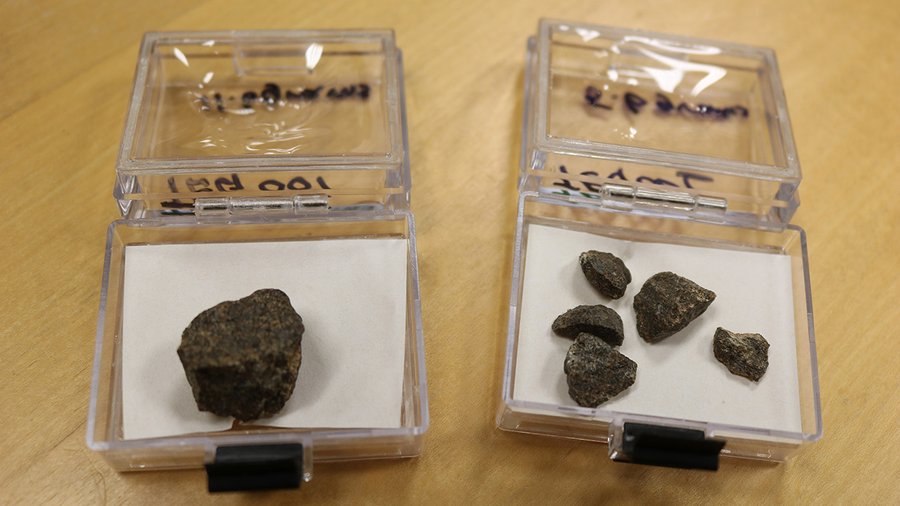
Samples of the Martian meteorite Teghaza 001. — © University of New Mexico
By far the oldest volcanic rock on Mars
The first special feature: Teghaza 001 is extremely old. Uranium-lead dating of tiny zircon crystals in the meteorite material revealed that this piece of rock must have formed on Mars at least 4.1 billion years ago. “This was a big surprise,” says senior author Carl Agee of the University of New Mexico in Albuquerque. “Teghaza 001 is by far the oldest volcanic rock from Mars ever found.” Previously, only two Martian meteorites of similar age were known, ALH 84001 and NWA 7034. However, these differ significantly from the new find and are more heavily modified.
That’s not the case with Teghaza 001: “It’s like you went back in time and chipped off a piece of a ledge on Mars four billion years ago,” says Agee. “We have never found a meteorite like this before.” The mineralogical analyzes showed that this Martian rock comes from the Martian mantle and reached the surface of Mars in a volcanic eruption more than 4.1 billion years ago. There the rock slowly cooled and crystallized.
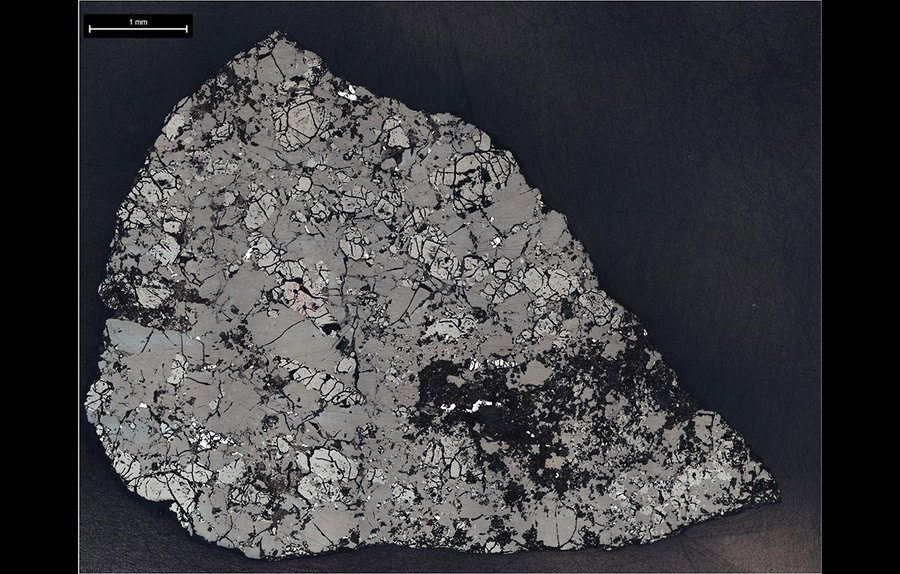
Thin section of a piece of the Martian meteorite Teghaza 001. Mineralogical and isotopic analyzes were carried out on this sample. — © NASA/JPL-Caltech
Stone evidence of water on Mars
This leads to the second peculiarity of the Martian meteorite: It contains silicate minerals with an unusually high proportion of the oxygen isotope 18O and traces of manganese oxides. They are considered possible evidence of atmospheric oxygen and/or microbial life. “All of this suggests that these rocks came from an environment that was Earth-like: there was water and volcano-fed hydrothermal systems,” Agee reports. “That makes this Martian meteorite particularly valuable.”
Teghaza 001 thus confirms that Mars was rich in water and suitable for life in the Pre-Noachian epoch 4.5 to 4.1 billion years ago. “If there was ever surface life on Mars, this would be exactly the time period to look for it,” says Agee. “At that time, Mars may have had a magnetic field that protected it from radiation. It also had surface water and a denser atmosphere. If life arose on Mars, this was the most likely time for it to occur.”
Geological evidence from the southern highlands
The analyzes also provided the first clues as to where the meteorite could have come from on Mars. “The element ratios of Teghaza 001 differ from those of all other Martian meteorites. This suggests that it must come from a different area of the Martian mantle than these,” explain the researchers. To narrow down its origins, they looked for mineralogical matches in geological data from Mars orbiter probes – and found them.
According to the comparisons, Teghaza 001 could have come from the southern highlands of Mars – a region of the Red Planet that has so far been little studied. The Martian crust there is considered to be the oldest on the planet. The entire highland area is around five to six kilometers higher than the northern lowlands. Agee and his team see the most likely place of origin as the region northwest of the approximately 2,300 kilometer wide Hellas impact crater – the second largest in the solar system.
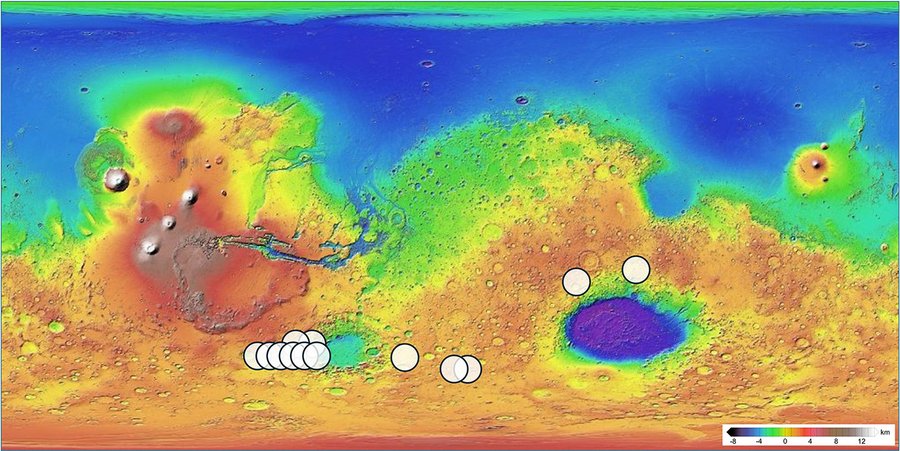
This elevation map of Mars shows the most likely origins (circles) of the Martian meteorite Teghaza 001 in the southern Martian highlands. Hellas Crater is the large deep blue spot. — © NASA/JPL-Caltech/ USGS
The newly discovered Martian meteorite is a unique witness to the early days of Mars and provides new information about a region of the Red Planet that has hardly been explored so far. Teghaza 001 is a real rarity, says Agee: “The chances are extremely slim that we will find another meteorite like this in the foreseeable future.”
Source: Yang Liu (California Institute of Technology, Pasadena) et al., Science, 2026; doi: 10.1126/science.adz5646