

Beyond Neptune, countless icy celestial bodies revolve around the sun – ranging from smaller comets to icy chunks of various sizes to small planets and dwarf planets such as Pluto or Eris. But they are just the tip of the proverbial iceberg: So far, astronomers have only discovered a fraction of these trans-Neptunian objects and described their orbits.
Now there is a spectacular new discovery: In images from the new Rubin Observatory in Chile, astronomers have discovered an unusually bright, large trans-Neptunian object, which they classify as a new dwarf planet. The celestial body, named ED138 in 2026, has already been confirmed as a dwarf planet candidate by the Minor Planet Center of the International Astronomical Union (IAU).
“Mixture of enthusiasm and disbelieving amazement”
Astronomer Matthew Holman tracked down the new dwarf planet using a special algorithm that scans the images from the Rubin Observatory for fast-moving objects. By comparing the positions of billions of light points, the system found what it was looking for: it identified a bright, relatively large point of light that had to be in the outer region of the solar system – but could not be assigned to any previously known trans-Neptunian object.
“My first reaction was a mixture of excitement and disbelief,” says Holman. “Objects of this kind are extremely rare. So I immediately started checking whether I or the algorithm had made a mistake.”
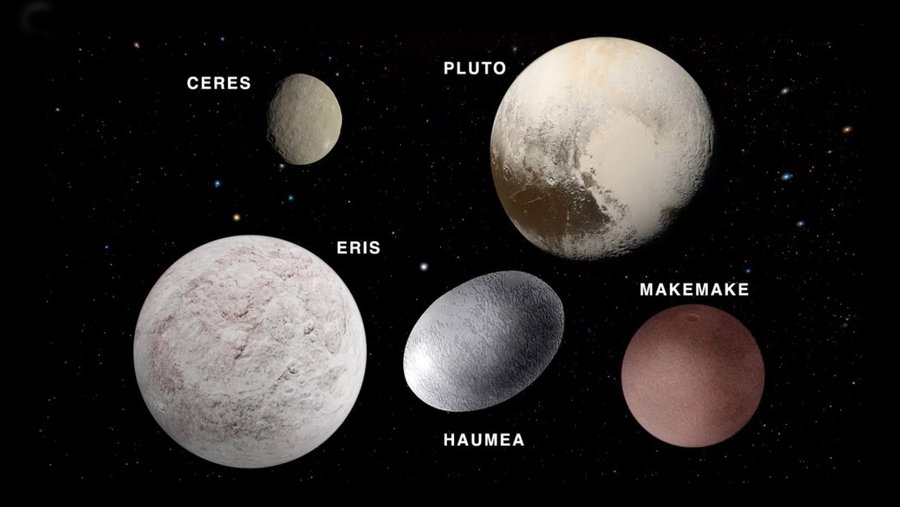
To date, only these five dwarf planets have been officially recognized by the International Astronomical Union. — © NASA/JPL-Caltech
To do this, Holman and his colleagues searched additional image data from the Rubin Observatory for traces of the object named 2026 ED138. With success: the telescope captured the point of light a total of 30 times in 20 nights. The object ED138 also appeared several times in archive recordings from the Dark Energy Camera at the Cerro Tololo Inter-American Observatory in Chile dating back to 2016. Together, these images provided important information about the likely size, shape and orbit of the trans-Neptunian object.
Why ED138 is likely a dwarf planet
According to initial analyses, the newly discovered celestial body is between 600 and 1,500 kilometers in size – making it one of the largest objects beyond the orbit of Neptune, as astronomers report. Its high brightness and albedo suggest that ED138 is covered by ice and likely has a high overall ice content. According to astronomers, the size and mass of this object are sufficient to give it a spherical shape.
This means: The trans-Neptunian object 2026 ED138 meets the requirements for a dwarf planet. According to the guidelines of the International Astronomical Union, a celestial body is considered a dwarf planet if it orbits the sun and is heavy enough to assume a hydrostatically stable spherical shape due to its own gravity. However, unlike real planets, a dwarf planet does not need to have its orbit cleared of other objects. This last requirement is also the reason why Pluto lost its planetary status in 2006 – it has been a dwarf planet since then.
One of only six dwarf planets in our solar system
“If ED138 is confirmed as a dwarf planet, it would belong to a very small group of celestial bodies,” explains Holman. The International Astronomical Union has only officially recognized five dwarf planets in the solar system: the ice-rich celestial bodies Pluto, Eris, Haumea and Makemake beyond Neptune and the dwarf planet Ceres in the asteroid belt between Mars and Jupiter. To confirm the shape and size of ED138, further observations in the infrared range are now needed.
However, the orbit of the newly discovered dwarf planet candidate is much better known. According to the images, ED138 is currently around 46 astronomical units away from the Sun – it is therefore beyond Pluto, whose orbit is on average around 40 astronomical units away. However, the new dwarf planet’s orbit is tilted by around 25 degrees compared to the planet’s orbital plane. Holman and his team interpret this as an indication that ED138 has moved out of its original orbit due to gravitational interactions with Neptune.
“ED138 is just the beginning”
As spectacular as the new dwarf planet candidate is, astronomers believe that ED138 is just the beginning of a whole series of trans-Neptunian discoveries by the Rubin Observatory. “Rubin’s combination of speed, depth and precision opens up unprecedented possibilities for exploring the sky,” explains Mario Jurić from the University of Washington. “This fundamentally changes how quickly and precisely we can determine orbits and also understand the distant solar system.”
Since the Rubin Observatory began operations, astronomers have used this telescope to discover more than 11,000 new asteroids and around 380 new trans-Neptunian objects in the solar system. “The Rubin Observatory will repeatedly image the entire southern sky for ten years, allowing us to detect additional objects that were not detected by previous sky surveys,” says Jurić.
Source: NOIRLab, NSF–DOE Vera C. Rubin Observatory