

Gamma ray bursts (GRB) can release as much energy in just a few seconds as our Sun does in its entire lifetime. But the cause of these cosmic explosions remained unclear for a long time – because astronomers simply missed most of the gamma ray bursts: they were over before common telescopes could detect them.
That only changed on November 20, 2004, when NASA’s Swift space telescope launched into orbit. Thanks to several combined telescopes, this multi-wavelength observatory was able to capture radiation from visible light to UV and X-rays to extremely short-wave gamma rays. More importantly, Swift responded to cosmic events within fractions of a second. For the first time, astronomy had a telescope that was both fast and flexible enough to study mysterious gamma ray bursts and other short-lived cosmic events.
Why Swift crashes and how NASA wanted to save it
But now an era is ending: It is expected that tomorrow morning, on November 4, 2026, the Swift Observatory will enter the Earth’s atmosphere and burn up. The reason for this is a lack of fuel: Because the observatory was no longer able to regularly raise its orbit, it has sunk lower and lower in recent months. In the summer of 2026, NASA therefore launched a risky rescue mission at the last minute: an orbital towing robot was supposed to grab the Swift telescope with its three gripping arms and pull it into a higher orbit. Nothing like this had ever been attempted before.
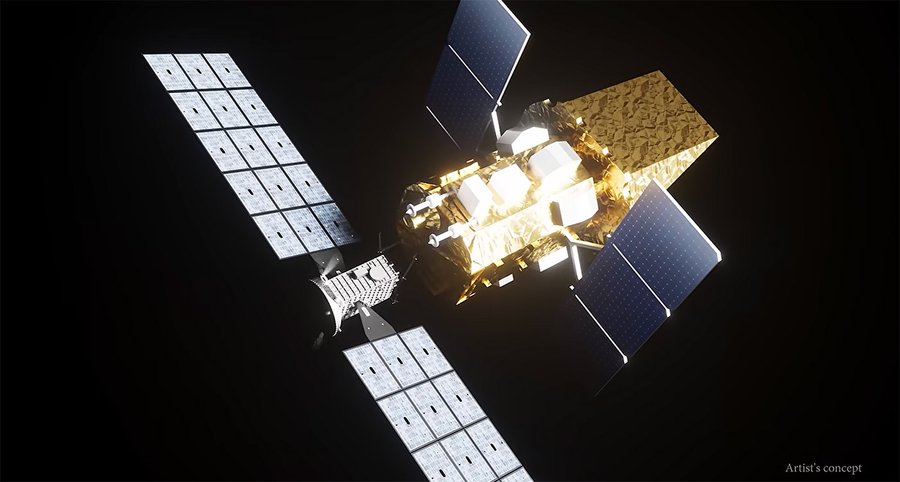
This is how the rescue mission was planned: A robotic satellite was supposed to grab the Swift telescope and tow it into a higher orbit. But the mission failed. — © NASA/Goddard Space Flight Center
But the mission failed: the towing satellite went into a tailspin and was unable to carry out its task. This means that the end of Swift can no longer be prevented: in mid-October, the space telescope fell below the critical flight altitude of 297 kilometers and has been falling ever faster since then. Swift is currently only orbiting around 275 kilometers above the Earth’s surface, NASA reports.
Entry into the Earth’s atmosphere is now imminent: according to NASA estimates, it will happen tomorrow morning around 9:00 a.m. our time somewhere between 20 degrees north and south latitude. After entering the atmosphere, the almost 1.5-ton satellite will largely burn up, but NASA expects that some particularly compact components could survive the crash. “However, the risk of harm to someone on Earth is low – about 1 in 2,100,” explains NASA.
A bitter loss – and not yet a fully-fledged replacement
The end of the Swift Observatory is a bitter loss for astronomy. Because there is currently no fully-fledged replacement – no space telescope is so fast and can monitor such a wide range of wavelengths at the same time. “Swift has been instrumental in expanding our understanding of the changing universe,” explains NASA astrophysicist Shawn Domagal-Goldman. The observatory demonstrated how crucial observations with fast reaction times are for the entire astronomy.
Swift first demonstrated how quickly the gamma-ray observatory could react in May 2005, when it detected the gamma-ray burst GRB 050509B, which lasted just 0.03 seconds. It was the first time that astronomers were able to capture a short burst of gamma rays from the very beginning – a phenomenon caused by the merger of two neutron stars. In 2017, Swift’s images helped observe the radiation from the first merger of its kind detected by gravitational waves.
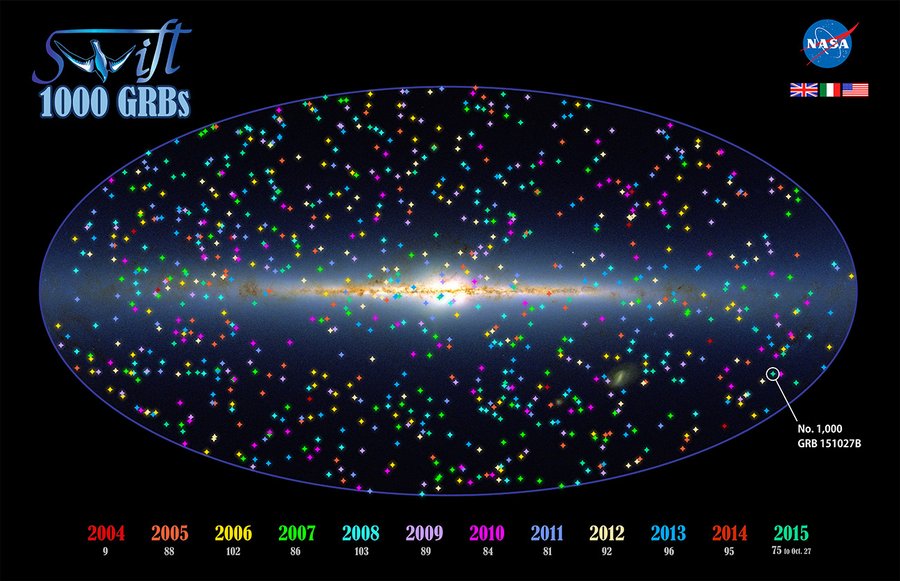
In 2015, the Swift Gamma Ray Telescope detected its 1,000th gamma ray burst. This map shows the distribution of the ones he had discovered up to that point. — © NASA/Goddard Space Flight Center and 2MASS/J. Carpenter, T. H. Jarrett, and R. Hurt
Swift’s legacy: gamma-ray bursts, X-ray flares and star deaths
In the almost 22 years of its mission – a good ten times longer than originally planned – the Swift space telescope has detected more than 2,000 gamma ray bursts, 1,400 stellar explosions and active galactic nuclei. It has observed how supermassive black holes tear stars apart, mapped the X-ray sky and even – almost on the side – tracked down asteroids and comets in our solar system. “Swift has delivered incredible, sustained value,” says Domagal-Goldman.
It is not yet clear when and in what form Swift will be replaced. “We are currently exploring how we can leverage and expand NASA’s existing fleet of space telescopes, from commercial offerings for rapid launches to space to efficient, innovative new missions,” says Domagal-Goldman. Until then, astronomers still have around twelve terabytes of images and data from the Swift telescope, including many observations that have not yet been evaluated. “This will enable new discoveries for decades to come,” says Domagal-Goldman.
Source: NASA