

Just a few hundred million years after the Big Bang, massive black holes with millions to billions of solar masses existed. Even then, these black holes located in the centers of galaxies consumed so much material that they released enormous amounts of energy as radiation – they became quasars, the brightest objects in the cosmos.
Puzzles about early giants
But how could these enormous structures grow so early and so quickly? Astronomers suspect that these early quasars must have formed in areas with unusual amounts of dark matter. Their gravitational pull attracted enough gas to form many stars and large galaxies – which the quasars then fed on. But that’s not enough to explain the rapid growth of these supermassive black holes. In addition, the galaxies in their surroundings must have been so close together that they merged with each other and with them their central black holes.
The problem, however, is that astronomers have already discovered many galaxies and quasar pairs shortly before their merger. But from the early cosmos, where such collisions should have been frequent, such pairs are so far rare: researchers only know of three close quasar pairs from more than 12.8 billion years ago. One of these pairs has not yet been clearly confirmed.
The distant quasar turns out to be a pair
Now a fourth pair of quasars has been added – and this one is older and closer together than any previously known. Astronomers led by Silvia Onorato from the Gemini Observatory in Hawaii discovered it when they analyzed quasar images from the James Webb Space Telescope. As part of the aether survey, the telescope’s near-infrared spectrograph targeted 200 quasars from the first billion years after the Big Bang. They represent 43 percent of all quasars known so far from this phase of the cosmic dawn.
But one of these quasars was not alone: Onorato and her colleagues discovered a previously overlooked second spot of light in the quasar J1602+4228A, around 12.9 billion light-years away. Could it be part of a close quasar pair? To check this, the astronomers examined the “suspected case” for two nights using the high-resolution spectrographs of the Gemini North telescope.
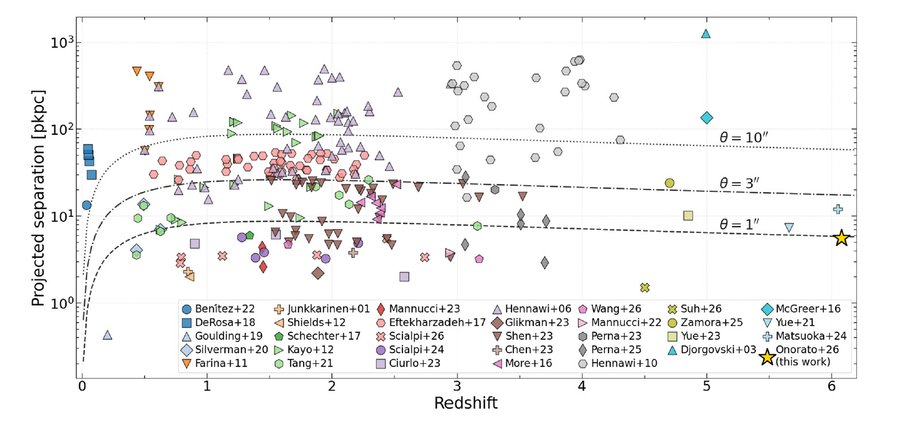
Comparison of the newly discovered quasar pair J1602+4228AB /yellow star) with other known pairs in terms of age and distance from each other. — © Onorato et al./ The Astrophysical Journal Letters, CC by 4.0
“Oldest and most compact pair of quasars”
This confirmed the suspicion: the distant quasar J1602+4228A is actually a pair of closely orbiting, highly active massive black holes. These orbit each other at a distance of just 18,100 light years – that is less than the distance from the solar system to the center of our Milky Way. “J1602+4228AB is the oldest and most compact known pair of cosmic dawn quasars,” Onorato and her colleagues report.
The two quasars existed 900 million years after the Big Bang. They are only the third clearly confirmed pair of quasars from this early era of the cosmos. At this time, the radiation from the first stars and galaxies was still ionizing the neutral hydrogen of the early cosmos. Through this era of reionization, the cosmos also became permeable to short-wave UV radiation. What role quasars played in this is still unclear.
Astronomers have named the newly discovered quasar pair “Nāpōwawāʻenakaulua”. In Hawaiian, this means something like “Two celestial bodies of unfathomably powerful darkness amidst radiant heat, returning energy to the universe.”
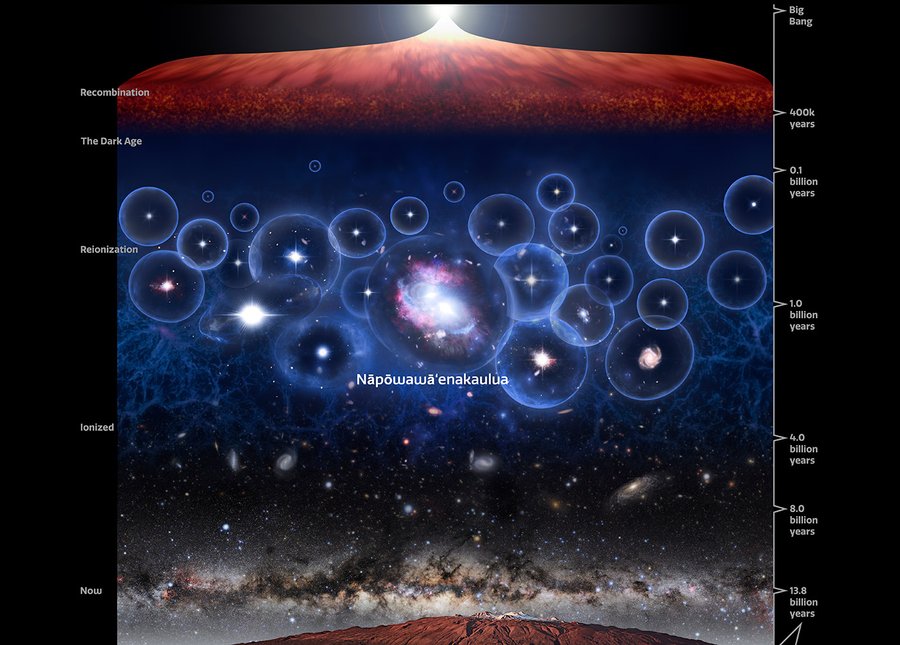
The newly discovered quasar pair J1602+4228AB, also called Nāpōwawāʻenakaulua, dates back to the dawn of the cosmos – the era of reionization. — © International Gemini Observatory/ NSF-NOIRLab/AURA/ P. Marenfeld, M. Zamani
Surprisingly massive
The large mass of the two quasars is even more unusual: the two active black holes are 1.5 billion and 400 million solar masses. For comparison: the central black hole of the Milky Way “only” weighs around four million solar masses. “It is amazing that even back then these quasars were as massive as the supermassive black holes in the largest galaxies today,” says Onorato.
Both quasars also have an extremely high “eating rate”: their brightness suggests that they devour more matter per unit of time than the Eddington limit dictates. This is considered the upper limit for classical accretion by black holes. In today’s cosmos, exceeding the Eddington limit is considered almost impossible, because above a certain feeding rate the radiation released becomes so strong that it prevents further material from being sucked in. However, there are initial indications that this limit did not apply in the early cosmos.
A clear explanation is still missing
How the newly discovered quasar pair could become so massive so early remains unclear. “There is currently no clear explanation as to how any of these gigantic quasars could have existed so early in the universe – let alone two,” explains Onorato.
However, she and her team suspect that the heavy pair could be another indication of local peaks in the matter density of the early cosmos. This agglomeration of dark matter, gases and galaxies may have created the conditions necessary to enable these two active black holes to grow rapidly and feed at high rates. “At Nāpōwawāʻenakaulua, we as astronomers can study how the very first massive galaxies and their central black holes formed at this early stage.”
Source: Silvia Onorato (International Gemini Observatory, Hilo, Hawaii) et al., The Astrophysical Journal Letters, 2026; doi: 10.3847/2041-8213/aeb11f