

Betelgeuse is hard to miss in the sky, as the red supergiant, which weighs around 16 to 19 solar masses, shines as the bright shoulder star of the constellation Orion. It is already nearing the end of its life cycle and could be on the verge of going supernova. When Betelgeuse suddenly darkened at the end of 2019, it attracted worldwide attention. A few months later, however, the all-clear came: the darkening came from a huge dust cloud that was created by a violent plasma outburst from the supergiant.
In 2025, Betelgeuse hit the headlines again: Astronomers discovered that the red supergiant is not alone – it has a much smaller partner star. The companion, named Siwarha, weighs only 1.5 solar masses and orbits Betelgeuse at a distance of only 2.3 times its radius.
Radio view of the red supergiant
Now high-resolution radio recordings provide new information about Betelgeuse and its small partner. A team led by Lynn Matthews from the Massachusetts Institute of Technology evaluated observation data from the Very Large Array in the USA and the Atacama Large Millimeter/submillimeter Array (ALMA) in Chile. Both observatories had repeatedly targeted Betelgeuse from 2021 to 2026 in seven radio frequencies between 22 gigahertz and 485 gigahertz.
The new data shows how Betelgeuse’s gas envelope has evolved since the Great Darkening of 2019. Accordingly, the brightness temperature has increased again to almost normal values of around 3500 Kelvin. Nevertheless, measurable traces of the plasma burst remain measurable: “In all observed radio frequencies, Betelgeuse’s atmosphere is cooler than in UV measurements in the same layers. This indicates the ongoing presence of cooler plasma in the hotter material of the chromosphere,” the astronomers report.
Siwarha flies through Betelgeuse’s atmosphere
The most exciting result, however, is something else: the radio data reveals that Siwarha is disrupting the atmosphere of its much larger partner Betelgeuse. “This companion orbits the star so closely that it passes through its extended atmosphere,” explains Matthews. The small companion star apparently leaves behind a kind of wake vortex – similar to the wake of a ship in the ocean.
Because little Siwarha is significantly hotter than Betelgeuse at around 12,000 Kelvin, it could also influence the ionization and currents in the supergiant atmosphere, as the astronomers explain. However, the resolution of their recordings was not yet sufficient to clearly prove this. According to the team, further investigations are necessary here.
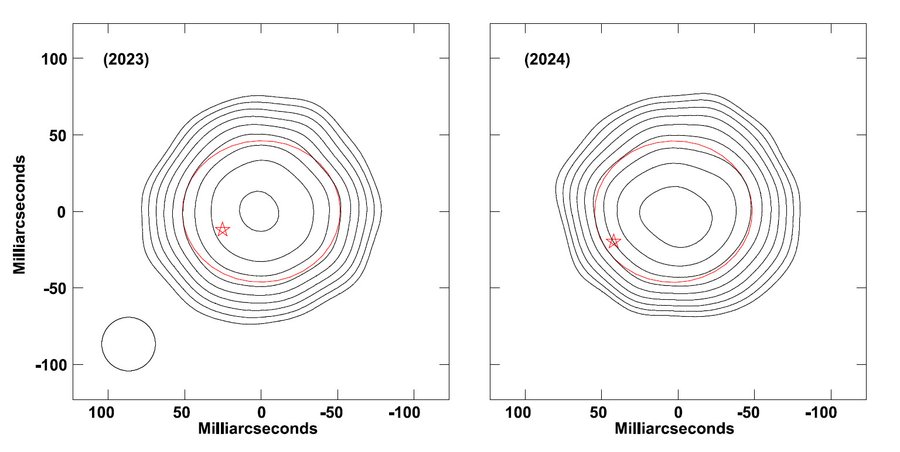
The circles mark the radio emissions from Betelgeuse’s atmosphere, the red star marks the position of Siwarha. — © Matthews et al. / The Astronomical Journal, CC by 4.0
Deformed gas shell
But there is another indication of the disruptive influence of the companion star, as Matthews and her colleagues found: When they examined how the shape of Betelgeuse’s radio emission changes over time, a subtle but clear effect emerged: “We see a systematic increase in the ellipticity of the supergiant when the companion star is at its furthest distance from us,” the astronomers report. However, if Siwarha is directly in front of or behind Betelgeuse, it appears almost round.
According to astronomers, this suggests that Siwarha also influences the expansion of Betelgeuse’s atmosphere. They compare this to the deformation of the water surface of a lake or the sea when a larger object moves just below the surface: Although the radio telescopes cannot image Siwarha directly, they can see how it changes its atmosphere as it orbits the supergiant.
Matthews and her colleagues hope that future expansions of large radio observatories such as the Next Generation Very Large Array will soon reveal more about the prominent pair of stars. This could, for example, clarify how strongly Betelgeuse’s enormous gravitational pull tugs on its smaller partner and narrows its orbit over time. But it could also show how exactly Siwarha messes up the atmosphere of his much larger partner.
Source: Lynn Matthews (Haystack Observatory, Massachusetts Institute of Technology, USA) et al., The Astronomical Journal, 2026; doi: 10.3847/1538-3881/ae953d