
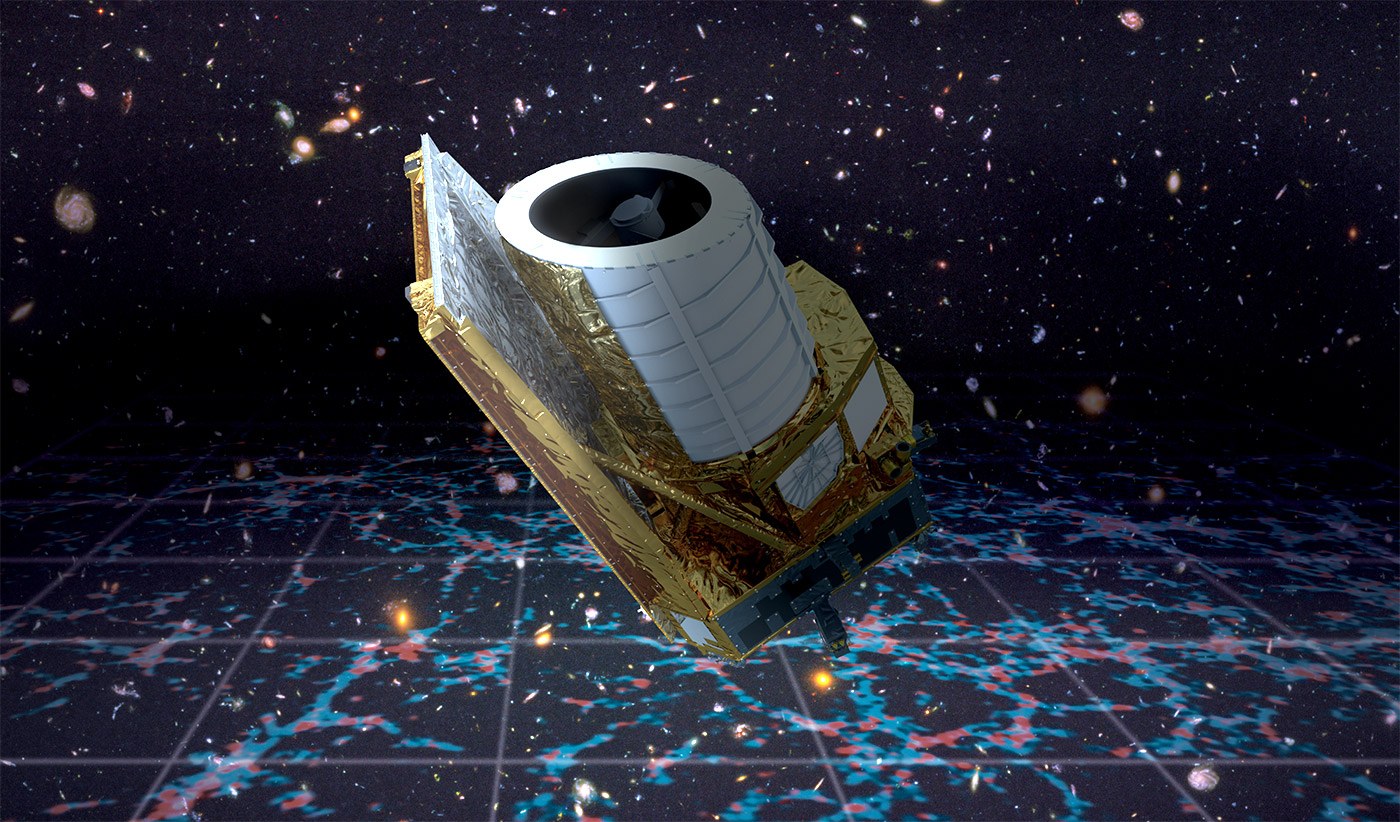
The European space telescope Euclid was launched in July 2023 to primarily collect data about the “dark side” of our universe: dark matter and dark energy. This should help clarify what the invisible dark matter consists of and how dark energy drives the expansion of the cosmos. To do this, the telescope’s two instruments map galaxies and other celestial objects up to ten billion light-years away. Because Euclid can image a large section of the sky in just one pass, but still in high resolution, this mission is particularly well suited for detailed yet comprehensive 3D mapping of the cosmos.
Sky map covering the area of 9500 full moons
The first large data package from the Euclid mission now confirms this. It includes the results of around 13 months of observation in the form of images, spectra and large-scale sky mosaics in visible and near-infrared light. “These are much more than just pretty pictures. Today we mark a scientific milestone in our understanding of the cosmos,” says ESA Science Director Carole Mundell. “This Euclid data release represents the most comprehensive space-based sky survey of its kind to date.”
The new Euclid sky map shows a section of the sky of 1,900 square degrees – the equivalent of 9,500 full moons. “The data catalog contains raw data, calibrated images, catalogs and spectra over a huge area of the sky,” explains Euclid project scientist Valeria Pettorino from ESA. “This will make it possible to map the large-scale structure of the universe with a level of detail that has never been achieved before.”
Galaxies, quasars and strong gravitational lenses
Specifically, the mapping includes the positions and features of more than 900 million galaxies, over 60 million quasar candidates, the high-resolution spectra of a good 160 million light sources and around 15,000 candidates for strong gravitational lenses – massive foreground objects that amplify the light of distant galaxies and quasars. They provide important insights into the distribution of invisible dark matter. The new catalog of these gravitational lenses is more extensive than all previous ones combined, says ESA.