

Facebook is heavily criticized for privacy violations. Some critics even call for their own Facebook account to be deleted. What about privacy on Facebook?
Who sees my posts on Facebook?
Facebook users decide for themselves who sees the messages, photos and videos they post. This can be done per message. For example, share a vacation photo only with friends and a charity fundraiser with everyone. Facebook users can therefore excellently monitor who sees which things about them. But the criticism is not about the information that other Facebook users see, but about the information that the company Facebook collects outside of its own social platform.
Facebook tracking cookies
For example, the social platform tracks users in different ways. Many companies (such as sites and apps) share data from their own users with Facebook. This is also known as the ‘off-Facebook activities’. For example, Facebook knows which sites people visit or what they put in a digital shopping cart. But Facebook also tracks those who don’t have an account at all through the like and share buttons that are featured on many web pages. If you visit a page with those buttons, your IP address, location and browser information will be passed on to Facebook. User or not. The only difference is that Facebook users are tracked in more detail because they are given a unique Facebook ID. This ID is also passed on when logged out of Facebook. All this information is stored in so-called tracking cookies.
Furthermore, Facebook tracks users through other services that they own. The largest and best known two are WhatsApp and Instagram. It is true that WhatsApp has so-called end-to-end encryption. This is a security that means that no one, not even Facebook itself, can read your messages. But information about your use of the app, your friends and your location, among other things, is passed on to the parent company.
Why collect data?
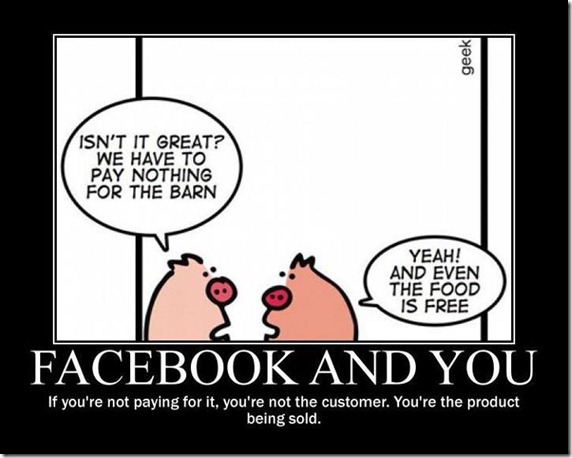
What should a company do with all that information about users? Check out the illustration below. This includes the text ‘If something is free, you are not the customer, but the product.’ In a nutshell, this is the other side of Facebook. The social medium is free. But for that you pay with yourself. Facebook collects and shares information with third parties for targeted advertising. And that doesn’t stop when you close the Facebook website. Facebook uses all this information to best serve its advertisers. Because the more targeted the advertisement, the greater the chance that the consumer will make a purchase. But critics point out that the information Facebook collects could fall into the wrong hands. Which can lead to less harmless practices than showing personalized advertisements.
delete facebook?
Anyone who has followed the story so far will understand that Facebook is not the problem. Deleting a Facebook account is not the solution. We have to focus on the online techniques that make it possible to track users, so the tracking cookies. Facebook is certainly not the only company that uses them to collect information from users. Google does it, Microsoft, but also Nu.nl, De Telegraaf and broadcaster MAX. All with the aim of offering the user tailor-made advertising.
Better protect privacy
The internet user is not completely at the mercy of the advertising wolves. For example, delete the data that other companies collect for Facebook. Or make sure that Facebook does not store data from other apps and sites from now on. Read here how that works.
It is also possible to use a program that blocks tracking cookies. Privacy Badger is one of the better ones. This program nestles in the browser and blocks tracking cookies, but allows cookies that are necessary to log in or order something in a web store. Unfortunately, Privacy Badger doesn’t work with Safari (but it does with Chrome, Edge, Opera, and Firefox). An alternative for Safari users is Adblock Plus.
These tools don’t make you suddenly invisible to those who collect information about you, but you do make it difficult for them.