
The question seems pretty clear to me 🙂
My mother, and many of my family are deeply religious (Jehovah’s Witnesses).
I myself was brought up that way, but since I was 11 I started to see gaps in the faith, and turned more towards the theory of evolution.
Now my mother gave me a book that they study and believe.
I’m going through this book now, trying to disprove it on all fronts (I’ve already found a lot of demonstrable lies).
This is not because I want to impose my view, but to show that they believe things that are simply not true.
Now it says in the book that an intermediate form of a giraffe has never been found, and indeed I can’t find it (yet).
Of course I understand that not all fossils have been found, and that not every animal has become a fossil. But if I can also prove that a fossil has been found, this would prove crystal clear that the book is full of lies, and with that I can prove even better that the book is no good.
Thanks in advance.
Answer
Dear Sam,
Fossil giraffes of the genus Giraffa are known from the Pliocene era, about 2 to 5 million years ago. These primordial giraffes had many anatomical similarities with modern giraffes (especially dental features are important), but not the characteristic long necks. Why have no giraffes with half-long necks been found so far?
Maybe it’s just a matter of time and a lot of research, but we have to recognize that complete fossil skeletons of large land animals are extremely rare. That’s because a large animal that dies on land will almost always be torn apart by scavengers, and what’s left is mostly cleaned up by smaller animals and microbes. Then molars and teeth fossilize best and that is what paleontologists often have to do (eg Pleistocene giraffe). To escape this recycling process, a cadaver must be quickly and completely buried under a layer of sediment. Only then is there a chance of fossilization of a complete skeleton, which mainly takes place in or near a river or lake. Fossilization in the permafrost (mammoths) or in glaciers (Ötzi) is even rarer.
Thus, complete evolutionary lines of large land animals are impossible to document in great detail on the basis of complete fossil skeletons. Due to the small number of more or less complete fossils, paleontologists see only snapshots of the evolution of many large land mammals.
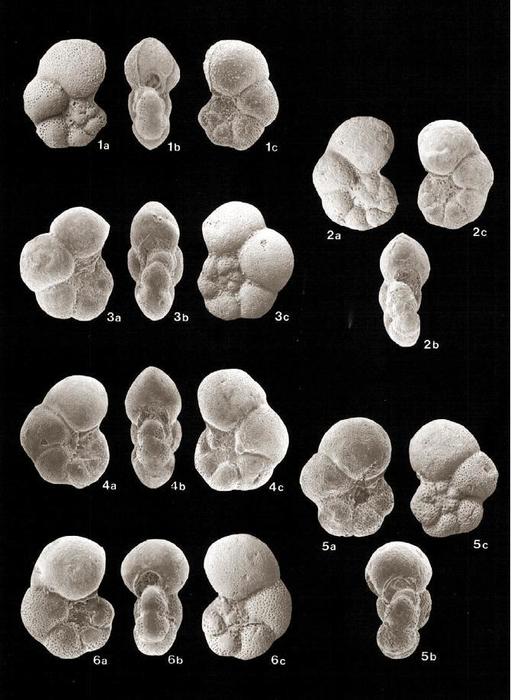
We know complete evolution series mainly from organisms that leave behind large quantities of fossils, especially in sediments in seas and oceans, such as the calcareous shells of snails, shellfish and especially from microfossils such as the foraminifera in the accompanying photo.
These are shells of single-celled organisms the size of a grain of sand. They are five different copies, each in three views. Numbers 1-3 are bowls of the species Globanomalina chapmani. Numbers 4-6 are representatives of Globanomalina luxorensis, a species that evolved from the other species some 55 million years ago. The differences are minimal, but striking for the connoisseur. The evolution of such small organisms may not be that spectacular, but it can be documented very accurately and thus one of the many proofs of evolution.

Answered by
Prof. dr. Robert Speijer
Geology – Paleontology – Paleoclimatology. You study geology in Leuven!

Old Market 13 3000 Leuven
https://www.kuleuven.be/
.