
I’m having trouble with this actually embarrassingly easy question… Hopefully you can help me (I’m not a great physicist)? Friction with the air should be neglected. (This is not a school assignment; the exams are over but I would like to understand this.)
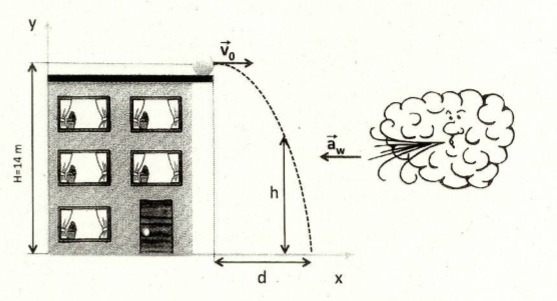
Answer
First and foremost you choose a cross of axes. Let’s place the origin at the ball’s point of departure, the x-axis horizontally to the right and the y-axis vertically downwards. For example, the starting position of the ball is (0,0) and the initial velocity (3.6 , 0)
1) We neglect the air resistance on the ball:
We first look at how long it takes for the ball to hit the ground. In the absence of air resistance, in the y-direction
y
With y0 = 0 m and also vy0 = 0 m/s this becomes
So that y
In the x direction we have x
with x0 = 0 (thanks to our choice of ashwort) and vx0 = 3.6 m/s we find after 1,689 seconds: x = 6,082 m
But I see on the drawing you attached that there is a wind blowing to the left, so in the negative x direction. According to that drawing, that wind causes a constant acceleration ‘aw’
The formula for the movement in the x-direction can therefore be extended with that term, in the same way as the acceleration of gravity is incorporated in the y-equation, because that aw is assumed to be constant:
x
Because of our choice of the axes, there is a minus sign in front of aw. You can now choose aw and recalculate the distance on landing, again after 1,689 seconds. After all, that number does not change because the wind blows purely in the x-direction and therefore has no effect on the movement in the y-direction.
Depending on the value you choose for aw you will end up with a different distance, but definitely less than the 6,082 m without that wind. If wa = 4.62 m/s2 when it hits the ground, the ball hits exactly the foot of the building, but that’s like a very strong wind!
2) Of course one can wonder to what extent it is still ‘correct’ to take into account the wind, but not the air resistance. If one does want to take the air resistance into account, it suddenly becomes mathematically much more difficult, because that force is no longer purely horizontal or vertical. It is in fact tangent to the orbit (which it also determines itself), so that the separation between what happens in the x and in the y direction is no longer possible.

Answered by
prof.dr. Paul Hellings
Department of Mathematics, Fac. IIW, KU Leuven

Old Market 13 3000 Leuven
https://www.kuleuven.be/
.