
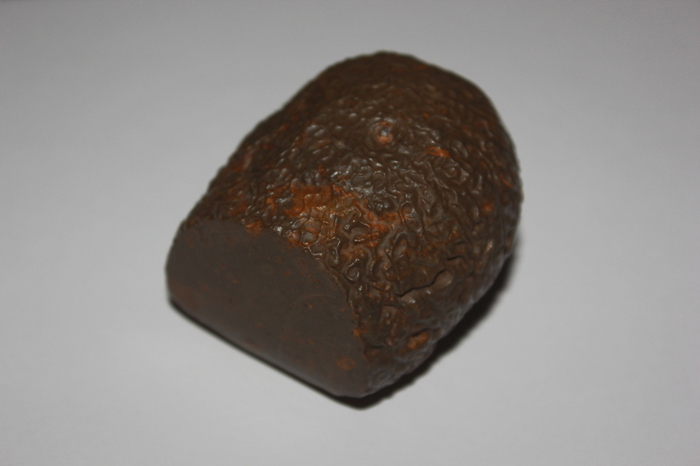
I bought this stone from someone who suspected it might be a meteorite. He himself found this “stone” in the desert area of Erfoud (Morocco). I’ve had it for a number of years now, but now I would like to know for sure what I finally bought at the time. (It has been cut to view the inside of the stone and then polished back. Mvg, Dennis
Answer
Dear Dennis,
Meteorites are regularly found in some desert areas (including Antarctica). They hardly argue there. The best way to identify your stone is to do an analysis yourself. There is already a start: the saw cut. I assume this stone had no metallic sheen after cutting and polishing. If that’s true, it’s not an iron-rich meteorite, but that doesn’t mean it isn’t an iron-rich rock. It could therefore still be a silicate-rich meteorite, although I have my doubts about that. You can know whether the stone contains a lot of iron by determining the density. This is fairly easy to determine using a scale (the mass) and a determination of the volume of the stone (eg with a small measuring cup with some water in it: the volume difference is the volume of the stone). Iron-rich stones and minerals have a density of at least 5 kilograms per liter. On the next page you will find all kinds of suggestions for identification: http://meteorite-identification.com/streak.html. If you are still in doubt after your own analysis, you could contact scientists at the VUB who study meteorites.

Answered by
Prof. dr. Robert Speijer
Geology – Paleontology – Paleoclimatology. You study geology in Leuven!

Old Market 13 3000 Leuven
https://www.kuleuven.be/
.