
Fifteen years ago, Opel, Renault and PSA knocked on the door of the Far East
Halfway through the first decade of this century, a new market segment emerged that became extremely popular in no time: that of the midi SUV. The European car manufacturers are startled awake and have to run to their feet to be able to jump on the train set in motion by the Asian brands. This results in a number of interesting cross-pollinations. A reconstruction.
For decades, the off-road vehicle has had only one task: to work for a living. It doesn’t matter how you get to the other side, as long as you get there. Comfort is at the very bottom of the priority ladder. That changes in the 1970s with the arrival of the Jeep Cherokee and the Range Rover. These cars have the appearance and capabilities of an off-road vehicle, but as a driver you no longer arrive at your destination broken-bones. There is good insulation, leather on the seats, carpet on the floor, air conditioning, an automatic transmission, cruise control, a nice audio system. The two models just mentioned are considered the founders of today’s SUV, the Sport Utility Vehicle. In the US, cars such as the International Harvester Scout, Ford Bronco and Jeep Wagoneer have already done the necessary pioneering work in the 1960s. You could go even further back in time, but then we digress. While ‘on the other side’ just about every American brand has an SUV in its range – whether or not a ‘rebadge’ of another model of the group – we still have off-road vehicles. Apart from a lost American, we do it with Land Rovers, Land Cruisers, Patrols and Pajeros. So many Asians, and from European soil you could add the Mercedes G-class to this. And ahead, the Lada Niva. The same applies to all these models, however: they are primarily intended for plowing through the terrain, not for sliding on the asphalt.
From workhorse to luxury horse
A good way to distinguish between ‘real’ off-road vehicles and an SUV is the construction of the car; real 4x4s are based on a simple but very strong ladder chassis (body on frame), but more modern cars have a self-supporting body, where the wheel suspension and body are integrated. It provides a much more comfortable ride. There are of course exceptions to the rule, because a Cadillac Escalade or Ford Expedition still rolls on such a ladder chassis. The reason: these ‘full size’ SUVs are derived from pick-ups, the majority of which are still used for what they were once intended: the heavy work.

Premium brands are fast approaching: ML Class, X5 and Cayenne
The evolution goes even further, because SUVs drive more on than next to the asphalt and therefore four-wheel drive, whether or not in combination with low gearing, is no longer necessary. Only rear or front wheel drive is fine. This is how the off-road vehicle slowly transforms from workhorse to luxury horse. Car manufacturers are becoming increasingly aware of this initial niche, the popularity of which is starting to increase sharply. The European ‘premium brands’ are hooking up with their X5s, Cayennes and MLs, but the volume brands are not yet looking beyond their sedans, hatchbacks and station wagons. After all, their audience is not in the market for such a large, expensive SUV. Until the size of this car type starts to shrink and prices start to fall. Then an SUV suddenly became an interesting alternative. And then the Peugeots, Opels and Renaults of this world had nothing to offer. That led to panic.
The SUV became smaller: Sportage and Tucson
It is Kia that fuels the fire for a large, affordable SUV in 2002 with the Sorento. For more compact pioneers such as the Suzuki Vitara (1988) and the Toyota RAV4 (1994) there had always been only a modest market in Europe, but when Kia goes down a size after the Sorento with the Sportage, the bear is loose. Together with sister model Hyundai Tucson, the Koreans are marketing a model that not only looks tough. but also very attractively priced. The customers of Opel, Peugeot and Renault are not immune to this. Hyundai supplies the Tucson in 2004 from €23,495, you have a Sportage from €24,280. That is little more expensive than a slightly decorated Peugeot 307 or Opel Astra station wagon.

For the record: we are talking about the second generation Sportage, for the first (1994) there was never much enthusiasm. A front-wheel drive with a manual four-cylinder is more than enough for most people, but those who need it can also turn to the Koreans for 4WD, an automatic transmission, a V6 or a diesel engine. There is nothing the SUV-less European volume brands can do; they have to think headlong about how they can still join the sudden hype. Developing your own model takes years, but for the short term the solution must be sought in one of the oldest practices in the car industry: badge engineering.

There was not much enthusiasm for the first Kia Sportage, which was perhaps still too early.
Badge engineering
The concept of badge engineering simply means that as a car manufacturer you can quickly add a new model to your range by borrowing one from another brand and sticking your own logos on it. For Ford of Europe at the beginning of this century, a phone call to Dearborn is all it takes to get some Escapes this way from the US. Thanks to parent group General Motors, Opel does not have too much trouble with that either.

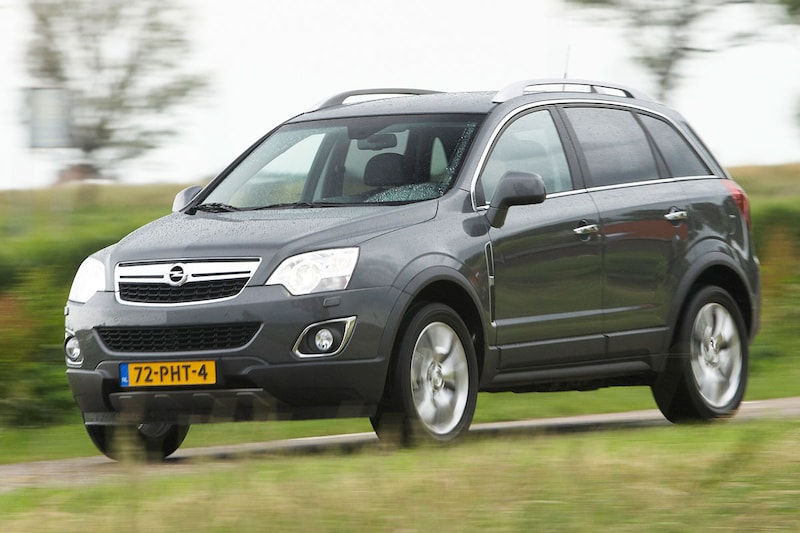
Opel Antara, courtesy of GM’s Korean branch
In the early 1990s, it already renamed an Isuzu to Opel (the Frontera), in 2007 it sold an SUV borrowed from Daewoo and related to the Chevrolet Captiva under its own brand name as Antara. Both models are simply offered here side by side, with the starting price of the Captiva (€30,995 in 2006) being €1,000 lower than that of the Opel Antara. But when Kia and Hyundai suddenly go wild here around 2005 with their midi SUVs, typical European brands such as Peugeot, Citroën and Renault have nothing to offer. Renault quickly arranges something with its Korean partner Samsung: its QM5 will be sold with us from 2007 as Renault Koleos.

The PSA brands, Citroën and Peugeot, knock on Mitsubishi’s door. The Outlander is renamed Peugeot 4007 and Citroën C-Crosser. A few years later they repeat this trick with the ASX, which gets two cousins in the form of the Peugeot 4008 (never delivered in the Netherlands) and Citroën C4 Aircross. They are emergency measures, strange birds among the rest of the range, and the consumer can also see that: between 2007 and 2012, a total of 2,900 Koleossen, 4007s and C-Crossers were sold. By comparison, in the first full year of sales (2005), Kia sells 3,135 Sportages and Hyundai 5,346 Tucsons. And those aren’t even the peak years.

Integrated and accepted
Consumers do not like to be fooled, it turns out once again, and so Peugeot, Citroën and Opel eventually also present their own SUV models. Or in any case: models where it is less clear that it concerns a ‘borrowed’ model. Opel will introduce the Mokka in 2012 (actually a far-Opel-de Buick Encore), a model that is now completely ‘own’. It is fully integrated and accepted in the range, along with the slightly larger Crossland and Grandland. The connoisseur knows that under the new owner Stellantis, Opel shares many components with … the former PSA brands Peugeot and Citroën. Everything is now under one roof, but all brands in any case have their own identity. After the emergency measures with the disguised Mitsubishis, we are introduced to the Peugeot 3008 in 2008, of which, remarkably enough, no Citroën sister model appears. In fact, after the C4 Aircross, that brand no longer had a (midi) SUV until it presented the C5 Aircross in 2018. The sudden midi-SUV craze unleashed by Kia and Hyundai in 2004 caused panic among the European competition, but in the end everything worked out. The question now is: what will be the next hype and who is sleeping right now?
– Thanks for information from Autoweek.nl