
First look back at the beautiful car year 1998
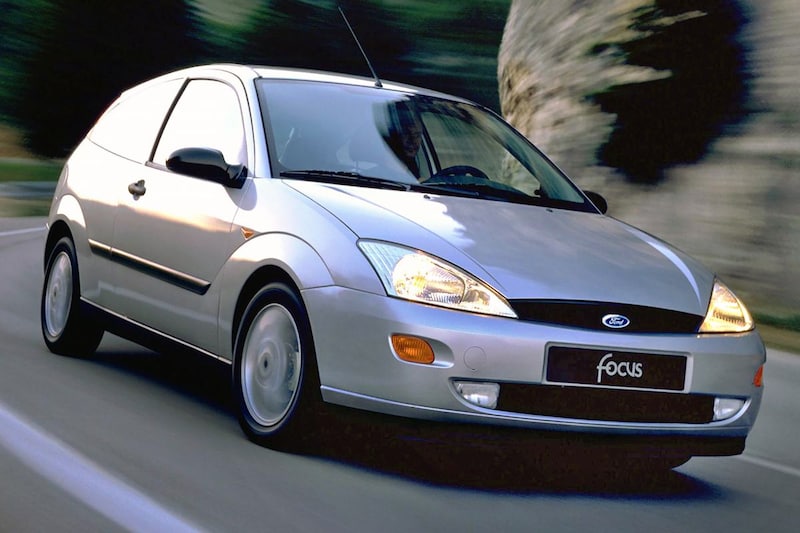
We’re going to look back a lot this year at car year 1998, and before that we kick off with the Ford Focus. It is one of the most important newcomers of that year, and that is already 25 years behind us. The first Ford Focus was controversial and turned the car world upside down. Here you can read why.
What did the start-up process look like?
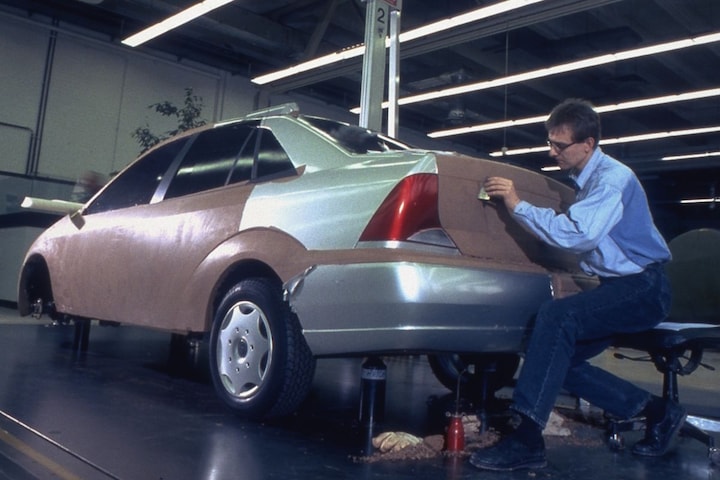
Ford realized it was do or die after the troubled life the fifth-generation Escort led. Richard Parry-Jones, who was instrumental in shaping the driving dynamics that characterized Fords from the late 1990s, who passed away a year and a half ago, once said: “We were good at selling cars to large fleet owners, but now we really wanted a car which was pleasant for the rider himself.” The last Escort, the generation from 1990 to 1998, has been facelifted several times to keep it up to date. With its successor, Ford wanted to create a car that was good from the start and that, like its big brother Mondeo, could be used worldwide. That was part of the Ford 2000 strategy, so the American Focus had to be the same. In the 1980s, an American Escort was different from a European one in many ways. In October 1996, Ford first sent the Focus onto the road as a camouflaged prototype, exactly two years before its market launch. When we saw the first spy pictures, we still assumed the name Escort for the new compact mid-sized car. The code name for the project Focus was C 170. At the end of 1996 we knew that the new design style would be called New Edge. The Focus was not the first New Edge Ford, because the Ka came in 1997, followed by the Puma and the Cougar.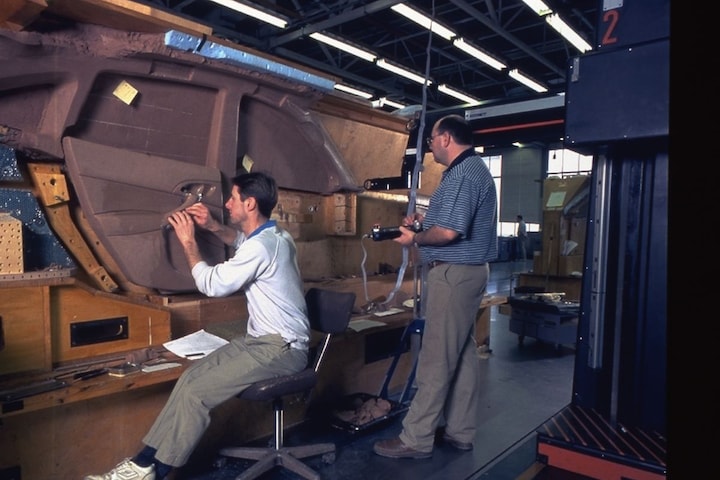

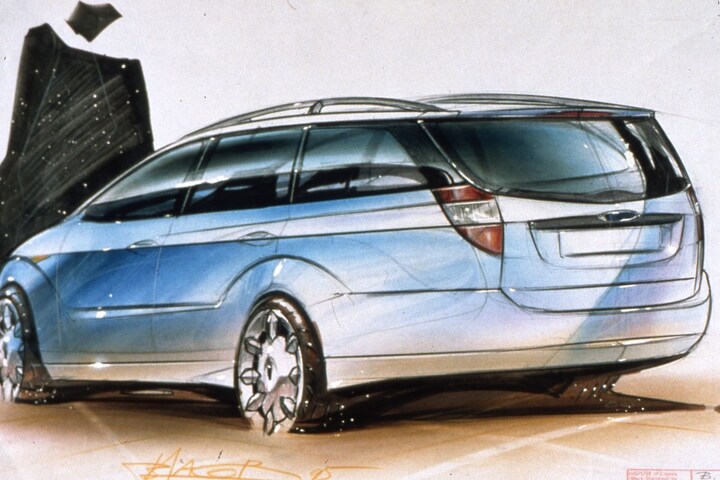
In the photo above and – below design sketches of the first Ford Focus Wagon. It would eventually be designed less extreme than originally intended.
How revolutionary was he really?
It is always a big gamble for a manufacturer to take a completely different tack with a new model of a very important line. The New Edge design was quite a change of course, especially in the main, but also very traditional C-segment. So maybe it was a good thing that Ford threw the Escort nameplate on the scrap heap after thirty years. That decision was made just before the market launch. For a long time, Ford management wanted to go for the trusted name. When media company Burda learned that Ford’s new car would be called the same as its magazine Focus, it went to court. Eventually Ford got the green light for the new name and that’s a good thing. After all, the Focus was different from its predecessor in almost everything. The appearance was revolutionary, but so was the chassis. The rear suspension was multi-link as standard on all grades. That made the Focus such a sharp driving car. Even though this solution cost an additional 50 euros per car sold, it was well worth the investment in retrospect. Until then, the torsion beam was common for the rear wheels, the Focus made a breakthrough and got other manufacturers thinking. Incidentally, in the compact middle class, a multi-link rear suspension is still not common on all versions and is only mounted from a certain power. Did the Focus take over nothing from its predecessor? Yes, the Zetec engine family. These were sixteen valves that were already available in the Escort in the early 90s. The engines and gearboxes were therefore certainly not revolutionary.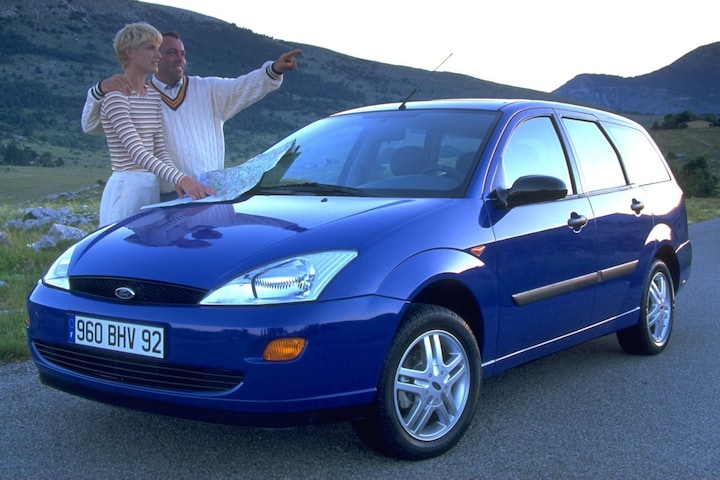
How was the Focus received?
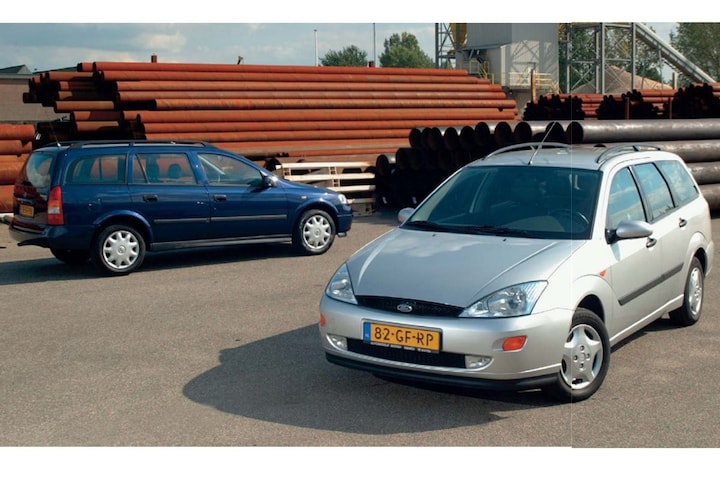
Ford has won all the international car awards that matter, with the 1999 Car of the Year title being the most important. AutoWeek immediately made a trio test in October 1998, in which a Ford Focus 1.6 16V was compared with an Opel Astra and a Volkswagen Golf. With its fantastic driving characteristics, the Focus won that test with flying colors. The only downsides were the gearbox and the somewhat small luggage compartment. ‘Hugely good’, the test editor on duty even said to him.
What were the choices during the market launch?
The three- and five-door hatchback kicked off the Focus party, in 1999 the two other body styles arrived. The Wagon was of course very important for the Netherlands, the sedan less so. Diesel drivers had to wait until 1999. The auto-igniters that became available at that time were not the most advanced available. Common rail injection only made its appearance in 2001 and that was very late. The petrol engines were from the outset the well-known 1.4 (80 hp), 1.6 (100 hp), 1.8 (115 hp) and 2.0 (140 hp), which had already warmed up a few years earlier in the Escort and Mondeo. There were three trim levels, Ambiente, Trend and Ghia. The latter had a bit more chrome and Ghia shields at the C-pillar. Alloy wheels were not standard even on this top trim. And what about the 14-inch wheels that are standard, even on the Ghia? Before that time it was really small. You always got different caps. If you wanted 15-inch wheels with wheel covers, that was also possible on the Trend. You saw the 15-inch alloy wheels that you could get as an option on the Trend very often. For example, the Focus was just a bit more finished than with 14-inch steel wheels with caps.


How was it received by consumers?
In 1999, the Focus’s first full year of sales, the Ford finished in third place, behind the Volkswagen Golf and the perennial number one, Opel Astra. That was a relief for the brand, because predecessor Escort had last managed to finish on the podium in 1995. In 1999, 22,281 Focuses were registered. Despite the revolutionary appearance, many Dutch people opted for the Focus. Its reputation as the best-handling car in its class made it easier for people to cross the threshold that its striking appearance raised for many. The design of the Focus falls into the category ‘you like it or don’t like it at all’. All the more amazing that the Ford Focus became the best-selling car of 2001 worldwide with 917,000 units.

Any details during his life?
A really heavy version only appeared in 2002, although the ST 170 with 170 hp didn’t have a lot of power for a hot hatch even before then. At the end of that year, however, that fantastic Focus RS came. It’s one of the best hot hatchbacks of all time, with its standard Quaife differential, even better driveability and a specially developed 2.0 turbo engine. It had 215 hp. The facelift was already behind the Focus as a model. In 2001, Ford made very minor changes to the appearance. The front turn signals moved from the front bumper to the headlights, which were made of clearer glass. Inside, Ford’s people were just as meticulous. Later, a Ford bobo sometimes let slip that they should have taken the interior of the Focus to a higher level with the update in 2001. According to him, the use of materials could not match what you found in the interior of the Volkswagen Golf IV. Air conditioning was standard on all trims from the facelift.


What were its competitors?
Those were of course the Volkswagen Golf and the Opel Astra. Its predecessor Escort had been fighting in Europe for three decades in the same segment as the Opel Kadett, the predecessor of the Astra, and in 1974 the Volkswagen Golf had joined it. It was no coincidence that the Focus was launched in 1998, because in the same year the Opel Astra G rolled into the showrooms, the second generation of the Astra. The Volkswagen Golf IV came at the end of 1997, and it was therefore still fresh when the Dutch showroom debut of the Ford Focus, on October 29 of that year. The German trio was therefore completely fresh and cheerful, the Peugeot 306 was a bit older, the Renault Mégane had been there since 1996 and we could go on, because the C-segment was incredibly large and important. Every volume manufacturer had such a model (Fiat Bravo / Brava, Alfa Romeo 145/146, Toyota Corolla, Nissan Almera and Mazda 323), although the Focus was not really affected by the Korean entries in those days. Kia was not really taken seriously with the Sephia, Daewoo did surprise with the Lanos and Hyundai had the Accent from 1999.
Which version appeals the most to the imagination?
For the Ford Focus RS, Ford’s Special Vehicle Team went so far that the car became incredibly expensive: €41,995. The expensive Quaife differential, the Sparco seats and the turbo block developed only for this version drove prices up. Between October 2002 and November 2002, 4,501 were built (of which 2,147 went to Great Britain) and you can see that in the current prices: €30,000 to almost €40,000 are paid for them. That puts it in the list of legendary hot hatchbacks from the beginning of this century, such amounts are also paid for the first Volkswagen Golf R32. So that RS appeals the most to the imagination. But at AutoWeek we are also very fans of the Focus Futura. This very luxuriously decorated Focus was supplied with, among other things, leather upholstery, a sporty chassis, sports seats, electric windscreen heating, 15-inch wheels and a navigation system with CD changer. Ford released the Futura versions in honor of the brand’s centenary in 2004. That means that the Focus Futura was really a last revival of the Focus 1, after all, the second generation came in September of that year. The Focus Futura came with the 1.6 petrol engine and the 1.8 TDCi common rail diesel.
How many were built and how many are left?
The first Ford Focus was produced in Europe and America. In Saarlouis, Germany, and Valencia, Spain, 3,660,491 were produced. 2,154,932 examples were built in the US and Mexico. So a total of more than 5.8 million copies.
Number of first-generation Focuses with Dutch registration: 26,919
1998 139 (hatchbacks only)
1999 2,529
- Hatchback 1730
- Saloon 167
- Wagon 632
2000 2,987
- Hatchback 1,739
- Saloon 281
- Wagon 967
2001 3,301
- Hatchback 2.128
- Saloon 181
- Wagon 992
2002 4,621
- Hatchback 1.711
- Saloon 356
- Wagon 2,554
2003 4,991
- Hatchback 1.810
- Saloon 175
- Wagon 3.005
2004 7,019
- Hatchback 3.461
- Saloon 64
- Wagon 3,494
2005 1,332
- Hatchback 621
- Saloon 4
- Wagon 707
source: vinacles
What has been the impact of the Ford Focus?
Ford set the bar for driveability so high in the compact mid-size class that the car is still the benchmark when it comes to driving pleasure and handling. Partly for this reason, the Focus is decisive for the image that Ford still has. All Ford models have a sporty feel. The basis of the first Focus also helped other brands that then belonged to the Ford Motor Company. The first Mazda 3 and the Volvo S40/50 used it and they were also praised for their driving characteristics. The Ford Focus Mk1 had such strong design that many were disappointed to see the second generation. It just looked boring next to its predecessor. In terms of design, no Focus after the first has made such an impression. There are many other brands in this series about the top cars of 1998, but the first Focus is the best compact mid-sized car of the past 25 years. In any case, it is the C-segmenter with the most impact during this period. 
 The American versions of the Ford Focus.
.
– Thanks for information from Autoweek.nl