

According to cosmological models, equal amounts of matter and antimatter must have been created during the Big Bang. However, when a particle meets its antiparticle, they both annihilate each other, releasing energy. The universe would therefore have to have been destroyed again immediately after its creation. Why this didn’t happen is one of the biggest mysteries in physics.
Search for the symmetry violation
A possible explanation would be that matter and antimatter particles are not perfect mirror images after all: “In many physical processes, the laws of nature remain unchanged if you replace all particles with their respective antiparticles and reverse all spatial coordinates. This principle is called charge-parity symmetry, or CP symmetry for short. We are looking for processes in which this symmetry is violated,” explains Agnieszka Dziurda from the Institute of Nuclear Physics of the Polish Academy of Sciences (IFJ PAN) in Krakow.
In fact, physicists have found the first indications of such asymmetries. They were evident, among other things, in the decay of exotic baryons – particles made of three quarks, including a beauty quark – and in some mesons – particles made of a quark and an antiquark. However, the small differences in the behavior of these particles and their antiparticles are not yet sufficient to explain the dominance of matter over antimatter.
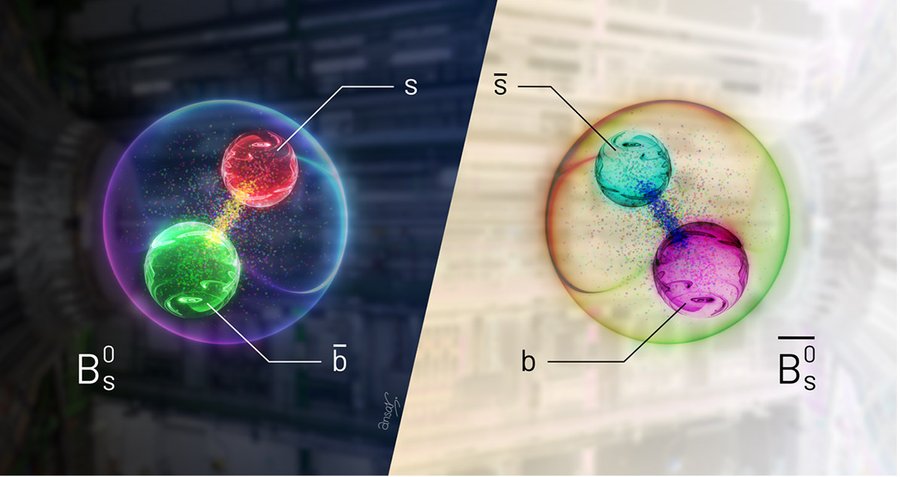
Bs⁰ beauty mesons can transform into their own antiparticles. They oscillate back and forth between the two states trillions of times per second. — © CERN/CMS, Ansar Iqbal
Beauty Meson Bs⁰: Rapid change between worlds
That’s why Dziurda and her colleagues from the LHCb collaboration investigated the behavior of another type of particle: the beauty mesons Bs⁰. These short-lived particles consist of a beauty quark and a strange antiquark, but oscillate extremely quickly with their reverse state consisting of a beauty antiquark and a strange quark. Previous measurements in the LHC particle accelerator at the CERN research center have shown that this change occurs several trillion times per second.
More importantly, however, according to the standard model, these two Bs⁰ variants should decay in the same way – there should be no asymmetries. No matter which variant is present, the decay products would have to be identical and behave the same. “If we still detect an asymmetry, this could be an indication that previously unknown physical processes play a role,” explains Dziurda. In fact, experiments have shown the first indications of deviations for certain decay channels of beauty mesons.
Asymmetry search in LHC measurement data
For their analyses, the physicists evaluated data from proton collisions in the LHCb detector of the LHC particle accelerator from 2016 to 2018. “We had to ensure that any asymmetry observed in the data – no matter how small – was not caused by the detector itself,” reports Dziurda. The team therefore used complex calibrations and regularly reversed the magnetic field in the LHCb detector, which is important for capturing the particles.
The reason for this: Because the particles produced when the Bs⁰ mesons decay have different charges, their trajectory curves in different directions in the magnetic field. As a result, these particles end up in other parts of the detector – and this can cause construction-related differences in the measurement data that give the impression of asymmetry. The physicists therefore have to correct these detection differences through the measurement procedure and the evaluation methods.
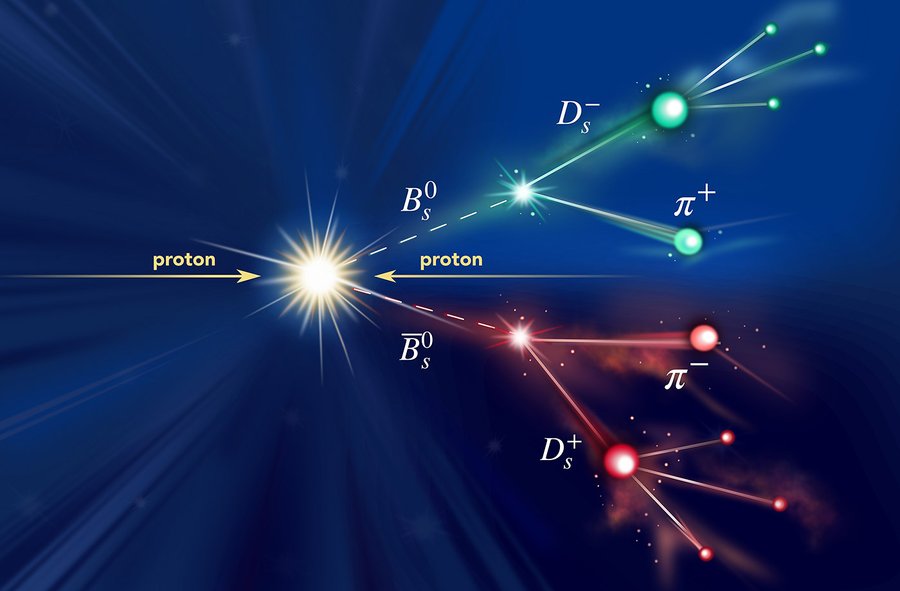
Proton collisions in the particle accelerator produce short-lived Bs⁰ mesons that continue to decay – depending on their state, mirror-image combinations of antiparticles and particles are created. — © IFJ PAN
Tiny discrepancy – but not enough
The evaluations showed: The vast majority of decays of the Bs⁰ beauty mesons corresponded to the predictions of the standard model. But around once or twice per thousand decays, the physicists detected a tiny difference in particle behavior. “This discrepancy could be due to theoretical effects that have not yet been fully taken into account in our calculations,” says Dziurda. “At this point we cannot rule out that it points to physics beyond the Standard Model.”
However, the observed deviations are smaller than the measurement uncertainty. The physicists therefore consider it more likely that their result agrees with the predictions of the Standard Model. The measurement data from the CMS detector at the LHC produced a very similar result in July 2026. Here too, physicists were unable to find any clear symmetry breaks in the decays of the Bs⁰ beauty meson.
This means that the great mystery of matter-antimatter asymmetry remains unsolved. At least the new results further restrict the search area in which symmetry violations can still be hidden, as the researchers explain. Next, they want to evaluate the Bs⁰ decays in the measurement data recorded by the LHCb detector from 2019 onwards. Because the systems were expanded and modernized for this period, these measurement data are more precise and comprehensive. This would enable physicists to detect more subtle effects.
Source: LHCb Collaboration/CERN; Physical Review Letters, 2026; doi: 10.1103/ljtv-y278