
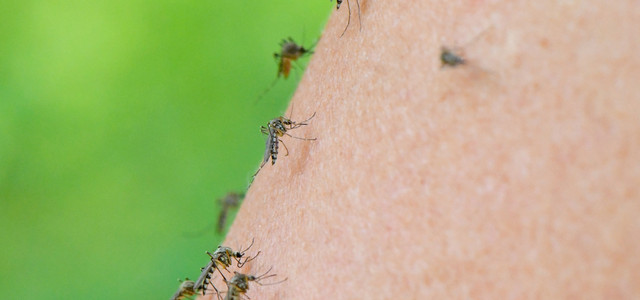
Anyone who believes that tiger mosquitoes are the greatest risk is wrong: local mosquitoes are now spreading the West Nile virus as far as Saxony and Thuringia. What this means for barbecue fans.
No matter whether in the forest, at the lake or in the city: there are lots of mosquitoes everywhere that can spoil a carefree time outdoors. “There is a lot of ignorance and misinformation when it comes to the subject of mosquitoes,” says Doreen Werner from the Leibniz Center for Agricultural Landscape Research (ZALF), who leads the “Mosquito Atlas” project together with the Friedrich Loeffler Institute. The help of amateur researchers is an important tool for keeping possible threats at bay.
The mosquito atlas has been a project run by the two institutes since 2012. Citizens can send in captured mosquitoes, which will be scientifically identified and examined for pathogens. The ZALF is a non-university federal and state research center based in Müncheberg, Brandenburg.
Tiger mosquito so far without evidence of pathogen
Although mosquitoes such as the tiger mosquito have attracted widespread attention, the introduced species do not currently pose the greatest threat: “No worms or viruses have yet been detected among the invasive mosquito species,” said the expert. Although these could be potential vectors and are brought in “practically constantly” from southern Europe by freight traffic and tourists, the pathogens in mosquito saliva cannot multiply optimally over a longer period of time under the current climatic conditions in Germany.
Given changing environmental conditions with longer warm phases, this cannot be ruled out in the future – but there is currently no evidence of this. “But the probability is no longer zero.” The fact that it is getting warmer in this country is due to climate change. In general, climate change in Europe is leading to earlier heat periods, more tropical nights and milder winters – which means that native mosquito species can reproduce better and exotic mosquito species can survive better.
The Asian tiger mosquito (Aedes albopictus) was first documented in Germany in 2007. It is now particularly widespread in Baden-Württemberg, Bavaria, Hesse and Rhineland-Palatinate, but has also been detected in Thuringia and Berlin. The tiger mosquito is considered a potential vector of pathogens such as dengue, chikungunya and Zika viruses. However, for efficient transmission of these viruses, temperatures need to remain consistently high over long periods of time.
Instead of tiger mosquitoes: native mosquitoes are virus carriers
However, the central vector for pathogens such as the West Nile virus, which can be particularly dangerous for older or sick people, is a common companion on many summer evenings outdoors: the common house mosquito.
According to data from the Friedrich Loeffler Institute and the Robert Koch Institute, local mosquitoes have now spread the virus from Berlin and Brandenburg to Saxony, Saxony-Anhalt and Thuringia. The West Nile virus was first detected in Germany in late summer 2019 in people who were infected in this country.
But mosquitoes can become a problem not only because of the transmission of diseases, but also because of the sheer number of them – be it the native Rhine crane fly or the introduced tiger mosquito. “Both species are extremely penetrant and annoying,” says Werner. Unlike the house mosquito, they attack their victims relentlessly and are difficult to drive away. In addition, they sometimes occur in such large numbers that they also fall under the scientific definition of the word “plague”: This is 20 or more bites per minute. “Under such circumstances, a barbecue evening is no longer possible.”
The Rhine snake (Aedes vexans) is a native flood mosquito whose larvae develop in large numbers in flooded meadows and floodplains after flood events. It can reach enormous population densities in a short period of time and travels up to several kilometers to find hosts.
Blackfly bites carry infection risks
The black fly, on the other hand, causes sometimes considerable wounds. Unlike mosquitoes, for example, which suck the blood out of their victims via a fine proboscis, these animals tear a small crater in the subcutaneous connective tissue until a small drop of blood forms, which is licked up. Werner explains that the possible consequences of improper treatment are more problematic than the sting itself.
“When it comes to blackfly bites – as with all puncture sites – the most important thing is to keep your hands away from the skin opening,” warns Werner. Even slight contamination that gets into the wound when scratching could sometimes lead to serious secondary infections. Black flies live and reproduce in oxygen-rich streams.
Biting midges can even get through tent tarpaulins
The biting midge also follows a similar blood-sucking tactic – but usually completely hidden. The animals, which are usually only one to two millimeters long, often go completely unnoticed until the itchy bite becomes noticeable, says Werner. Anyone who retreats into their tent to escape midges is not safe here either: due to their size, the tiny pests could squeeze through even the thin gauze fabric of tent tarpaulins. There are several thousand species of biting midges worldwide.
However, there is no clear scientific answer as to which of the mosquitoes causes the most unpleasant bites: every reaction to a bite depends on your own immune system, says Werner. In addition, the protein cocktail secreted during the sting influences the reaction: proteins that are unfamiliar to the body could lead to stronger defense reactions.
Mosquito researchers rely on support
In order to document the occurrence and spread of mosquitoes and to be able to intervene as quickly as possible when potentially dangerous species appear, mosquito researchers rely on the public’s help, says Werner.
So far, around 42,000 participants in Germany have caught and sent in more than 250,000 mosquitoes for research. Newly created mosquito populations are initially quite easy to eliminate. That’s why prompt support is extremely important for a quick response.
Independent journalism needs people who stand behind it – including in Google searches. Now send a signal for more sustainability and → Save Utopia as a preferred source.
** marked with ** or orange underlined Links to sources of supply are partly partner links: If you buy here, you are actively supporting Techzle\.com, because we then receive a small part of the sales proceeds. More info.