
Design new SUV
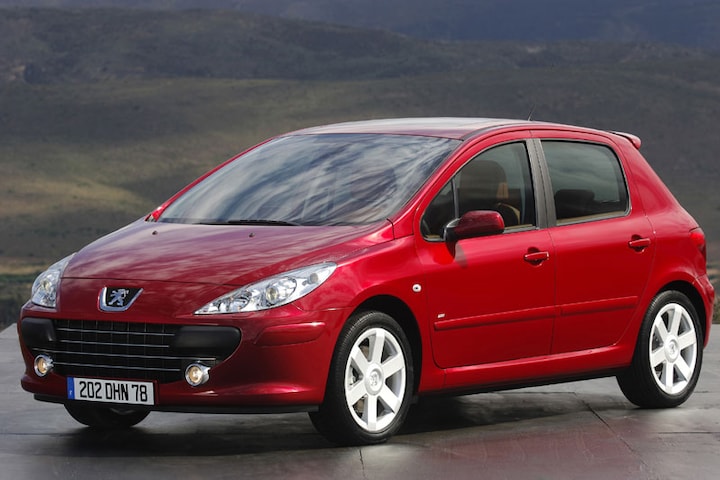
Around the turn of the century, Peugeot built cars with enormous lion eyes and ditto mouths, situated in energyless body shapes that suffered from morbid obesity. Their unpleasant proportions with grotesque overhangs at the front made them appear even heavier. French finesse was completely lacking. How is Peugeot doing almost 20 years later? After the Peugeot 408, Niels van Roij now analyzes the Peugeot e-3008.
Nothing makes the Peugeot design woes around 2000 as visual as photos of the four-wheeled monstrosities from the noughties:


After 2010: wonderful studies translated into production models
Under a fresh new design management, the serious excess weight came to an end around 2010: brand new ideas and modern study models appeared, including the SR1, SXC and the absolute bull’s-eye that made every car designer happy: the copper-made Onyx sports car.


It was clear that the new design DNA was flexible enough to produce a wide range of cars. All slim, fresh and intelligent looking. With extremely beautiful surfacing details. Ooh la la!
The ideas from the study models turned out to be able to be translated flawlessly into new production cars: the second 208, the 308 and 3008 and the second generation 508. The 405, drawn by Pininfarina in the 1980s, with its typical graphic expression between the rear lights, was used on very refreshing way repeated in those new models.

The still beautiful Peugeot 405.
The current 508 sedan is actually sporty. If the Peugeot customer is looking for a high roof and ditto entry, then there is the very successful second batch of 3008 SUV.


Peugeot 3008.
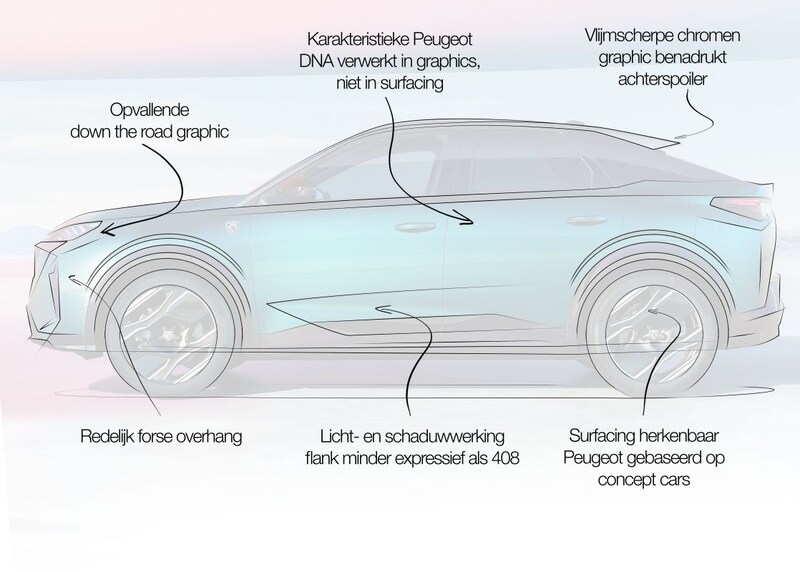
Then the new e-3008. A pronounced design choice has also been made here. In a three-quarter front view we see a very pronounced front. The horizontal design of the previous generation is missing something.

Front of e-3008 looks inactive
The nose has a double and striking down-the-road graphic: the combination of headlights and grille. The Peugeot designers connected the units with a black graphic and placed a second grille underneath, facing forward – away from the headlights. One that slopes downwards strongly in the upper corners, creating a somewhat hanging effect. This makes the front look unpleasant and inactive – while an SUV should look dynamic. The fine-mesh grille has three slim tusks integrated on the side, within the graphic.

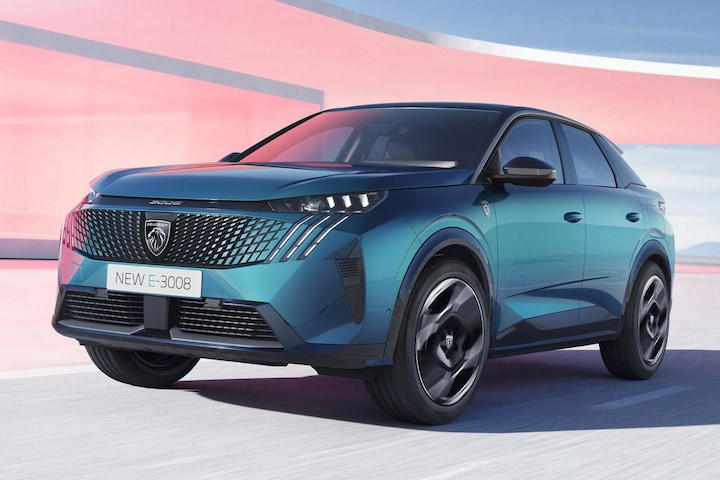

In the 408, the grille with its fine components has an intelligent appearance. The teeth, placed at the extreme corners, increase its optical width. On the e-3008 they are located further inwards and thus reduce the visual impact of the front.
The surfacing is recognizably Peugeot, clearly based on the fairly present shape spectrum of the above-mentioned concept cars. A lot of sculpture is placed around graphic elements such as headlights and taillights and the black side sills. The light and shadow effect in the surfacing on the flank is clearly less expressive than on the 408. A shame, because the traditionally very difficult to distinguish part of the design actually brings a lot of distinctiveness to that car. That is somewhat lacking with the e-3008.
We find the characteristic Peugeot design language in the graphics rather than in the surfacing of the e-3008 flanks. Due to the range, they must be as smooth as possible for an electric car.
Striking folds and precise changes of direction have been made at the rear. In particular, the sharp bumper angle and the large diagonal towards the rear light communicate the visual height of the body – ideal for an SUV.


Distinctive design elements around the roof, with razor-sharp chrome graphic that emphasizes the rear spoiler, characterize the new Peugeot DNA.
In the mission to create a real Peugeot, the designers have been less successful than with the 408. It is clear that electrification plays an important role in this. We’ll have to get used to it.
– Thanks for information from Autoweek.nl