
Winter sports enthusiasts and electric driving
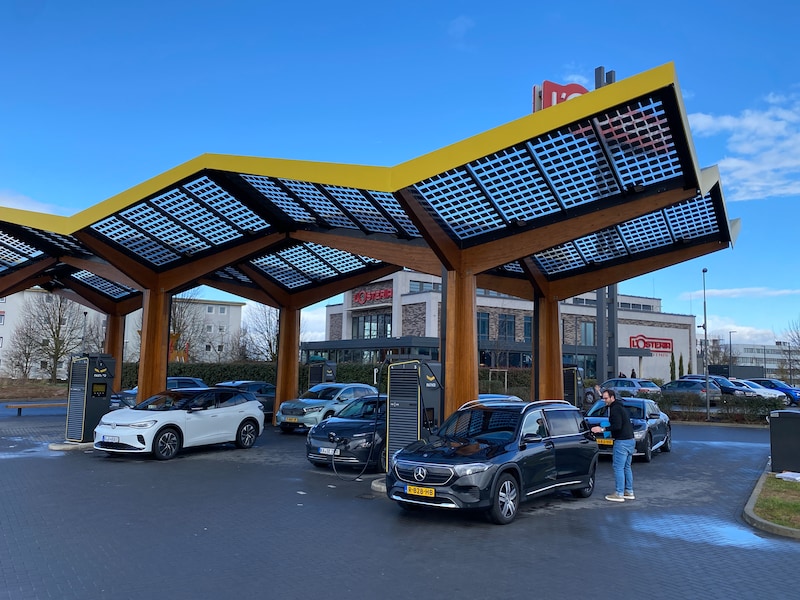
Charging station traffic jams: were they really that bad, or was it a bit of scaremongering? Anyone who went on winter sports with an electric car this weekend had to take into account hours of delays. The thousands of holidaymakers would end up in major charging station traffic jams, especially around Frankfurt, according to KPMG after its own investigation. We went to see with our own eyes.
Honking loudly, an old Citroën C5 comes to a stop in the parking lot of Raststätte Bad Camberg, about forty kilometers before Frankfurt. Behind the wheel is an elderly German man gesticulating: he cannot drive unhindered to his parking space, because an Audi E-tron with Dutch registration is blocking the road. “Those damned Dutchmen always,” the man roars after getting out. “I worked in Holland for thirty years and nothing against you, but you make a mess in traffic.”
It should be clear: not everyone is pleased with the many thousands of yellow license plates that will be traveling through Germany this weekend, to and from winter sports. But what the angry man doesn’t know is that the Audi in question is so awkwardly standing there – albeit with the hazard lights on – because its owner is standing in line for the fast charger.
The four available spots of the relatively modest Ionity charging station are occupied by other electric cars, including three from the Netherlands. The black E-tron belongs to Will Teeuwen (49) from Asten Heusden: he is next in line and is therefore ready at this strategic location. “As soon as I move somewhere else, another EV driver will soon take my charging spot. I’ve had that before and that’s quite annoying,” responds the Brabander, who spent a week in Mayrhofen with his 19-year-old son Thom. has the back. “But don’t worry, it’s my turn in fifteen minutes.”

Wil and Thom Teeuwen are waiting with their Audi.
A mess on ‘electric Black Saturday’
Anyone who watches this scene could conclude that it is indeed a mess at the charging points along the Autobahn this weekend. According to a report by consultancy KPMG, between 8,000 and 10,000 electric cars will be driving from the Netherlands to the Alps and back this winter sports season, the lion’s share of which will pass Frankfurt on the A3. The center of gravity of the crowds – there is already talk of an electric ‘Black Saturday’ – would be today, because this is the changeover day between the different holiday regions. Holidaymakers from the south return home, while the Central and Northern Netherlands go out. Critics call the messages ‘scare-mongering’, but does our winter sport actually result in a traffic jam at German charging stations?
Audi driver and ‘charging station waiting’ Teeuwen is firm about it: “It really isn’t as bad as that research suggests. During our way there last week, we may have had to wait twenty minutes together before we could charge, and now a It is also a matter of shrugging your shoulders and resigning yourself to the fact that your journey will take a little longer, but you are used to that with an electric car.” As soon as his E-tron is allowed to charge, Teeuwen paces across the parking lot while his son lights a cigarette and some wet snow carefully falls.
Many electric drivers tend to cover their inconveniences with the cloak of love, or at least tone it down a bit. This includes 47-year-old Karin Poot from Houten, who is on her way to the Black Forest in her Hyundai Kona Electric. “I used to always go on holiday to Austria, but since I’ve been driving electric I’m looking for it a little closer to home. I drive alone and then it’s not pleasant to be on the road for so long; my pure travel time is about three hours, but including the I’m on the road for about six hours after charging.” She has no experience with long charging station traffic jams, although all that waiting is ‘irritating’. “You accept it, but it is indeed annoying when you arrive at a charging point and all places are occupied.”

Karin Poot and her Hyundai Kona.
Tip: find and choose the right charging station
The nine Dutch people who are charging at the Fastned station near Limburg an der Lahn confirm that a lack of charging places is becoming less and less common. In addition to a Mercedes EQB, a Kia EV6, a Hyundai Kona Electric, a Skoda Enyaq and a Tesla Model 3, Sander Kok from Arnhem is supplying his Peugeot e-208 with fresh energy. “We get about 220 kilometers per charge, and we were able to connect right away. We’ve had no problems the entire journey.”
This also has to do with recent investments in the international charging network, as you will notice along the way. Exactly one year ago, this Fastned charging station only had two fast chargers and a ‘slow’ model that charged at 50 kW. Then the cars were indeed in the queue until around the corner. Things are going a lot smoother this year: the Dutch company has now installed twelve fast chargers here with a maximum capacity of 300 kW each, while a sign on the roadside already announces the next expansion. Those constant innovations are also necessary, because the chargers of German suppliers such as EnBW in particular are still not among the fastest.
That is why you should find out where the right charging stations are before you leave, advises Mariska van Hoorik (37) from Heemstede. Together with friend Robin (49) and daughter Katelyn (15) she is on her way to Kirchberg in Austria by Volkswagen ID4. We meet her at the fast charger in the parking lot of a McDonalds, about a mile from the highway. “As soon as we need to charge, we use an app to see where you can find good chargers in the area. We use the Pump app, which shows us exactly where fast chargers are and whether it is busy there. have to stand in line, so a smooth journey is in your own hands.”

Mariska and Robin use the Pump app.
Electric on holiday: more charging station traffic jams in the future?
Sometimes finding a charging spot also turns out to be a matter of luck, or bad luck. When corporate tax expert Marco Ramaekers from Utrecht arrived with his family and Tesla Model 3 at the Supercharger just past Cologne, there was still plenty of room. A cup of coffee later, all ten local charging spots are full. So it can go that fast. Manu Brems and Maaike van Lochem (both 21 years old) claimed the latter, and unsuspectingly get out of their Model S. “This car shows on the way whether there is room somewhere”, says Maaike. “So we assumed we could charge here. Otherwise I wouldn’t mind waiting for someone else to make room. We’re on vacation after all!”

Manu Brems and Maaike van Lochem.
We find that good-natured attitude with almost all electric drivers we speak to on the road, although the quasi-positive ‘thinking about it’ sometimes feels a bit forced. After all, anyone who has an empty battery and cannot continue can do nothing but accept the situation. But what this tour of the German fast chargers has also shown is that charging point density has taken promising steps in recent years. If you use the right approach (thorough preparation, choose the right charging locations and schedule extra travel time) and don’t blindly follow the herd, you won’t have to wait unnecessarily long for a fresh battery charge.
But what if many more motorists start traveling electrically? Are we still stuck? This falls and stands, among other things, with the further roll-out of the fast charging network: the number of locations must continue to grow faster than the number of electric cars in order to be able to handle future charging peaks. The charging speed of the poles must also be increased rapidly: there are still an awful lot of outdated 50 kW poles in Europe. Other solutions, such as the rapidly expanding network of battery exchange stations from the Chinese manufacturer Nio, can also offer solace. In any case, there is still a lot to be gained, but judging by this journey, the claimed ‘threat’ of charging station traffic jams appears to be not too bad. An impatient honking Citroën C5 causes more nuisance.
.
– Thanks for information from Autoweek.nl