
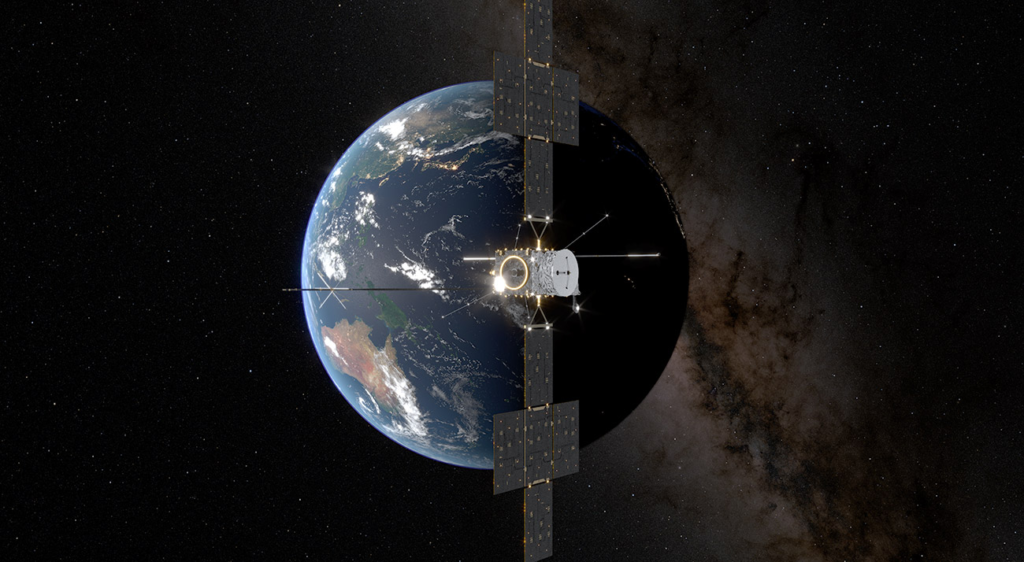
The European space probe JUICE (Jupiter Icy Moons Explorer) has been traveling to Jupiter and its large icy moons Ganymede, Europa and Callisto since April 2023. Their subglacial oceans are considered possible locations for extraterrestrial life in the solar system. But before the probe reaches its destination, it has to gain momentum several times by flying close to the Moon, Earth and Venus. These gravity assist maneuvers save fuel and put you on the right course.
Flyby at a distance of only 8,640 kilometers
Now another risky close flyby is coming up: this afternoon, the JUICE space probe will fly extremely close to the Earth and descend far below the flight altitude of the geostationary satellites. The probe will reach its shortest distance at around 1:45 p.m. our time: it will fly over the Indian Ocean at an altitude of just 8,640 kilometers. Shortly beforehand she crosses Australia. This close Earth passage will change the spacecraft’s flight direction by around 20 degrees and accelerate it by around 3.5 kilometers per second.
In order to rule out possible navigation errors and guide the probe safely past Earth, the European Space Agency ESA has been preparing this flyby for weeks. Six points in time were scheduled for optional course corrections to correct even small deviations from the correct trajectory and speed. “But we only needed one of these maneuvers, around four weeks before the Earth flyby,” reports JUICE operations manager Angela Dietz from ESA. “It was a small but very effective correction that put JUICE in the right position for the flyby.”
ESA has one last chance to make course corrections this morning at 8:00 a.m. It can then change the orbit of the space probe, for example to prevent a collision with a satellite. However, if everything goes as planned, this shouldn’t be necessary. “All flybys are risky and require careful preparation and monitoring,” explains project scientist Claire Vallat. “But this one is at least simpler than the combined Earth-Moon flyby in 2024.”

Process of the current earth flyby. — © ESA /CC-by-sa 3.0 IGO
Magnetic field and lunar horizon in view
The close Earth passage is also an important opportunity to try out the Jupiter probe’s scientific instruments. Therefore, all ten measuring instruments will be switched on during the flyby. One of these instruments is the J-MAG magnetometer attached to a 10.50 meter long boom. When it arrives in the Jupiter system, it will, among other things, collect more precise data about the oceans beneath the ice crust of Jupiter’s moons.
During today’s Earth flyby, JUICE will dive deep into the Earth’s magnetic field and will be exposed to a magnetic field intensity of more than 3000 nanotesla. This offers researchers the perfect opportunity to calibrate and test J-MAG. “The values are a factor of a thousand larger than in the standard tests and enable a perfect test of the magnetic field sensors under conditions that we will later find in the orbit around Jupiter’s moon Ganymede,” explains Werner Magnes from the Institute for Space Research in Graz.
The orientation of the space probe using its navigation camera will also be tested during the flyby. It will later help guide JUICE safely around Jupiter’s moons. This afternoon the probe will aim at the horizon of Earth’s moon to calibrate its visual navigation system. “We will turn the probe in different directions as it flies by to point the camera and measuring instruments at different parts of the Earth and the moon,” explains Vallat.
What’s next for JUICE?
After the current flyby, the JUICE space probe only has to complete one more flyby on its eight-year journey to Jupiter: in January 2029 it will gain momentum one last time on Earth. This takes them on their final course to the planet Jupiter and its moons. The probe will then arrive at Jupiter in July 2031. Initially, 35 close flybys of the three large icy moons Europa, Ganymede and Callisto are planned before JUICE swings into an orbit around Jupiter’s largest moon Ganymede.

Process and schedule of the JUICE mission to the moons of Jupiter. — © ESA /CC-by-sa 3.0 IGO
Source: European Space Agency, Austrian Academy of Sciences – Institute for Space Research