
Sharply folded
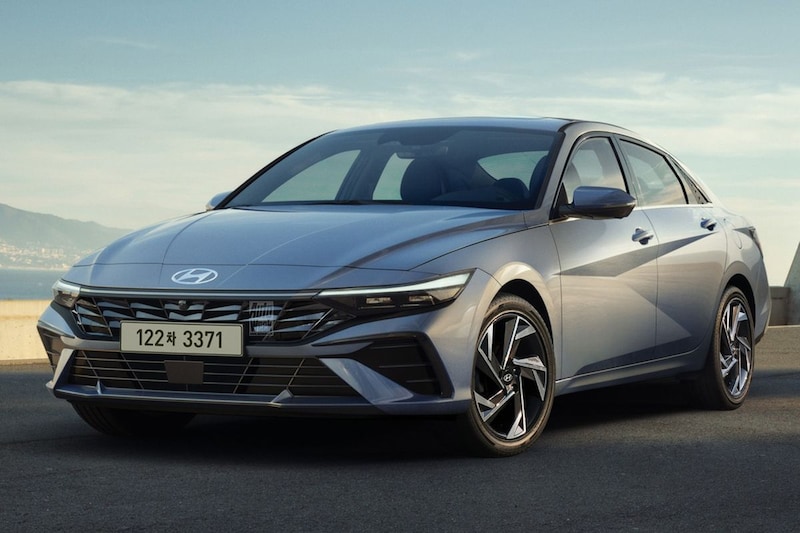
Remember the Hyundai Elantra? In the Netherlands, the model disappeared from the market in 2006, but the model has never left outside Europe. In its home country of South Korea, Hyundai is now releasing the first photos of the facelifted current version, which of course looks nothing like its distant ancestors.
At the end of the eighties, Hyundai brought the Sonata to the Netherlands. The first-generation Sonata pushed the Stellar out of the showrooms here, but with a length of 4.68 meters it was no less than 26 centimeters longer than its Ford Cortina-based predecessor. As a result, the gap between the smallest sedan after the Sonata – the 4.28 meter long Excel – was gigantic. The gap between those two models did not remain unfilled for long. The first generation Elantra, presented at the end of 1990, came to our country in 1991 as Elantra. That sedan was already followed in 1995 by the slippery second generation Elantra / Lantra, a car that also appeared as a station wagon. That station wagon disappeared again with the introduction of the third generation Elantra, which also came to the Netherlands with that name in 2000. In 2006, Hyundai closed the Elantra book. Just as the Accent was replaced in the Netherlands by the i20 specially developed for Europe, the Elantra made way for the i30, which was also tailored to the European customer. However, the Elantra continued happily outside Europe. In fact, the model has been working on its seventh generation for several years now. Time for a facelift, but beware: for the Dutch market it obviously has no form of relevance.

The first Hyundai Elantra came to the Netherlands in the early 1990s as Lantra.
Why the whole Elantra expound above? Especially to make you think back to the Lantras and Elantras of yesteryear. The current Hyundai Elantra is a car with a completely different character than its predecessors. The current Elantra – it only exists as a sedan – was presented in 2020 and looks even more intense than its already not very modest predecessor after its facelift. The current Elantra, like the new Accent we recently covered, perfectly illustrates how Hyundai dares to package its models in a more daring and eccentric way these days. In 2023, the brand is already getting away with exuberant designs, such as the Ioniq 5, Ioniq 6 and Santa Fe. In the nineties and at the beginning of this century, however, Hyundai was much more of a brand that was still in full development and could not afford too bizarre design frills.

The second, slippery generation of the Hyundai Lantra. It was also available as a station wagon.
The Hyundai Elantra has been running since 2020 and will soon receive a facelift in its home country of South Korea – where it is called Avante. Hyundai does not hold back with that facelift either. In fact, it goes quite far. The complete shape of the headlights is different, with the result that Hyundai also had to adjust the front screens for the facelift. That is not always common with a facelift. Hyundai now cuts the grille into two parts and makes the bumpers at both the front and rear even more exuberant than before.

The third and last Elantra for the Netherlands was also called Elantra here. It was available as a sedan and a five-door liftback.
No dive into the unknown for the Dutch market without closing with some interesting tidbits. There is also a 280 hp strong N version of the current Elantra, but there is more. As mentioned, the Elantra made way for the i30 specially developed for our market in Europe. But did you know that Hyundai sells the Elantra in Australia as an i30 Sedan?
From 1991 to 2001, Hyundai sold more than 25,000 Lantras. The Elantra, which was delivered from 2001 to 2006, was just under 3,900 units. Between 2007 and 2022, the Hyundai i30 was sold over several generations, accounting for around 20,000 units.
.
– Thanks for information from Autoweek.nl