

The Voyager probes, launched in 1977, are humanity’s most distant active outposts – and a miracle of robust technology: despite almost 50 years in space and dwindling energy reserves, the two NASA space probes continue to send data. Originally intended only to explore the outer planets, both have now reached interstellar space, Voyager 1 in 2012, Voyager 2 in 2018. Since then, they have provided unique data about this unexplored environment of our solar system.
Voyager 1 reaches one light day
Now Voyager 1 is reaching another milestone: the space probe will be around 25.9 billion kilometers away from us at around 11:16 a.m. today – that’s equivalent to a whole light day. It marks the distance that even light and other electromagnetic waves propagating at the speed of light take 24 hours to travel. For comparison: The sun’s light takes around 8.3 minutes to travel around 150 million kilometers to Earth.
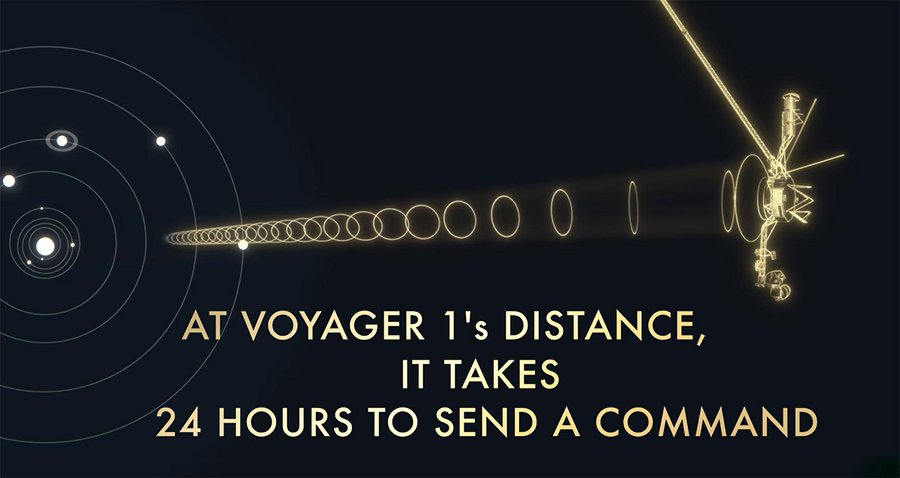
Voyager 1 has been flying through interstellar space since 2012. It has now reached a distance of one light day from Earth. — © NASA/JPL-Caltech
“Now when we send a message to Voyager, we have to wait two days before we get the response,” says Voyager project scientist Suzanne Dodd of NASA’s Jet Propulsion Laboratory (JPL). “This milestone underlines the immensity of the universe, but also the endurance of this most distant explorer of humanity.” Voyager 1 is not only the most distant man-made vehicle ever, it has also exceeded a distance mark that has never been reached before.
Participatory activity to celebrate Light Day
To celebrate Voyager 1’s Light Day, NASA is calling for the global participation campaign “Shine Bright for Voyager’s Light Day”: After sunset, people should point a flashlight, their cell phone or another light source into the sky and use it to send the Voyager probe’s VGR call sign via Morse code. “With this action, we create a symbolic wave of golden light that circles our planet after sunset,” explains NASA.
And this is how it works: three short flashes and one long flash for the V, then two long flashes and one short flash for the G and finally one short flash, one long flash and one short flash for the R. These three Morse letters are a symbolic greeting to the distant Voyager 1 spacecraft. NASA is also calling for photos and videos of this event to be posted on social media using the hashtag @NASA.
Ancient, but still robust
But despite this historic milestone, little will change for Voyager 1 itself: “The spacecraft will not notice any change in its environment when it reaches this distance mark, and nothing will change on board the spacecraft either,” explains Dodd. It continues to fly through space at more than 61,000 kilometers per hour and is moving further and further away from its earthly place of origin.
It will be a while before another space probe reaches this milestone: its sister probe Voyager 2 could reach the distance of one light day in around nine years – in the year 2035. Because it took a different course through the solar system and completed flybys of Uranus and Neptune, it is lagging a little behind Voyager 1.
The amazing thing about it: The two ancient space probes achieved all of their achievements using ancient technology from the 1970s. Their on-board computers don’t even have a millionth of the storage capacity of a modern cell phone and the transfer rates are 38,000 times lower than a standard cell phone connection. The Voyager probes do not store the data from their scientific instruments on hard drives or flash memories, but rather on data tapes. Because all essential components were installed twice or three times, NASA was able to compensate for and work around defects themselves.
The problem of energy
But even their robust technology doesn’t help the Voyager probes in one respect: their energy supply is slowly running out. The plutonium in their thermoelectric generators has decayed to such an extent that it can release less and less energy. The available power decreases by around four watts per year. To save energy and extend operating time as long as possible, NASA has shut down several scientific instruments on the two Voyager spacecraft in recent years. Of the ten measuring devices, two are currently still active on each probe.
In June and September 2026, NASA also carried out a risky measure on both probes by switching several power-consuming processes to more economical alternatives. “This risky measure is intended to ensure that the space probes and their remaining measurement instruments remain warm enough to continue collecting scientific data,” the space agency said. Theoretically, the two Voyager probes could remain active until the 2030s – even if only with one scientific measuring instrument each.
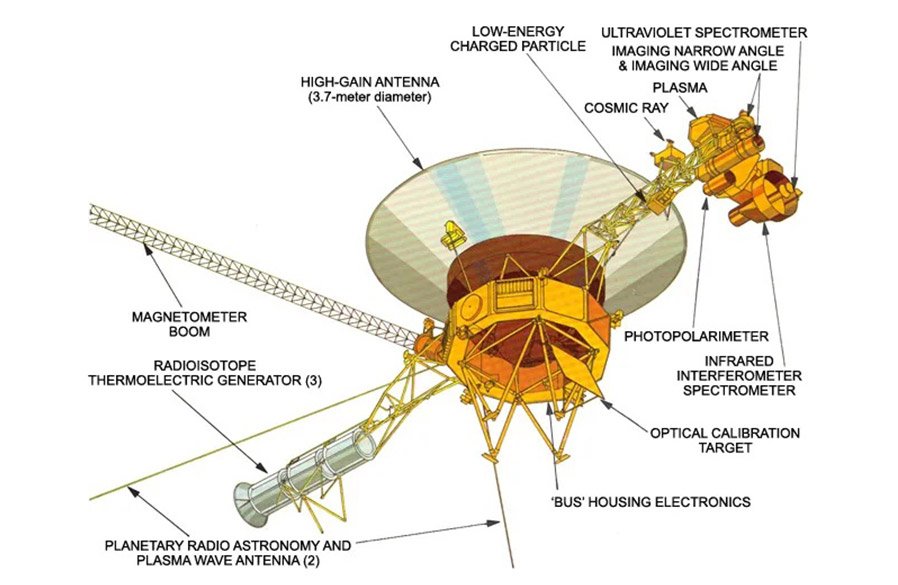
Because their radioisotope thermoelectric generators are running low on plutonium supplies, only two scientific instruments are active on each of the Voyager probes. — © NASA/JPL-Caltech
How long will the probes last?
Even 49 years, two months and eleven days after the start of its mission, Voyager 1 continues undeterred on its path through the unexplored expanses. If everything goes well, it could continue sending unique data from interstellar space for several years. “Every bit of additional data we can acquire is not only a valuable bonus for research, it is also a testament to the unprecedented engineering effort that went into these spacecraft,” says Patrick Koehn of NASA’s Voyager program.
But the days of this unique mission are numbered: the Voyager probes could finally run out of energy by mid-2030. They would then no longer be able to collect data or transmit data to Earth. However, Voyager 1 will leave the range of the Deep Space Network from around 2036 anyway. Their weak, well-traveled signals can no longer be reliably received even by NASA’s Earth-spanning telescope network.
What will happen next for the Voyager probes’ journey?
Nevertheless, the journey of the Voyager probes is far from over: even if the probes’ last energy reserves are exhausted, they will continue to travel through space as ambassadors for humanity. Because the space probes are hardly slowed down in the vacuum of space, they can continue to fly at almost undiminished speed for thousands of years – and with them the golden records on which images, sounds and greetings from Earth are stored.
According to NASA calculations, Voyager 1 will not encounter any other planet or star for a very long time: its course will only take it past the star Gliese 445, 17 light-years away, in around 40,000 years – but at a distance of 1.6 light-years. The red dwarf star lies north of us in the constellation Little Dipper. The Voyager 2 probe, on the other hand, is flying south and will fly past the red dwarf Ross 248 in around 40,000 years. In 296,000 years it will pass Sirius, the brightest star in our night sky.
Source: NASA