

Most stars are not formed individually, but are multiples: They form together in one of the dusty star cradles of the cosmos. Binary stars are particularly common, but astronomers have also discovered multiple systems consisting of three, four or even more stars. Typically, the stars in such systems have similar compositions and are approximately the same age.
Mysterious tumbling of a nearby red dwarf
But now astronomers have discovered a multiple star system that is out of the ordinary. Their discovery was pure chance: “We were actually looking for planets, but instead we found something much more surprising,” explains first author Étienne Artigau from the University of Montreal. The team’s goal was to clarify the strange behavior of the red dwarf star IRAS 21500+5903, which is around 28 light-years away. It was already known that it was accompanied by a distant white dwarf. This is around 124 astronomical units from the red dwarf.
The strange thing, however, is that earlier spectral measurements had already detected a slight wobble in the red dwarf, which cannot be explained by its distant companion. Recurring shifts in the spectral lines suggested that this star’s motion was being disturbed by a closer gravitational influence – possibly from an as yet unrecognized planet. However, the red dwarf’s speed fluctuated by more than 16 kilometers per second – around a thousand times more than expected for an exoplanet.
“Our initial assumption was therefore the presence of an as yet unrecognized brown dwarf orbiting close to the star,” report the astronomers. To test this, Artigau and his team targeted the red dwarf, named Welopōʻai, with the high-resolution SPIRou instrument. This high-resolution infrared spectrometer at the Canada-France-Hawaii Telescope in Hawaii is specifically designed to detect the spectral signatures of exoplanets via radial velocity measurements.
A white dwarf as an unrecognized companion
The measurements revealed: The red dwarf star must have a close companion that is at least 0.6 solar masses. “This is well above the upper limit for a substellar object,” report the astronomers. “The estimated mass of the companion exceeds even that of the red dwarf star, which is around 0.42 solar masses.” This suggested that this mysterious companion must be a star – but there was no sign of it.
“The unusual combination of high mass and low brightness only allowed one plausible explanation: it had to be the relic of a burnt-out star,” explains Artigau’s colleague Charles-Antoine Parent. “The most likely explanation was a white dwarf, but we couldn’t initially rule out a neutron star or a black hole.” Images from the Gemini North Telescope in Hawaii then provided the final answer: the unknown companion is a white dwarf.
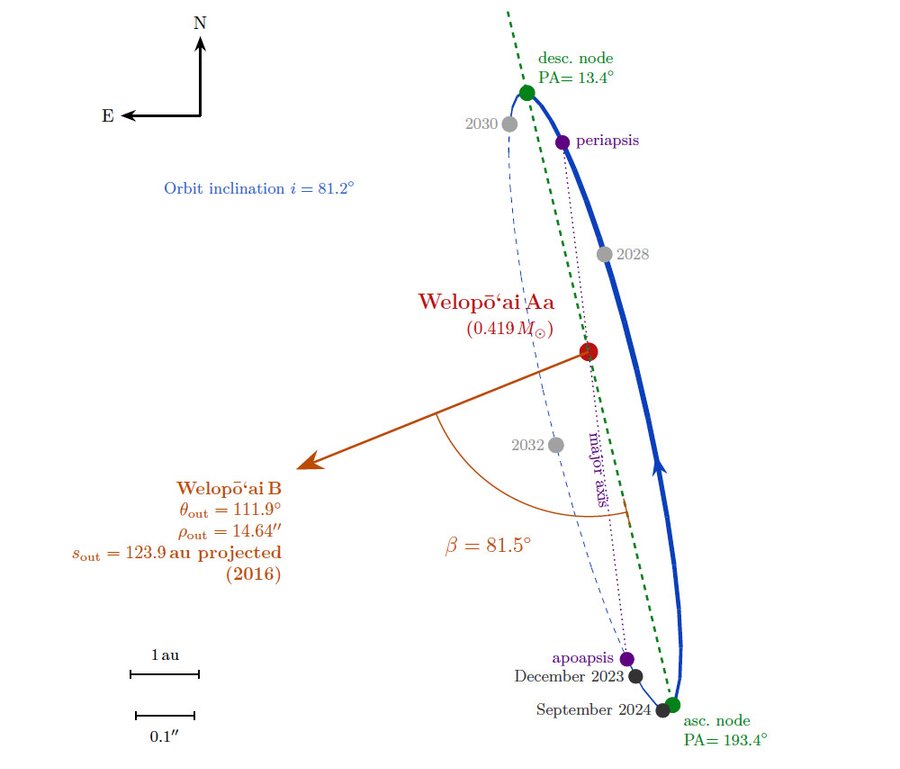
Observations over several years clarified the orbit of Welopōʻai Aa’s unrecognized companion. — © Artigau et al./ Astronomy and Astrophysics, a href=”http://creativecommons.org/licenses/by/4.0″ target=”_blank”>CC-by 4.0
“There is nothing comparable within 100 light years”
The star system, which is only 28 light-years away, consists of a red dwarf star – named Welopōʻai Aa – and two white dwarfs Welopōʻai Ab and B. The three stars form a hierarchical trio: The red dwarf star and the newly discovered inner white dwarf orbit each other at a distance of 4.6 astronomical units. The second, already known white dwarf orbits this inner pair at a distance of a good 123 astronomical units. However, its orbit is strongly tilted towards that of the inner pair.
Such a triple combination is already unusual: “Welopōʻai is the closest hierarchical triple system of this kind. There is nothing comparable within a radius of 100 light years,” report Artigau and his team. But when they analyzed the composition of the three stars using their spectral data, the astronomers discovered another peculiarity of the trio: the red dwarf is unusually rich in metals – it contains more heavy elements than the sun and also significantly more than the two white dwarfs. It also rotates relatively quickly.
Inexplicable differences
But that means: The red dwarf and its companions don’t fit together. While the white dwarfs are both around nine to eleven billion years old and therefore about the same age, the red dwarf is actually only around five billion years old due to its metal content. But such an age difference would be almost impossible for stars formed together in a system. “We examined a few scenarios that could explain this apparent paradox, but none of them are particularly convincing,” the astronomers report.
Accordingly, the younger red dwarf could have been subsequently captured by the two white dwarfs. However, that would have required a close encounter. “In the galactic disk of the Milky Way, close flybys with a distance of less than 100 astronomical units only occur once every 300 billion years – captures by binary stars are even rarer,” explain Artigau and his colleagues. But only 13.8 billion years have passed since the Big Bang – this scenario is therefore rather unrealistic.
“This system shouldn’t even exist”
Another scenario would be that the red dwarf is actually the same age as the two white dwarfs. He would then have to have acquired his surplus of heavy elements subsequently. As the astronomers explain, something like this would be possible if the red dwarf had taken over a corresponding amount of metal-rich material from the precursor star of the inner white dwarf. When it expanded into a red giant, the red dwarf star must have temporarily entered its envelope and then sucked up material during this common envelope phase.
The catch, however: Welopōʻai Aa and Ab are too far apart for this scenario. In addition, the red dwarf must have somehow managed to absorb two thirds of all the heavy elements from its partner’s shell without also sucking in its lighter gases. “There is no established accretion mechanism that transfers such a large proportion of metal from a giant star and excludes hydrogen and helium,” the astronomers write.
In other words: “This system shouldn’t even exist,” says co-author Patrick Dufour from the University of Montreal. “We have no plausible explanation for how it came about.” The team now hopes to find out more about the mysterious history of this “impossible” trio through further investigation. “Discoveries like these remind us that even our cosmic neighborhood still holds remarkable surprises,” says Artigau.
Source: Étienne Artigau (University of Montreal) et al., Astronomy and Astrophysics, 2026; doi: 10.1051/0004-6361/202661214