
Premium Plugs
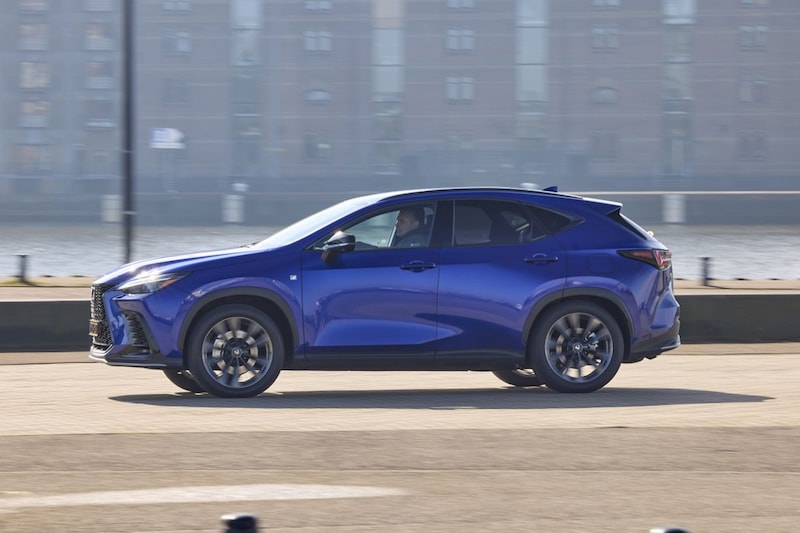
The new Lexus NX is a medium-sized SUV that is available with a plug-in hybrid powertrain, which is very important for our country. A car where the equipment and finish have been lifted to an above-average plan. In this test we highlight all the good and all the bad features of the 309 hp Lexus NX 450h+ AWD, which is designed as a sporty and very complete F Sport Line.
In which parts was the Lexus NX improved?
Where the South Korean brands look closely at the demands of the consumer in a specific market, the Japanese prefer to determine for themselves what is good and what is not. Toyota, with luxury subsidiary Lexus in its wake, therefore focused on hybrid drive much earlier than other brands. That quirkiness didn’t always work out so well. The first generation of the Lexus NX (2014-2021) was full of stubbornness that mainly opposed the medium-sized SUV. Not so much the hybrid drive, but rather the complicated infotainment system with mousepad operation and the very extreme design. We didn’t like that, in Europe.
For the second generation of the NX, Lexus seems to have listened to the criticism. The sharp edges are almost literally filed off the design and a large touchscreen takes the place of the mouse control. In addition to the hybrid version NX 350h (with 242 hp), there is now also a plug-in hybrid variant, a powertrain that is almost a necessity in the popular and crowded segment of medium-sized SUVs. Competitors such as the Range Rover Evoque, Volvo XC60 and BMW X3 have been available with such a powertrain for some time.
What is the effect of the plug-in hybrid technology on the consumption of the NX?
As a plug-in hybrid, the Lexus NX 450h+ has a combined engine output of 309 hp. This is the result of the collaboration between a 185 hp naturally aspirated 2.5-liter four-cylinder and two electric motors. An electric power of 182 hp is released on the front axle, the rear wheels receive 54 hp from the electric motor. Purely electrically, a maximum power of 237 hp is available.
Even with the considerable weight of almost two tons, the purely electric is more than smooth enough and the Lexus also reaches the speed limit of 130 km/h on the highway in the evenings. Thanks to an 18.1-kWh battery, the NX lasts quite a long time. During our test round, the battery pack does not have a puncture until after 56 kilometers, although the combustion engine did hit unsolicited for five kilometers in between. Lexus itself cannot provide an explanation for this. In practice, the range is about 50 kilometers, which is a decent score given the relatively low temperature during the test period.
Once the batteries are empty, the NX continues as a regular hybrid. Thanks to the years of experience of the Japanese, this happens almost unnoticed. Switching the 2.5-litre four-cylinder in and out is only noticeable if you draw your attention to it, and thanks to the surplus of power, the engine rarely has to work really hard. This benefits the peace and quiet on board. An average consumption of just under 1 in 15 is not that bad, given the size and available power of the NX 450h+.

Very nice, a deep compartment to store the charging cable.
How does the Lexus NX 450h+ drive?
Thanks to the high electrical power, the Lexus 450h+ delivers excellent performance. From standstill you can reach 100 km/h in 6.2 seconds, the intermediate sprint from 80 to 120 km/h – to quickly overtake a slower car – is beeped in just 3.8 seconds. All forces are transmitted to the wheels extremely smoothly by the continuously variable transmission of the Lexus, there are no interruptions to change gears.
Although the NX has four-wheel drive, it does not have much to do outside the asphalt. And certainly not as an F-Sport, because this version gets a sportier tuned chassis to reinforce the promising bumper work. The Lexus NX has adaptive shock absorbers and that provides a firm, but well-controlled handling. When cornering, the car has a significant reserve of grip. The NX is pleasantly stable on the road, but there is no real sportiness. For that, the steering certainly works a bit too vague around the middle position.
Is the Lexus NX useful in everyday use?
When you get in for the first time, you will not just find an ideal seating position behind the steering wheel, which can only be adjusted to a limited extent in the axial direction. In addition, the operation of the on-board computer and cruise control causes some headaches. You can operate eight functions twice via the two four-point keys and the buttons below, divided equally over two menus. With the button under the four-point button you then switch between those two menus, which are shown in the head-up display. So far no problems, it’s just a bit more distracting than regular buttons because you have to focus on the head-up display. With cruise control enabled, the menu on that side, however, is ‘fixed’ and you can no longer operate the on-board computer. A clumsy design flaw.

Pressing to unlock the door is counter-intuitive.
A shame, because we are very enthusiastic about the new infotainment system with large touchscreen. While it falters a bit every now and then, it generally responds quickly enough and the layout is far less cluttered than the old system. So kudos, and we also give it to the overall impression of the interior, which in good Lexus tradition looks like it was made for eternity. Try whether the sports seats in the F Sport version suit your physique, because they enclose even someone of average stature quite closely. That does not play in the rear seat and the NX offers sufficient space for the occupants, while the luggage space with 520 liters is also more than sufficient. With the rear seats folded, it holds 1,411 liters. The Lexus NX 450h+ is allowed to tow a trailer with a (braked) weight of 1,500 kilos.

520 liters of luggage space is neat.
What does the Lexus NX cost and what do you get for the money?
The Lexus NX is not cheap. The prices of the base version – the NX 350h with front-wheel drive – start at €66,995. An amount of €80,495 is the starting point for the plug-in hybrid NX 450h+. For such a price you can of course expect a very complete standard equipment. Regardless of the engine and version, every NX is equipped with a comprehensive safety package with eight airbags (including two knee airbags), an active Lane Keeping Aid and traffic sign recognition. PCS (Pre-Collision System) reacts to other traffic and automatically initiates an emergency stop if another car, pedestrian or cyclist suddenly comes to a stop and crosses the road – even in the dark. A reversing camera and adaptive cruise control are also part of the standard package, as well as Lexus Link Connect, the multimedia system with 9.8-inch screen and online services.
When you opt for the Executive Line, the equipment is expanded with 20-inch wheels, tri-LED headlights with high beam assistant, an electrically operated tailgate, a heated steering wheel, a digital interior mirror and Lane Change Assist, which actively supports the driver when changing. of roadway.
Modeled as the F Sport Line, the NX has a sportier look, with different 20-inch wheels, slightly more prominent bumpers and a grille with an open inlay. The interior is finished with aluminum moldings and you sit in bucket seats with leather upholstery. The rear seats are also heated and with the Drive Mode Selector you can choose from the Eco, Normal, Sport and Sport+ driving programs.
The choice of AutoWeek test coordinator Marco Gorter
Because the Lexus NX plug-in only starts with the Launch Edition, the ‘standard version’ is the best choice in this case. It already costs more than 80 grand and actually has everything the modern consumer could demand on board. Strictly speaking, saving for an F Sport or ExecutiveLine is not necessary, because it is mainly trinkets that you get.
– Thanks for information from Autoweek.nl