
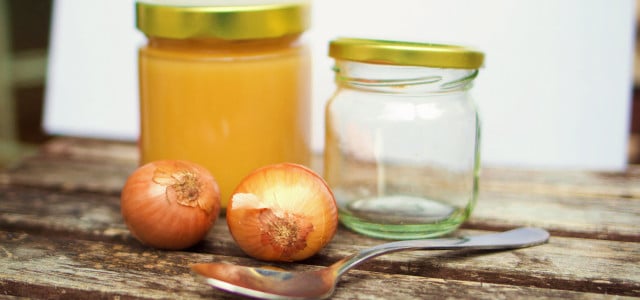
Onion juice with honey is the classic home remedy for coughs: onions have an antibacterial effect and you can use them in combination with honey to make an effective cough syrup yourself. We’ll show you how easy it is to make your own onion juice for coughs.

Do you have a cough? Onions have an antibacterial effect that you can use for coughs. Together with honey or a vegan alternative, you can make your own cough syrup in just a few steps.
Onion juice with honey: does it even work?
For the vast majority of home remedies, there is hardly any scientific evidence of their effectiveness. But that doesn’t mean that onion juice with honey isn’t effective against coughs: on the one hand, a certain antibacterial effect of onions has been proven, and on the other hand, there are studies that at least suggest that honey can help against coughs.
Experts also agree: Home remedies can sometimes be as effective as pharmaceutical remedies, simply because they often involve attention, time and being active yourself. “It may not be important to know whether the home remedy helped a lot, just a little, or whether there was just a placebo effect,” says Professor Dr. Jörg Meerpohl, head of the Institute for Evidence in Medicine at the University Hospital of Freiburg, told the Pharmazeutische Zeitung.
The recipe
For a glass of homemade cough syrup with onion you only need these ingredients:
- An onion
- Two tablespoons of honey (alternatively sugar)
- a clean screw-top jar
Tip: If you don’t have a used screw-top jar in stock, you can find a large selection in the online shops of Bottle Builder or Glasses & Bottles – alternatively also on Amazon.
Homemade cough syrup with onion: This is how you do it
And this is how you make your own onion juice for coughs – sweetened with honey:
- Peel an onion, cut it into small pieces and put the pieces in the jar.
- Pour two tablespoons of liquid honey over it. For the vegan version or if there is no honey in the house, sugar or other vegan honey alternatives can also be used to sweeten the onion juice. However, keep in mind that these are not a 1:1 replacement for honey in terms of health effects.
- Let the whole thing steep for several hours or, ideally, overnight.
- Then pour the resulting liquid through a small sieve and collect it.
- Your homemade cough syrup is ready and you can take it on a spoon several times a day.
Store the honey-onion juice in the refrigerator and ideally use it within three days.
Also read:
- Home remedies for dry coughs: These tips work quickly and safely
- If you have a sore throat: home remedies for tonsillitis
- Reduce fever: home remedies for high temperatures
Onion juice for cough: tastes sweeter than it sounds
The onion is a traditional home remedy for sore throats, earaches and insect bites (EMA) and has been used for centuries. According to tradition, it has anti-inflammatory, germicidal, antibacterial and pain-relieving effects.
If you’re now wondering whether onion juice with honey doesn’t taste pretty disgusting: surprisingly, the taste is actually tolerable and sugary sweet thanks to the honey or sugar. Children also often find homemade cough syrup delicious.
Version with onion and sugar
In addition to the onion juice recipe mentioned above, this version with rock candy can also be effective:
- To do this, cut an onion into small pieces and cook it with a little rock sugar over low heat.
- Press the cooled (!) brew through a kitchen towel.
- You can drink the juice obtained in this way by the spoonful.
- The ingredients in the juice are said to work against inflammation and germs and soothe your bronchi and the cough.
Onion juice alternatives: homemade cough teas and other home remedies
As with a cold, it is important that you drink a lot when you have a cough. Cough teas can help not only because of the medicinal plants they contain (e.g. thyme, anise, ivy). The liquid you consume through the tea moistens the mucous membranes, liquefies thick mucus and relieves the urge to cough.
- In addition to onion juice with honey, thyme and plantain can also help against coughs. Thyme has a bronchodilator, cough-relieving and antibacterial effect. You can also use thyme oil as a mouthwash for a sore throat. The home remedy ribwort plantain can stimulate the immune system and has an antibacterial effect, and the plant also has a positive effect on the structure of the mucous membrane. Infuse the leaves of thyme or plantain into tea or boil them down to make a syrup.
-
Homemade ginger tea has a similar effect, thanks to its immune-stimulating, disinfecting effect: Cut a piece of ginger into small pieces and boil it with water.
-
Diluted apple cider vinegar is considered an effective expectorant. Simply mix 2 tablespoons of apple cider vinegar with 200ml of water and gradually drink either cold or warm (preferably sweetened with a little honey).
- Sage tea can also help with colds and sore throats.
- For a dry cough, some people swear by a cup of hot milk with honey.
- Gargling with salt water can also help against a sore throat.
Inhale for coughing
Hot steam has a beneficial effect on coughs and phlegm. The easiest way is to inhale using an inhaler. You can get this in pharmacies or drugstores.
You can also simply pour hot water into a bowl and slowly inhale the steam with a towel over your head. You should inhale three to four times a day.
If you add a little sage to the infusion, it can soothe your mucous membranes even more. Dry coughs are relieved by inhaling and thick mucus is loosened. However, you should make sure that the water is not too hot. The ideal temperature for adults is around 70 degrees Celsius and for small children between 45 and 50 degrees Celsius.
When is homemade cough syrup not enough?
Coughing is a natural reaction of the body to remove pathogens from the respiratory tract. With the help of onion juice with honey, inhalation or other home remedies, you can often relieve the irritation and help the body heal.
However, if the cough lasts longer than about two weeks, is painful or accompanied by fever, chills or other severe symptoms, or if you suspect a viral infection, be sure to seek medical advice. If you have difficulty breathing, you should call emergency services immediately.
** marked with ** or orange underlined Links to sources of supply are partly partner links: If you buy here, you are actively supporting Techzle\.com, because we then receive a small part of the sales proceeds. More info.