

Our Milky Way is one of the barred spirals: a straight structure with increased star density runs through its center, to which the spiral arms attach. This bar forms an important transport route for material and promotes star formation. Similar to the density waves of the spiral arms, it also rotates slowly around the galactic center over time. However, it is hardly visible from Earth: “The galactic bar is difficult to observe directly due to our position within the galaxy and the dust obscuration,” explains Hillary Davis from the University of Sydney.
Dispute over the galactic bar
Therefore, there are two contradictory assumptions about the appearance of the Milky Way bar: If astronomers determine its size and rotation indirectly via the movements of stars close to the Sun, they arrive at a length of around 16,300 light years and a rather slow bar rotation of 35 to 45 kilometers per second per kiloparsec (km s-1 kpc-1). In direct measurements, however, the bar appears to be a good 11,400 light years and 50 to 60 km s-1 kpc-1 significantly shorter and faster.
What the edges of the galactic bar look like is also controversial: Because the bar rotates, it creates shock fronts where the surrounding interstellar gas is compressed. In most other barred galaxies, these shock fronts suppress star formation – they create too much turbulence to form stars. This was also assumed for the Milky Way. According to current theory, most of their new stars form in the spiral arms.
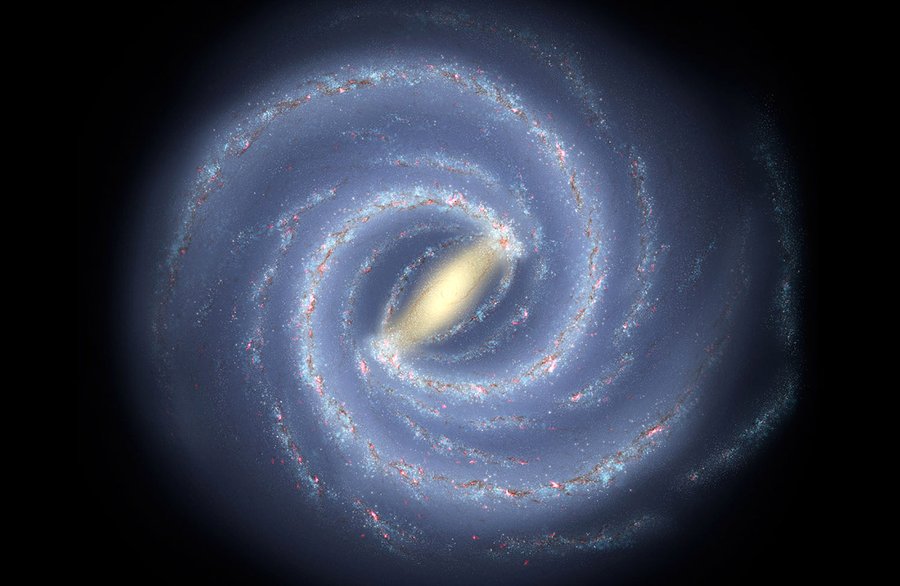
From our perspective, the central region of the Milky Way is obscured by dust and dense stars. This makes it difficult to determine the structure of the central bar and the innermost spiral arm region. This illustration is also only a rough approximation. — © ESA/Gaia/DPAC, Stefan Payne-Wardenaar/ CC-by-sa 3.0 IGO
Galactic masers in the shock front
But this picture may be wrong, as Davis and her colleagues have now discovered. For their study, they evaluated the positions of galactic masers and compared them with galaxy models. Masers produce concentrated microwave radiation, which is released in star-forming regions through, among other things, high-energy processes. Because these microwaves can penetrate the dust at the center of the Milky Way, they are important helpers in mapping our galaxy.
The evaluations revealed something surprising: the masers of the star formation zones not far from the center of the Milky Way apparently belong to a different structure than previously assumed. “We found that masers previously assigned to the Norma spiral arm exactly match the shock front that our simulations predict for the bar,” Davis reports. The standard view is that the Norma spiral arm of the Milky Way begins at the end of the bar facing us and then spirals outwards around almost the entire galaxy.
Is the Norma spiral arm shorter than expected?
But the analyzes suggest a different structure of our Milky Way: The Norma spiral arm may not begin directly at the end of the galactic bar, but much further out. The innermost star-forming regions of the Norma arm actually lie in an extension of the galactic bar. The masers follow the slightly curved shock front of compressed gases and dust emanating from the end of the bar, comparisons with galaxy models suggested.
“This suggests that at least part of the so-called Norma spiral arm may not be a spiral arm at all, but rather a region of star formation along the leading edge of the galactic bar,” explains Davis. “What is unusual is that we observed this process in an area where the shock waves are normally so strong that star formation is suppressed.” Unlike many other barred spiral galaxies, this is apparently not the case in the Milky Way.
“We assume that the Milky Way is forming stars along the shock front of its galactic bar. This is unusual for most bars in nearby galaxies,” says Davis.
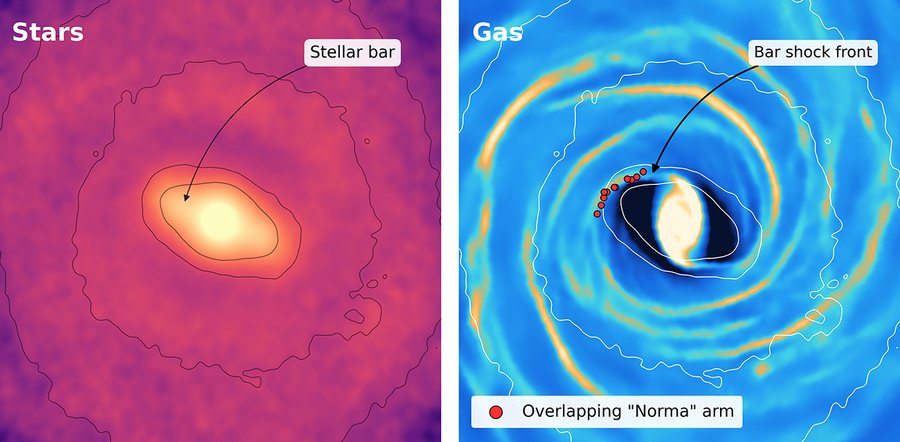
The red dots mark the position of the maser in the transition zone between the Norma spiral arm and the shock front of the central bar. — © Hillary Davis
Milky Way Bar is rather long and slow
The results also shed new light on the controversial features of the Milky Way bar itself. “Our results make it possible to narrow down the size, angle and rotation speed of the central bar more precisely,” the astronomers report. According to their calculations, the galactic bar is around 4.3 kiloparsecs long – this corresponds to around 14,000 light-years – and around 7,500 light-years wide. Its rotation speed is around 40 km s-1 kpc-1. “This suggests a long, slowly rotating bar,” say Davis and her team.
This could also explain why the Milky Way bar does not completely suppress star formation at its edges: recent simulations suggest that this may be typical of galaxies with a certain ratio of bar rotation to bar length – and the Milky Way bar fits into this category, the astronomers found. “We now have a significantly better understanding of the galactic bar and the star formation processes in the Milky Way,” says Davis.
Source: Hillary Davis (University of Sydney) et al., Nature Astronomy, 2026; doi: 10.1038/s41550-026-03010-5