
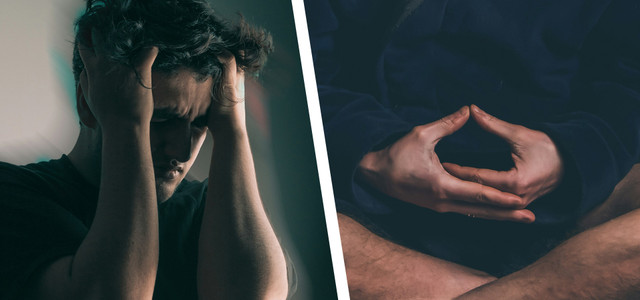
Meditation can be helpful, but it can also have dangerous side effects. Experts warn against trivializing the risks. Those affected report negative experiences and a psychology professor explains which people should be particularly careful.
To counteract everyday stress and other possible psychological problems, many people rely on meditation. They swear by the positive effect of mindfulness practice, which has also been scientifically proven in studies. The fact that meditation can also have negative and sometimes even dangerous side effects is often ignored or trivialized, according to a report in the research magazine Vollbild. It also includes those affected who claim to have become mentally ill through meditation.
Side effects of meditation are not uncommon
Compared to Vollbild, the American psychologist Willoughby Britton from Brown University warns that research in recent years has focused primarily on the positive sides of meditation, but the possible negative consequences have been examined less closely. Such risks are already found in old Buddhist texts and are therefore “nothing new”.
Britton himself found out in a ten-year long-term study that one in ten meditators develop side effects that would severely limit one’s everyday life. Most of the time these were anxiety states, dissociative experiences or a combination of these. In rarer cases, psychoses could also occur.
Dissociation is a condition in which one experiences one’s own consciousness as separate from the body. Mild dissociations happen every day, for example when you are highly concentrated and block out everything around you. But dissociations can also be unpleasant, for example if they cause forgetfulness or if the relationship between self and environment is perceived as disturbed.
A study by the Charité Berlin, published in the specialist magazine BJ Psych Open, came to a similar result to Britton. 22 percent of the approximately 1,400 test subjects examined developed undesirable side effects. Nine percent of them were only mild and temporary. The other 13 percent had moderate to extreme effects that required treatment and sometimes even made hospitalization necessary.
Full screen research: psychoses and panic attacks
The full-screen report also reports on specific cases in which those affected developed serious psychological problems after starting meditation. Nadin, a 28-year-old student from Düsseldorf, was treated as an inpatient in a clinic for two months because she had developed psychosis as a result of a retreat. Micki, a 26-year-old student from Wiesbaden, explains that he started having panic attacks while using a meditation app and ended up going to a clinic too.
Vollbild also mentions a particularly tragic case from Canada, where a 22-year-old broke off a meditation retreat prematurely and then committed suicide. However, her exact motives and whether meditation was actually the trigger have not been clarified to this day.
Why meditation side effects are often ignored
When those affected report negative experiences with meditation, the course providers often blame them themselves, explains Britton. It would then be said that the person is doing something wrong or that the problems were there before.
Micki explains that in the meditation community they say, “If you’re having trouble meditating, then you need to keep going. […] You’re so close to the finish line, now you just have to do a little bit more.” Nadin also reports that her guru did not take her negative feelings seriously and that retreat staff encouraged her to continue when she expressed her concerns to them.
Vollbild also warns that anyone without serious training can offer meditation courses and retreats. Many providers are therefore overwhelmed when it comes to serious psychological problems. In addition, there are no controls on corresponding offers.
Certain groups of people are particularly at risk
In a Spiegel interview from 2023, psychology professor Ramani Durvasula also warns that mindfulness exercises such as meditation could have undesirable side effects in certain groups of people.
Narcissists could use corresponding practices to enhance themselves and devalue others. In traumatized people, however, meditation threatens to cause anxiety.
Meditation can harm traumatized people
Due to side effects such as “hyperarousal or dissociation,” Duvarsula would not recommend meditation to very anxious people with a history of trauma: “I would make it clear that if meditating becomes overwhelming or causes anxiety, you can and should stop,” she explains.
But that doesn’t mean that traumatized people generally shouldn’t meditate. Meditation can also help reduce anxiety, according to a 2022 study in the journal Jama Psychiatry. According to Durvasula, whether mindfulness practices help or harm depends on the individual’s history and personality.
Beware of “mindful” narcissists
The psychology professor also warns of an effect that occurs specifically with narcissists. Narcissism is a personality style that, according to Durvasula, is characterized, among other things, by high self-demand, the search for confirmation and ego fixation. In addition, narcissists wear a “mask” in public that is different from their private side and can sometimes be cruel, callous and manipulative.
Narcissistic people often only get involved in things very superficially, explains Durvasula. Instead of truly integrating what they learned into their own lives, they sometimes practiced mindfulness and meditation to express their own superiority. “They rave about their meditation on social media, but in reality what remains is contempt and a feeling of superiority,” says the psychologist.
The narcissistic person can “excellently weaponize these wellness practices” to shame others or neglect family responsibilities under the guise of self-care. Other people can’t do anything about it, “because society tells them: Mindfulness and meditation are good. So what should they object to if someone takes care of themselves?”
On the other hand, narcissists have a tendency to frustration because they sometimes view mindfulness practices as a panacea. If the relevant methods don’t lead to success, it’s like: “I do everything, I do sports, I meditate – then why isn’t it improving?” says Durvasula.
Alternatives to meditation
Instead of meditating, Durvasula recommends that people who find meditation uncomfortable focus on the present in other ways: “Crafting or baking or something else that, while sensual, may not produce such stimulating states of mind.”
Narcissists, on the other hand, should practice practices that strengthen the connection with other people: for example, putting their cell phones away when talking to others, making eye contact and listening carefully.
People want quick answers to their problems and therefore often end up with mindfulness and meditation. However, Durvasula considers this “TikTokification of mental health” to be problematic. Mindfulness practices are just “one tool of many.” Although they can have positive effects, they still require a certain degree of caution.
Note: Anyone who feels psychologically stressed can find help from the telephone counseling service: on 0800/1110111 or 0800/1110222. Alternatively, the chat service is available at: online.telefonseelsorge.de
** marked with ** or orange underlined Links to sources of supply are partly partner links: If you buy here, you are actively supporting Techzle\.com, because we then receive a small part of the sales proceeds. More info.