

Is there an undiscovered planet in the solar system beyond Neptune? Astronomers have been discussing this question since the 1990s because the orbits of some trans-Neptunian objects in the Kuiper Belt do not fit common solar system models. Neither the early migration of the outer planets nor their gravitational influence alone can explain how these icy objects ended up on eccentric, highly inclined, or extremely distant orbits.
In 2016, two US astronomers caused a worldwide stir. They postulated the existence of a Neptune-sized, as yet undiscovered planet in the Kuiper Belt. Among other things, they considered the striking accumulation of certain orbital alignments in some trans-Neptunian objects as evidence for this “Planet 9”. However, later studies raised considerable doubts about the existence of such a planet – and despite intensive searches, no trace of it has yet been found.
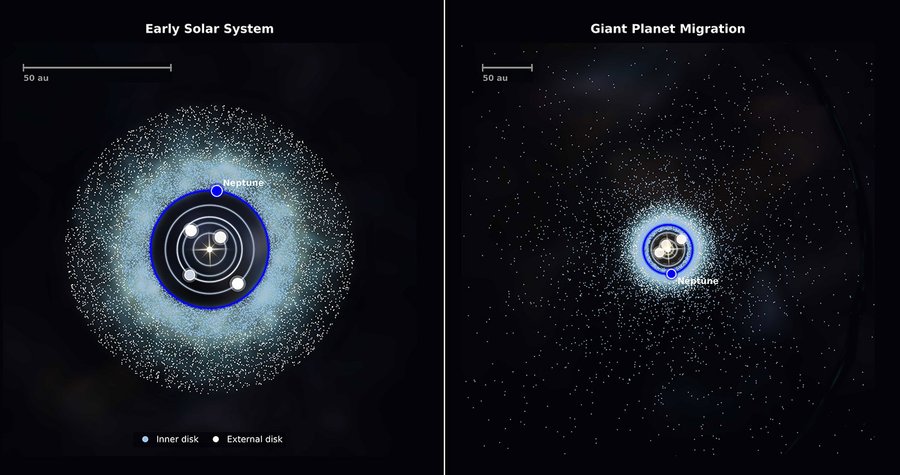
The common view is that an early migration of the outer planets and their gravitational effects dispersed the trans-Neptunian objects into their present orbits. However, not all orbits of these celestial bodies can be explained with this common model. — © Patryk Sofia Lykawka et al.
“Planet X2” instead of Planet 9
Now there is a new approach – and a new planet candidate. This “Planet “Imagine if, after decades of mapping our solar system, we discovered that another planet had been hiding from us all this time,” says Lykawka. “This could fundamentally change our view of the solar system and its history.”
For their study, the astronomers used computer simulations to understand how the various exotic Kuiper Belt objects could have ended up in their current orbits. To do this, they simulated the development of the solar system and the trans-Neptunian objects both without and with a “Planet X2”. They then compared the results with observational data on the different groups of Kuiper Belt objects.
Planet’s presence explains exotic trans-Neptunians
“Our analyzes show that the migration of Neptune can explain the orbits of trans-Neptunian objects within a distance of around 50 to 100 astronomical units,” write the astronomers. But this does not apply to more exotic and distant celestial bodies. This particularly affects extremely distant objects with orbital semi-axes of more than 500 astronomical units (AU), celestial bodies with an orbital inclination of more than 45 degrees relative to the planetary plane and also trans-Neptunian minor planets such as Sedna
“The long-term gravity influence of Planet X2 is necessary to reproduce their orbital architectures,” report Lykawka and his colleagues. “The scenario based on the scattering of these objects by the known planets, on the other hand, turned out to be extremely inefficient.” In these simulations, the trans-Neptunian objects were either ejected completely, crashed into other planets or did not travel far enough outwards.
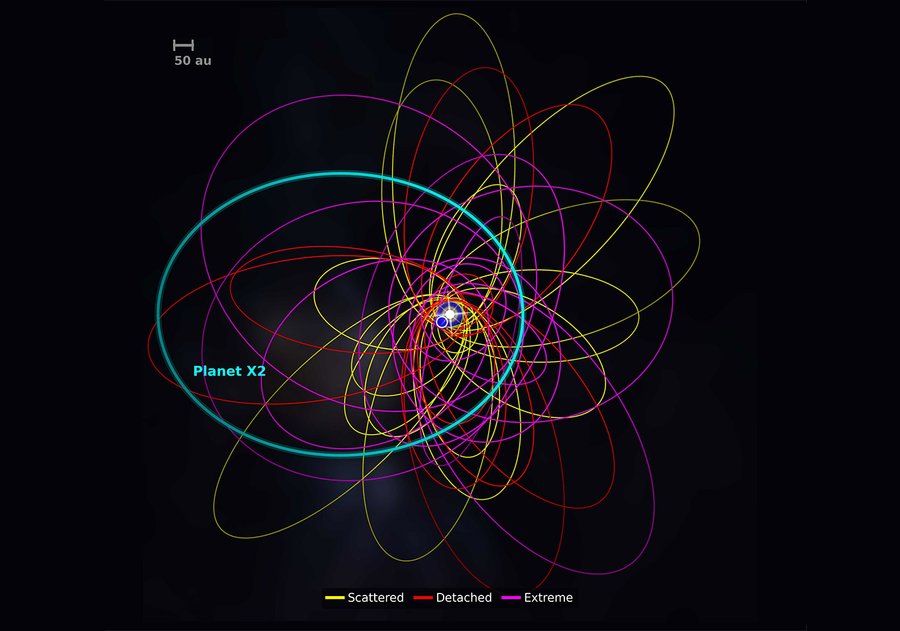
Orbits of the hypothetical planet X2 and some exotic trans-Neptunian objects. — © Patryk Sofia Lykawka et al.
Twice as heavy as Earth and far away
The analyzes also provided more detailed information about the mass and orbit of the hypothetical planet X2. Accordingly, it would have to weigh around two Earth masses and therefore be a little larger and heavier than our Earth. According to astronomers, the elliptical orbit of the planet Even at its closest approach to the Sun, Planet X2 would still be at least 200 astronomical units away.
“Taken together, our results provide evidence of a yet undiscovered planet in the outer solar system,” write Lykawka and his team. “The Planet This telescope has the largest digital camera in the world and can therefore image large areas of the sky in high resolution.
Ruby Observatory could help locate Planet X2
“The exciting thing is that we now have the opportunity to put this idea to the test,” says co-author Jonti Horner from the University of Southern Queensland. “As the Rubin Observatory systematically surveys the sky, it can provide us with information that will help us better understand the outermost reaches of our solar system – and find out whether there really is another planet waiting to be discovered.”
Source: Patryk Lykawka (National Astronomical Observatory of Japan) et al., Monthly Notices of the Royal Astronomical Society, 2026; doi: 10.1093/mnras/stag2033