
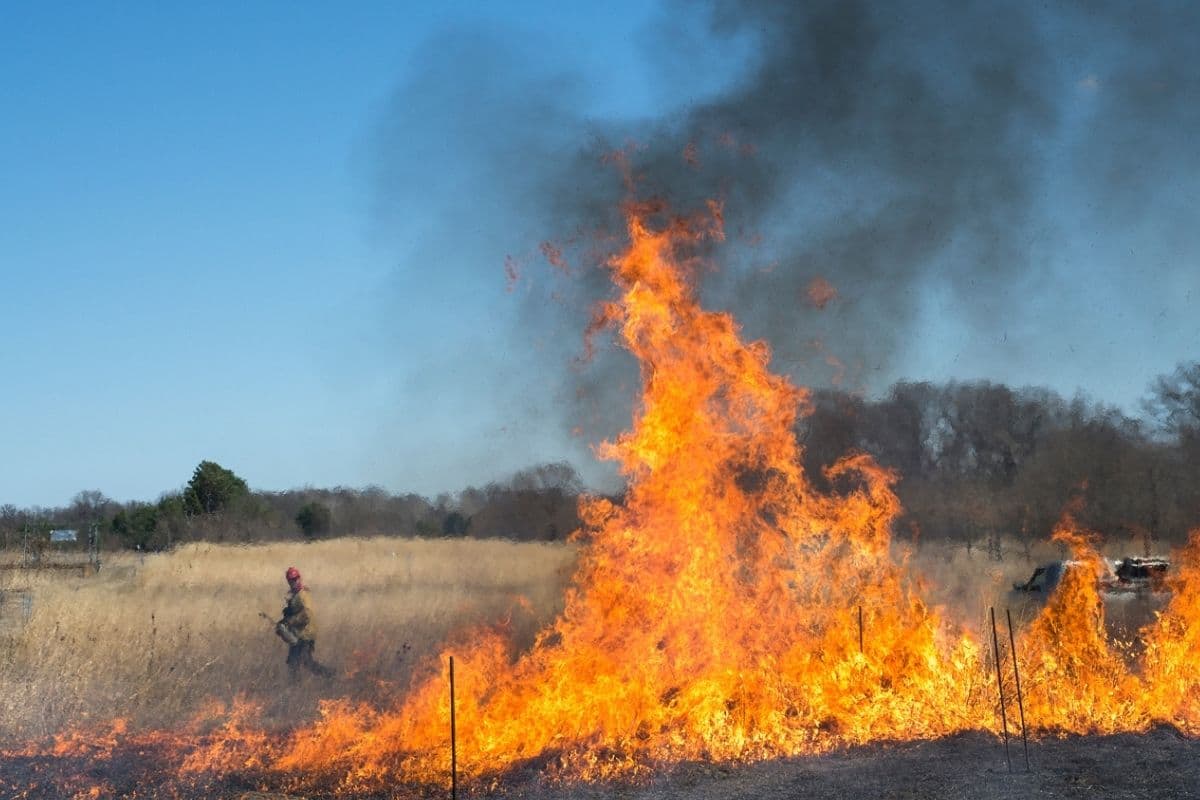
Although wildfires often bring death and destruction, well-controlled fires could just offset part of our CO2 emissions.
Scientists are currently looking for ways to capture and store CO2. This will play an important role in our fight against climate change. Researchers are now proposing a rather bold method in a study. And that by starting controlled fires.
Planting trees
A common way to offset our CO2 emissions is by planting trees. Trees remove CO2 from the air and mainly store extra CO2 as they grow. However, tree planting does not necessarily maximize carbon storage in natural ecosystems. So researchers set out to find a way to do that.
Controlled Burn
The researchers make a surprising discovery. Because although wildfires are often associated with a lot of death and destruction, in some cases they also appear to be good for the climate. Under controlled conditions, fires can cause more carbon to be stored in the soils of temperate forests, savannas and grasslands. “We found that in several ecosystems, fire can increase the amount of carbon stored in the soil,” said study researcher Adam Pellegrini.
That is how it works
Normally, carbon is recycled in the soil. Organic matter from plants is consumed by microbes and released as carbon dioxide and methane. But fire can cause more carbon to be retained in the soil. And in two ways. For example, it creates charcoal, which is highly resistant to decomposition. In addition, it forms clumps of soil that protect carbon-rich organic matter in the middle.
Roots
At the same time, fires can also cause plants to absorb more carbon. In grasslands, for example, a lot of carbon is stored underground, in the roots of plants. Controlled wildfires can then stimulate grass growth, creating more roots. As a result, more carbon can be stored in the roots.

A controlled fire on the savanna. Image: Adam Pellegrini
“If the frequency and intensity of fires are just right, ecosystems can store huge amounts of carbon,” Pellegrini says. “It’s all about the balance between the carbon that ends up in the soil from dead plant biomass and carbon that comes out of the soil through decomposition, erosion and leaching.”
With controlled fires, however, you should not think of the extensive forest fires that set the Amazon forest ablaze, for example. When fires are too intense – as we often see in dense forests – all the dead plant material that would otherwise decompose and release carbon into the soil burns. In addition, such fires can also degrade the soil, break down carbon-based organic matter and kill soil bacteria and fungi.
Most wildfires on Earth are caused by being started by humans. And so there is also an unexpected opportunity here. “We have to see this as an opportunity,” said Pellegrini. “People intervene in a process. So we might as well figure out how to use this to our advantage while maximizing carbon storage in the soil.”
The study shows that in some cases wildfires can be an unexpected weapon in our fight against a warming world. “When thinking about how to manage ecosystems to capture and store carbon from the atmosphere, fire is often seen as a bad thing,” Pellegrini says. “We hope that this new study will show that fire, if managed properly, can be beneficial – both for biodiversity conservation and carbon sequestration.”
Source material:
“Controlled burning of natural environments could help offset our carbon emissions– University of Cambridge (via EurekAlert)
Image at the top of this article: Adam Pellegrini