
Americans first
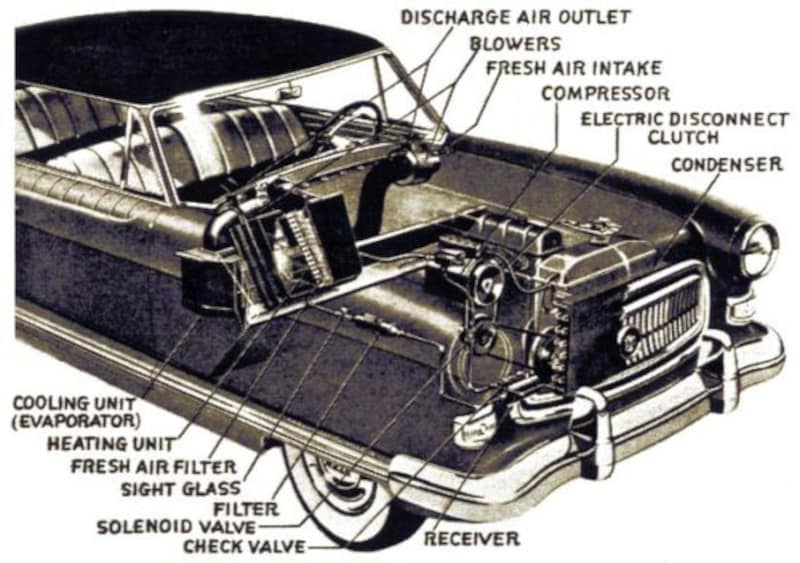
With advancing technical insight, we have become increasingly better able to manage complex systems over the years. Nevertheless, much modern technology has its roots in the past, including all-American air conditioning. It is now indispensable, even in used city cars that are ten years old, but 80 years ago it was considered something very special. And for many decades afterwards too. Here you can read how long car manufacturers have been working with air conditioning.
In 2024, even the smallest shopping car that is ten years old with air conditioning is for sale. However, it has not always been so obvious. In its early days, the car was little more than a horseless carriage, often open, leaving the occupants at the mercy of the weather gods. You have to dress against rain and cold, although this will be eliminated with the arrival of the closed bodywork. However, it does not get cooler than the outside air. Or is it? As early as 1884, the American William Whiteley came up with a solution in which ice blocks were placed in crates under the floor of a horse-drawn carriage. A fan driven by one of the axles then blows air along the ice into the carriage. Maybe shoddy work of the better kind, but it’s a start, because air conditioners today still blow air over a cold element.
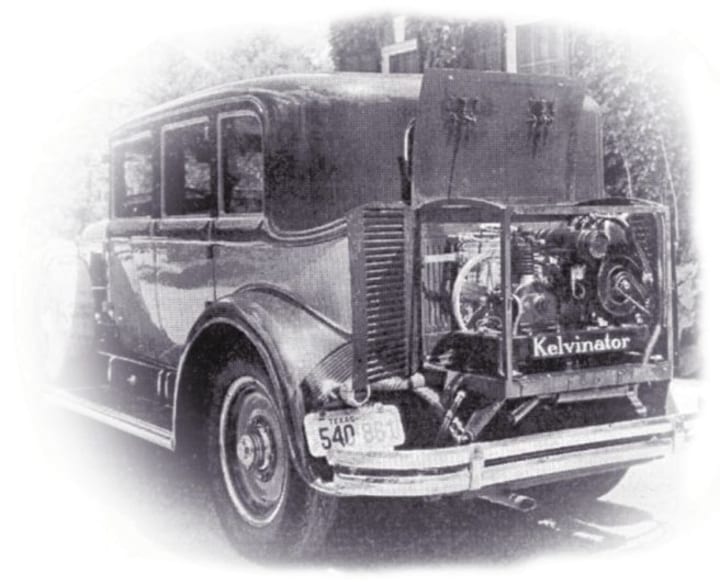
Refrigerator manufacturer Kelvinator did it right in 1930
Things only became serious when refrigerator manufacturer Kelvinator (the brand still exists and is now part of Elektrolux) installed a refrigerator module on the back of a Cadillac in 1930. A small, 1.5 hp combustion engine is used to drive the 370 watt cooling unit. It remains an experiment. Nevertheless, in the decade before the Second World War it did trigger all major American car manufacturers, who all started developing interior air coolers behind the scenes. Ultimately, Packard (which in those days operated at the same exclusive level as Rolls-Royce, for example) was the first in 1939 to present a car with air conditioning.
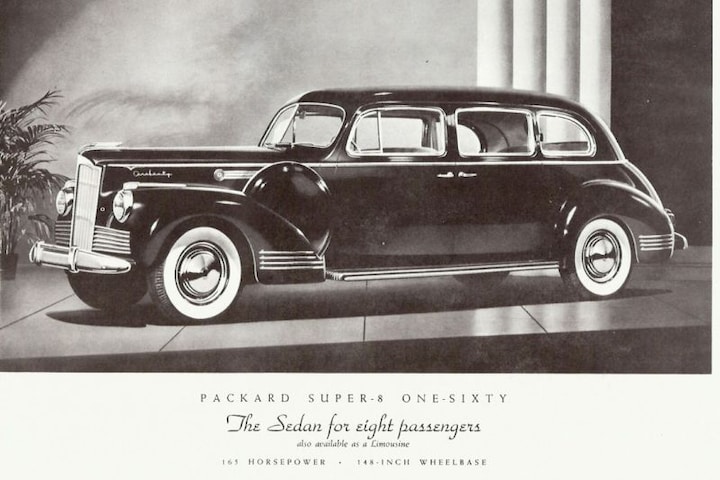
The system is retrofitted in the trunk by an external party (Bishop and Babcock Co.), but under the auspices of Packard. From 1940 to 1942, Packard supplied 1,500 air-conditioned cars. General Motors cannot lag behind and in 1941 (just one year) 300 Cadillacs are fitted with air conditioning. All these systems do not yet work perfectly. For example, no fresh air from outside is used, but the interior air is recirculated, which does not benefit the air quality in the car, especially if the occupants also smoke. And with the evaporator in the trunk, the passengers in the back seat quickly get a wet back from the deposited condensation. Oh, and if that’s not enough: the air conditioning cannot be regulated in those days. You can only turn it off by removing the driving belt from the pulleys under the hood. But hey, for those who can afford it, it’s better than sweating.
Cooling in summer, heating in winter
After the war, the thread is picked up again with improved systems and various independent suppliers also come up with air conditioning installations that can be retrofitted. However, they only became available to the general public when car manufacturer Nash (which had since acquired refrigerator manufacturer Kelvinator) came up with a factory solution in 1954 for $395 under the name Weather Eye. With just one dial, the Weather Eye ensures the right temperature in the car, cooling in the summer and heating in the winter. Admittedly, thanks to smart electronics, air conditioning in 2024 can be controlled many times more accurately and all occupants can set their own climate if necessary, but the basis of modern air conditioning still goes back to the principle of the Weather Eye. You can see how it works in the main image in this article.
– Thanks for information from Autoweek.nl