
Especially looking at what is already there




A new car just doesn’t draw itself. At least, not for now. This may change in the future due to the rise of artificial intelligence (AI). In a jolly mood, the English Leasecar has commissioned a smart piece of software to draw new generations of ten of the most popular new passenger cars in the United Kingdom. Is this the future?
Developing a new car costs money. Lots of money. Manufacturers spend millions, if not billions, on the development of a completely new car. The bulk of the costs are incurred in technical development, but do not discount the costs involved in the design-technical picture. Often several international design teams spend a long time sketching and modeling on clay models. Can artificial intelligence (partially) take over the function of car designers?
Probably not. Artificial intelligence bases its creations on what already exists, which means that the designs that AI creates often contain little news and will mainly be hodgepodge of existing design. AI can undoubtedly lend a helping hand. Cars drawn by smart algorithms can always serve as a source of inspiration.
UK company Leasecar has commissioned AI to draw new generations of what are currently popular new cars in the UK. This results in striking creations, digital cars in which you encounter design elements of existing cars.

Opel Corsa
In the ‘AI-Corsa’ we see influences from Opels, especially the previous generation, in the design of the grille and when viewed from the side. So you see that AI is based on what is already there. So no Opel Vizor for this new Corsa proposed by ones and zeroes.

Nissan Qashqai
Will be the new Qashqai? Probably not. While Nissan is slowly but surely toning down the V-Motion grille, this computer-generated car has a very fierce incarnation of it in its face. If you had told us this was a never-seen-before 2017 Nissan concept car, we wouldn’t have questioned it.

Ford Puma
Is this the unholy love baby of a Ford Puma and the Hyundai Prophecy Concept? No, according to an algorithm, this is the next generation Ford Puma. Interesting: the AI has turned the new Puma into a three-door. After all, there are enough pictures on the internet of the predecessor of the current crossover Puma…

Kia Sportage
This new Kia Sportage as the software imagines it is certainly not a new design. We find a tiger nose grille that is no longer applied in this fierceness and the windows are reminiscent of those of the previous generation Sportage.

Nissan Juke
The next-generation Nissan Juke, like the new Puma, will be a three-door crossover with a coupe-like roofline. Could AI be onto something here? We think not, but would only welcome the arrival of such a model.

Hyundai Tucson
Just like for the proposed Kia Sportage, this Hyundai Tucson does not fully match the current design language. Nice detail are the ‘digital’ exterior mirrors.

Tesla Model Y
With the presentation of the next generation Tesla Model Y, the AI was not quite sure what to do with it. We mainly see a Model Y, but with flatter viewers and a wider nose. It does not look wrong, although the placement (and design of) the side mirrors looks a bit unnatural.

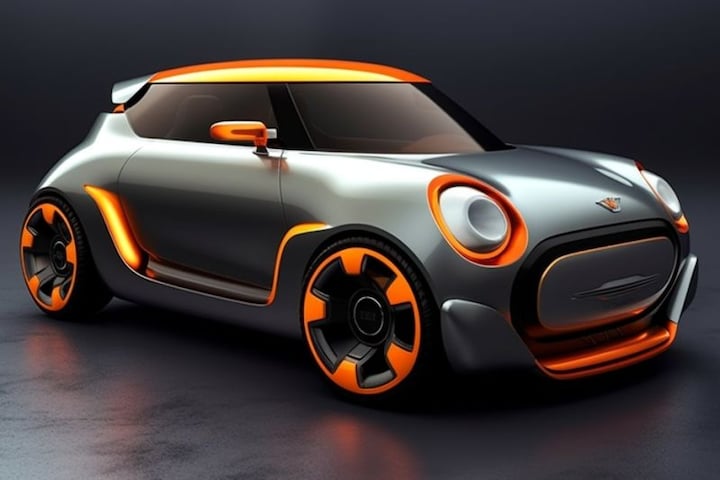
Mini
A dash of Smart #1 and a hefty dose of Mini Rocketman: that’s the next generation Mini. We have known for a long time that this is precisely not true. Would you like to see a mini-Mini like this on the road?

Volkswagen T-Roc
For the new T-Roc, the soulless designer was apparently inspired by old study models from Volkswagen such as the T-Prime GTE (Touareg) and Cross Coupe GTE Concept. Indeed: concept cars from about seven years ago.

Ford Fiesta
Did you think the current generation Ford Fiesta before the facelift was very similar to its predecessor? You’re not alone in that, it seems. The piece of AI thinks that Ford will simply repeat that trick for a second time with the next generation Fiesta. Who will tell our software sketch hero that there won’t be another Fiesta?
– Thanks for information from Autoweek.nl