
New industry emerges

The battery pack of an EV represents half the value of an electric car. It is too valuable to discard when it reaches the end of its useful life. The aim is to make 95 percent of battery cells recyclable in the future.
Is an old battery waste by definition? No, not exactly. Electric car batteries contain many valuable raw materials and are therefore rewarding objects for recycling. This reuse is currently still happening on a small scale, because most EV batteries have only been in use for a relatively short time. After all, no electric cars have been driving around for that long, at least not in large numbers. However, the need for battery recycling is increasing.
In principle, the life cycle of a battery consists of three steps: repair, reuse, recycling. In other words, repair, reuse and remanufacture. From 2035, the current recycling niche will probably develop into a real industrial sector. An important reason for this is the new battery regulation of the European Union. While until now only 50 percent of a car battery must be recyclable, the quota should be 90 percent in the future and even 95 percent from 2031. Specialist companies now recover aluminium, steel and plastics, but other materials must also be recyclable in the future. Experts estimate that by 2030, recycling capacity throughout Europe sufficient for up to 420,000 tonnes of battery material will be needed annually. Furthermore, newly produced batteries must contain a minimum proportion of recycled material in the short term. Moreover, by then manufacturers will be required to accurately calculate and provide insight into the lifespan of the batteries.

Crucial resources
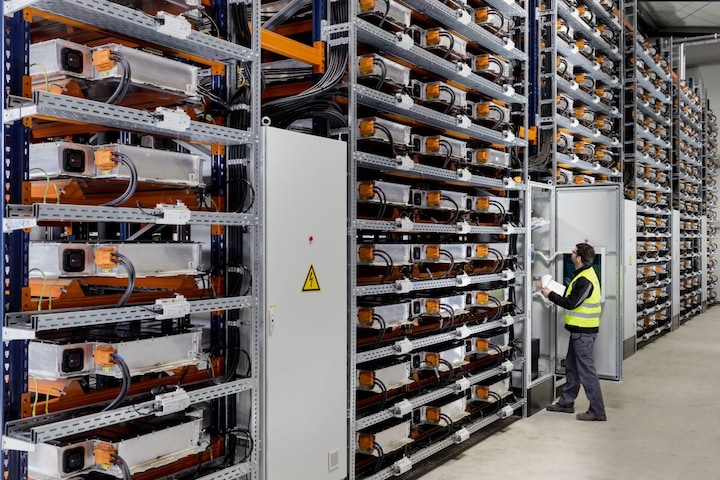
Of course, the focus of recycling efforts is on the so-called crucial raw materials, which are often extracted from the ground under questionable circumstances, such as through child labour. An average drive battery with a capacity of 50 kilowatt hours contains approximately 4 to 8 kilograms of lithium, 11 kilograms of manganese, 12 kilograms of cobalt, 12 kilograms of nickel and 33 kilograms of graphite. Before a battery really reaches its end of life, however, discarded car batteries first get a second life in the form of stationary energy storage. This means that they have to endure less than with the permanent acceleration and recuperation to which they are exposed in EVs. BMW, for example, uses a storage system with 700 batteries from i3s at its factory in Leipzig. These are interconnected and buffer solar and wind energy for use in the production process. After ten years of use and 100,000 miles of practical experience, used car batteries usually have 70 to 80 percent of their original capacity left.

Second life phase
They are then deployed for ten to twelve years in the less intensive second life phase; the recycling of batteries therefore only starts after they have been used for about twenty years. Companies are already preparing for this. No wonder: according to the German research institute Fraunhofer, the infrastructure required for recycling will require investments of more than six billion euros by 2040.
Complex recycling process
Bosch subsidiary Rexroth recently presented a technology in which the automatic discharge of the battery cells raises the efficiency and safety of recycling to a higher level. A pilot plant is under construction at the Battery Lifecycle Company in Magdeburg, Germany. Here, used batteries from different manufacturers will soon be tested, deeply discharged and prepared before entering the shredder. Eight lithium-ion batteries from electric cars can be discharged automatically in less than fifteen minutes. The system not only recognizes the different types of batteries, but can also prevent short circuits and fires. The biggest advantage is that further processing can take place without the use of electricity. The usual manual process takes up to 24 hours for the batteries to be fully discharged. The further recycling process is complex: the manual disassembly of the battery systems is followed by a sorting process, after which the shredder does its job. Strainers and magnets then separate the individual components. With the help of chemical reactions, which dissolve the substances by adding chemicals (hydrometallurgy), a kind of black mass is created. It contains sought-after substances such as graphite, manganese, nickel, cobalt and lithium. By contrast, the less efficient and more environmentally harmful process involving thermal melting (pyrometallurgy) that has been used until now is on the wane. This method requires temperatures of up to 1,450 degrees.

Car manufacturers do it themselves
In addition to battery manufacturers and recycling companies, the car manufacturers themselves are also involved in this subject. For example, Volkswagen has a recycling plant in Salzgitter, not far from Wolfsburg. The annual capacity: about 1,500 tons. Mercedes wants to build a factory in Kuppenheim, south of Karlsruhe, with a capacity of 2,500 tons. And Nissan is still looking for a location for a factory in Germany that should start operation in 2025.
Battery recycling is still a niche market
Battery recycling is still a niche market. But the various parties invest not only in the production, but also in the recycling of batteries. And so within a few years a completely new industry will arise.
.
– Thanks for information from Autoweek.nl