
The charging network also needs to change
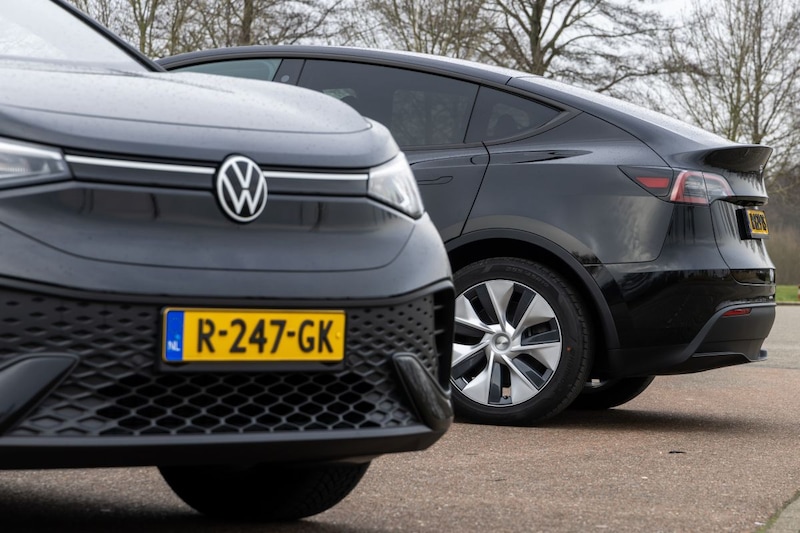
The bullet has been confirmed: after a whole series of other brands, Volkswagen in North America has also yielded to Tesla’s charging connection. This is a lot more painful for the German brand than for competitors who have already taken this step earlier.
After Ford, General Motors, Honda, Hyundai and Kia, Jaguar and Land Rover, Nissan, Rivian, Subaru, Volvo and Polestar, it was recently Volkswagen’s turn to adopt the Tesla charging connection in North America. Undoubtedly with a lot of sighing and complaining from the boardroom, because this step is quite painful, especially for Volkswagen. Volkswagen is responsible for the second largest fast charging network in the United States. That’s right: after Tesla’s Supercharger network, that is.
Electrify America (EA), as that network is called, was set up in 2016 by Volkswagen Group of America. Volkswagen did not do this voluntarily, but as part of its obligation to invest two billion dollars over ten years in the development and promotion of EVs to compensate for the tampering with diesel engines. All EVs, that is, not just those from Volkswagen itself. Electrify America, like all other non-Tesla chargers to date, uses the CCS combination plug that was initially the standard in this area outside Tesla.
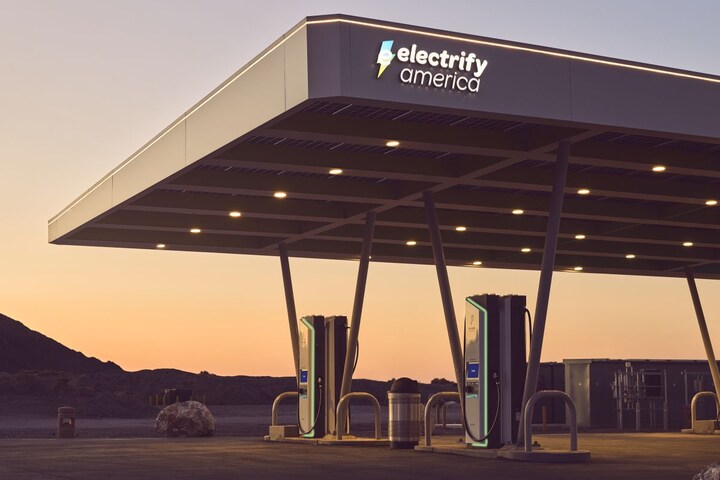
EA already indicated in June that the company’s chargers would also offer Tesla’s North American Charging Standard (NACS). Out of necessity, we might say, because the switch of almost all car manufacturers from CCS to NACS was already in full swing and could otherwise have been a major blow for EA. Now Volkswagen is having to make the change, and the days for CCS in North America seem to be numbered. Existing cars will not be lost if more and more chargers start offering NACS only, because with an adapter these models can also use such a charger.
Electrify America currently calls itself the largest ‘public’ charging network in the US, but that is actually no longer applicable. Now that more and more brands are switching to Tesla’s charging standard, Tesla’s Supercharger network is also becoming less exclusive. Tesla has almost 2,000 fast charging locations in the US, Volkswagen’s charging network has 859 at the time of writing.
Of all the major car manufacturers, only Stellantis has not yet reached the Tesla standard, but with all the external pressure that seems to be a matter of time.
Europe
In Europe, the battle between charging standards has been settled in a different way. Tesla initially used a single Type 2 connection in Europe for both AC and DC charging, but after the emergence of many other brands, it adopted the CCS standard, which has now become the standard everywhere here. Teslas also have a CCS connection here, just like Superchargers. That enabled Tesla to open up the Superchargers here early on to other brands, which is a much more difficult job in the US due to the different charging standards.
One CCS is not the same as the other
In Europe, the abbreviation CCS (Combined Charging System) refers to the CCS2 combination plug with a Type 2 connection, suitable for three-phase charging on an AC charger. In the US, ‘CCS’ means a CCS1 combination, with a type 1 plug that is not suitable for 3-phase charging. A CCS1 plug does not fit in a car with a CCS2 connection and a European EV cannot simply charge in the US or vice versa. The Tesla plug has at least one major advantage compared to both CCS plugs: it is a lot more compact and therefore requires a considerably smaller charging port.
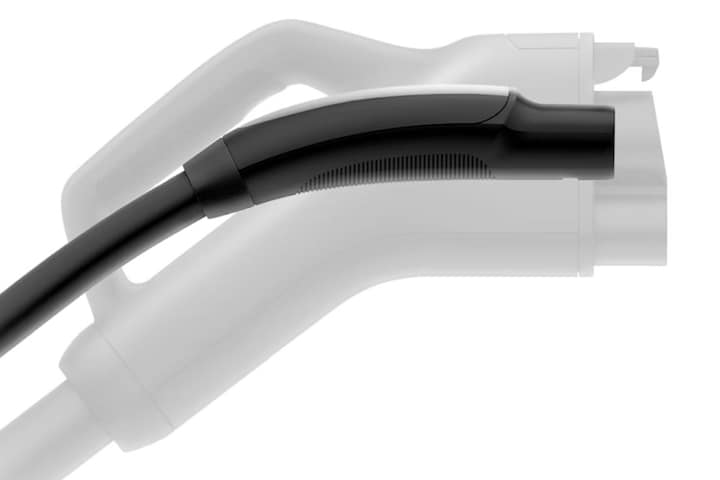
Tesla’s NACS in the foreground, the American CCS combination plug in the background.
– Thanks for information from Autoweek.nl