
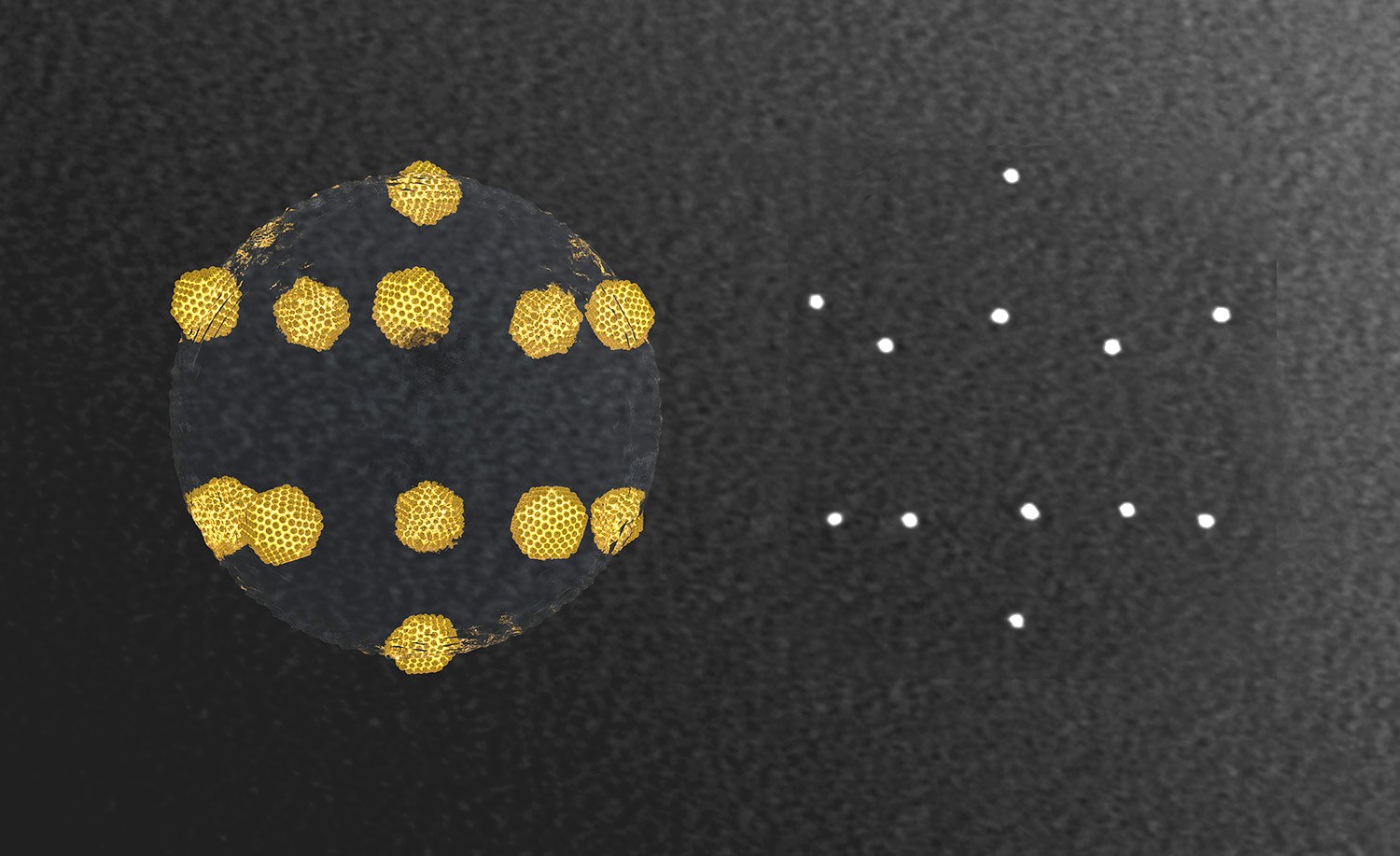
Identical electric charges repel each other, so they strive for the greatest possible distance between them. The British physicist Joseph J. Thomson already knew this when he was working on his atom model in 1904. He therefore looked for the most energetically favorable configuration of electrons on a spherical atom. Thomson’s atomic model has long been outdated, but the mathematical problem remains. Such optimal distributions play a role in many disciplines – from the structure of spherical viruses to crystal forms and colloids to geography.
The problem: What is relatively simple for a few loads is difficult to calculate for a larger number of loads. “Because the number of local minima increases exponentially with the amount of charges, the search for a solution quickly becomes more difficult,” explain Thomas Pohl from the University of Innsbruck and his colleagues. Analytical solutions to the Thomson problem are therefore only available for small systems.
Superfluid helium droplets as helpers
Now Pohl and his team have found a method through which the Thomson problem can be solved practically – through direct observation in the laboratory. This makes it possible to test mathematical models experimentally. “This opens up a new experimental approach to investigate how the charge order develops from small, clearly defined configurations to much larger systems on curved surfaces,” explains Pohl’s colleague Paul Scheier.
The heart of the new method are tiny droplets of ultra-cold helium. If this noble gas is cooled down to a few tenths of a degree above absolute zero, it behaves like a liquid without internal friction – it becomes superfluid. “Superfluid helium nanodroplets offer us an exceptionally clean and cold environment in which up to several thousand charges can organize on a curved surface with almost no external disturbance,” explains Scheier.
Gold deposits reveal the charge pattern
For their experiment, the physicists sprayed a beam of tiny helium droplets through an electron beam in a vacuum chamber. This causes impurities contained in the helium to be drawn to the drop surface by positively charged sodium and calcium ions and form charge centers there. Depending on the size of the drop, helium droplets with five to several hundred charge points were created. Because these charges repel each other, they strive for the lowest-energy, optimal configuration.
To visualize this charge distribution on the tiny and volatile helium droplets, the physicists sent the droplets through a cloud of vaporized gold atoms. These are attracted to the positive charge centers on the droplets and accumulate. “This simply creates charged gold nanoparticles at the charge centers,” explain Pohl and his colleagues.
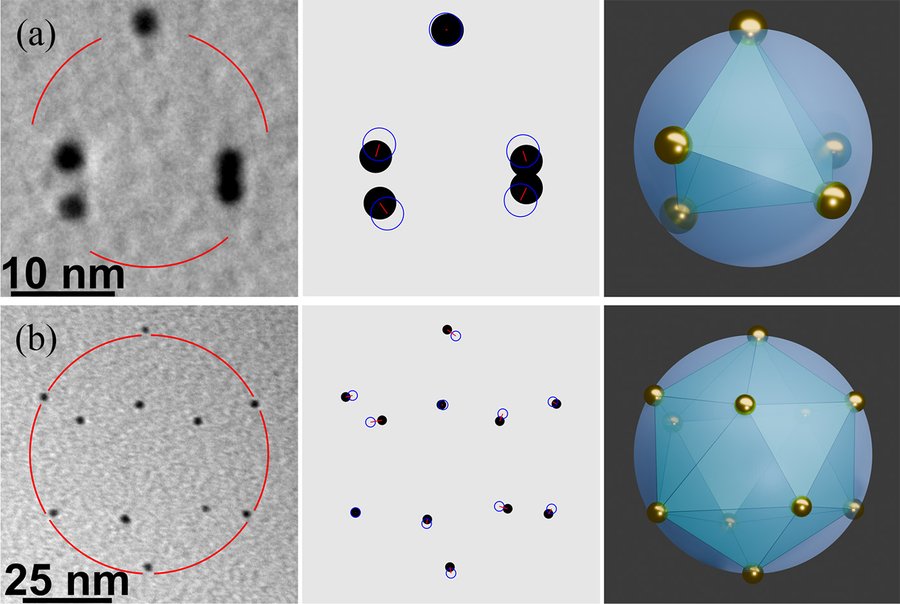
Experimentally visualized imprints (left) for charge centers on the surface of helium nanodroplets, comparison of the imprints with theoretical models (circle outlines) and projected Thomson configurations (right). — © Pohl et al./ Physical Review Letters, CC by 4.0
The highlight is that the helium droplets and their charge centers cannot be imaged directly – but the arrangement of the gold nuggets can. When the gold-loaded helium droplets impact a transmission electron microscopy sample carrier, the gold particles create an imprint of the original charge arrangement. “This allows us to preserve and image these arrangements after the helium has evaporated,” says Scheier.
From triangles to pentagons and hexagons
The experiments showed that small helium droplets with five to 36 charges are distributed in such a way that a triangular pattern is created on the surface. The arrangement of the charge centers corresponds to the theoretically predicted lowest-energy arrangement. “For droplets with fewer than 36 charge centers, there is a clear connection between the observed footprints and the three-dimensional ideal Thomson configurations,” report the physicists.
However, with larger droplets with a radius of up to one micrometer, a different picture emerges: the gold particles form a hexagonal lattice that is interrupted by individual pentagonal defects. “This defect structure is characteristic and arises from the frustration of a hexagonal packing on a curved surface,” explain Pohl and his colleagues. Because a hexagonal grid cannot be placed on a spherical surface without gaps, interspersed pentagons have to provide the necessary balance – like the leather honeycombs of a classic football.
Experiment helps mathematics
“We have thus developed an experimental platform to investigate the configurations of the optimization problem posed by Thomson in 1904 in real space,” state the physicists. With the help of the helium droplets, not only can the already calculated charge distributions be checked, the experiment can also be used to map arrangements that are not yet known.
“What excites me most is that this reverses the usual relationship between theory and experiment: instead of mathematics simply predicting what an experiment should yield, we can now let nature generate solutions and let mathematics explain what we observe,” says co-author Shengfu Yang from the University of Leicester.
Source: Thomas Pohl (University of Innsbruck) et al., Physical Review Letters, 21026; doi: 10.1103/qby4-bm6q