
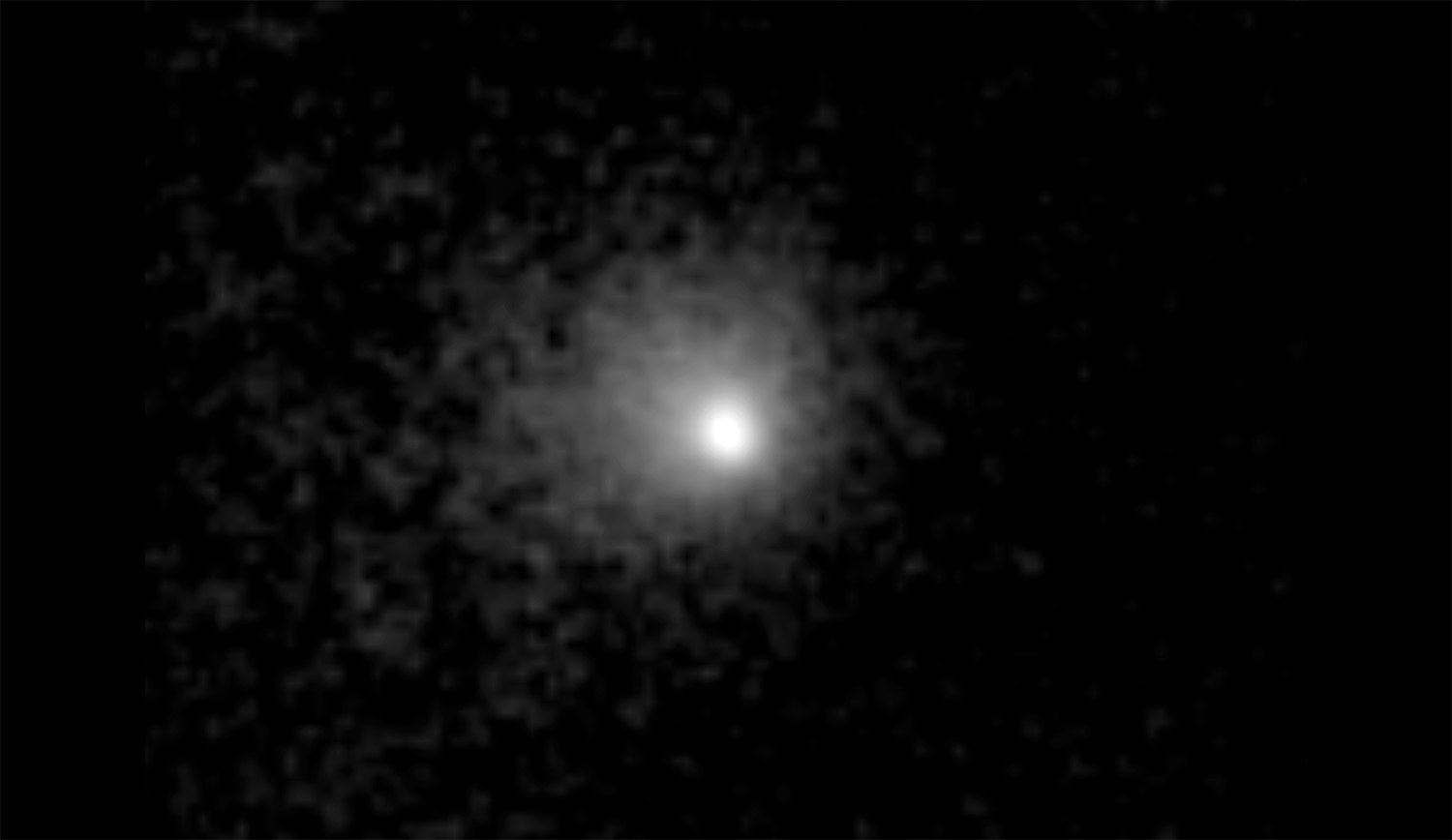
The European space telescope Euclid was launched in July 2023 to explore the “dark side” of our universe: dark matter and dark energy. To do this, the telescope’s two instruments map the position, structure and movement of galaxies, quasars and other celestial objects up to ten billion light-years away. Euclid’s special feature is that the telescope can image a large section of the sky in just one pass, but still in high resolution.
Diffused streak of light in 16 Euclid shots
However, a chance discovery that astronomers led by Mikko Pöntinen from the University of Helsinki have now made in images taken by the Euclid telescope is by no means dark or far away. They tried out newly developed software that looks for traces of foreground objects in the Euclid images. They found what they were looking for: “I was thrilled when my software discovered a track that spanned several recordings – the result of a fast-moving object,” reports Pöntinen.
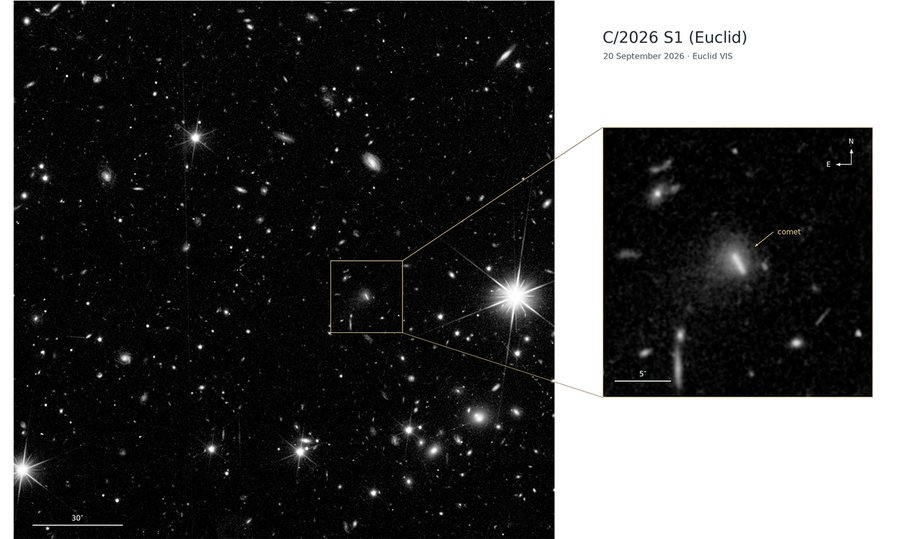
The newly discovered comet C/2026 S1 (Euclid) appears as an elongated light trail in the Euclid images. This reveals that it is a fast-flying foreground object. — © ESA/Euclid, Euclid Consortium/NASA, M. Pöntinen et al. 2026, CC-by-sa 3.0 IGO
Further images confirmed the find: The fast-moving object could be seen in a total of 16 Euclid images from September 16 to 24, 2026. The astronomers then compared the object’s position and trajectory with catalogs of known comets and asteroids, but did not find any celestial body that matched their finding. It therefore had to be an as yet unrecognized object. “A more detailed analysis showed that it was surrounded by a diffuse cloud – this suggests an active object such as a comet,” explains Pöntinen.
What is known about the new comet?
The astronomers then reported their discovery to the Astronomical Union’s Minor Planet Center, whereupon other astronomers also used Earth-based telescopes to look for the comet candidate. After they were also able to see the object, the newly discovered comet was now officially recognized. It has been named C/2026 S1 (Euclid).
The newly discovered comet C/2026 S1 (Euclid) is currently 1.3 billion kilometers from Earth, which is about halfway between Jupiter and Saturn. However, the comet does not orbit in the plane of the planet’s orbit, but rather almost perpendicular to it. It follows a trajectory that takes it in a highly inclined, eccentric orbit around the sun over the course of thousands of years. How long the comet takes to complete one orbit, how big it is or what its composition is is still unknown. Further observations must now clarify this.
Why the comet discovery was unexpected
For the Euclid telescope, this comet is an unexpected coincidence find, because it actually only looks in the directions in which there are very few solar system objects: the telescope only surveys areas of the sky that are significantly above or below the plane of the planet. Because it is too filled with dust and disturbing reflections to allow clear images from distant space, as the astronomers explain. The discovery of a new comet was therefore rather unexpected.
“Euclid is expected to see very few comets, so it was a happy coincidence that Euclid’s survey plan and the orbit of this comet matched,” says Bruno Altieri of the Euclid Collaboration. “The telescope was able to image it in several images at once.”
Source: European Space Agency