

Die meisten Sterne im Weltall sind keine Einzelgänger – sie sind Teil eines Doppelsternsystems. Wenn dann einer der beiden stellaren Partner das Ende seines Lebenszyklus erreicht, bläht er sich zum Roten Riesen auf. In close binary star systems, this can lead to a so-called “common envelope” phase: the companion star is swallowed by the bloated envelope of its partner. Beide Sternenkerne umkreisen sich nun innerhalb dieser gemeinsamen Hülle.
However, this stellar togetherness does not last: slowed down by the frictional resistance of the gas envelope, the orbit of the smaller star continues to narrow. It approaches the core of the red giant in a spiral course until it finally merges with it – that’s what the theoretical models say. According to these, many exotic binary systems can be traced back to such a merger process – from X-ray binary stars to pairs with white dwarfs to Type Ia supernovae. But because the common envelope phase is so short-lived, astronomers have never caught it in the act – until now.
For the first time, astronomers have managed to observe such a pair of stars from the beginning of the common envelope phase until their merger. The trigger for this was the striking change in a star in our neighboring galaxy Andromeda: From 2018 onwards, the object named AT 2025abao gradually began to become brighter, as Viraj Karambelkar from Columbia University in New York and his team discovered. Nähere Untersuchungen ergaben, dass dort ein Stern zum Roten Riesen geworden war.
But this alone was not enough to explain other unusual features of this object: “A large excess of infrared radiation indicates a stellar wind-related material loss of five hundred thousandths of a solar mass per year – this is substantially more than expected for isolated red giants,” explain the astronomers. The temperature development and the rapid fading of this star in the summer of 2025 did not match this either.
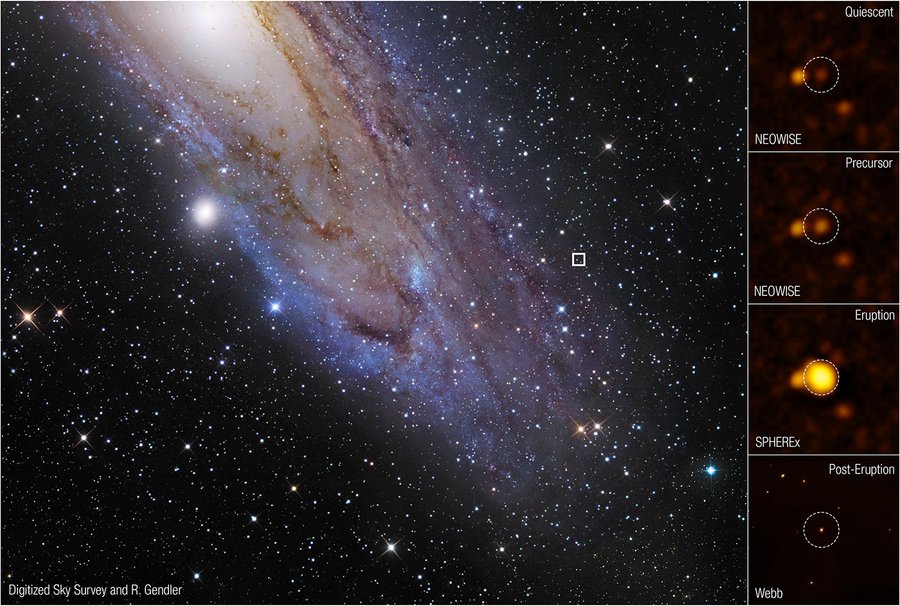
Lage von AT 2025abao in der Andromedagalaxie und Aufnahmen der verschiedenen Stadien dieses Objekts. – © NASA/ESA/CSA, STScI, Viraj Karambelkar (Columbia), Kishalay De (Columbia); Image Processing: Alyssa Pagan (STScI); Acknowledgment: DSS, Robert Gendler
Companion star plunges into red giant envelope
Further analysis provided the explanation: AT 2025abao was not a single red giant, but a stellar duo. This consists of a main star weighing around seven solar masses, which had expanded into a red giant, and a much smaller companion star of around 0.7 solar masses. “The change in AT 2025abao observed from 2018 onwards can be explained by the fact that the smaller companion entered the shell of the main star and orbited there in a spiral – this signaled the beginning of a common envelope phase,” explain the astronomers.
For the first time, astronomers have succeeded in observing a double star in this extremely short transition phase. “This precursor system corresponds to those in classic models of common envelope development for compact dual systems,” write Karambelkar and his colleagues. The high material loss, brightening and increased energy release of AT 2025abao occur because the smaller companion star loses enormous amounts of material and energy as it flies through the shared envelope.
Explosion signals the merger
But that wasn’t all: “In October 2025, the star underwent a dramatic eruption – it became a hundred times brighter within 25 days and its photospheric temperature rose to around 8,000 Kelvin,” report Karambelkar and his colleagues. AT 2025abao now shone as brightly as 1.5 million suns, while at the same time its outer shell expanded outwards at around 330 kilometers per second – a clear sign of a violent release of energy.
“The observed kinetic energy of around 10⁴⁸ erg suggests that the companion star has migrated inward to a distance of around three solar radii,” the astronomers write. Das aber bedeutet: Der kleinere Begleiter muss mit dem Heliumkern des Roten Riesen kollidiert und mit ihm verschmolzen sein. This explains the eruption. “AT 2025abao thus represents a common envelope evolution that ended in a merger of the two stellar components,” said the team.
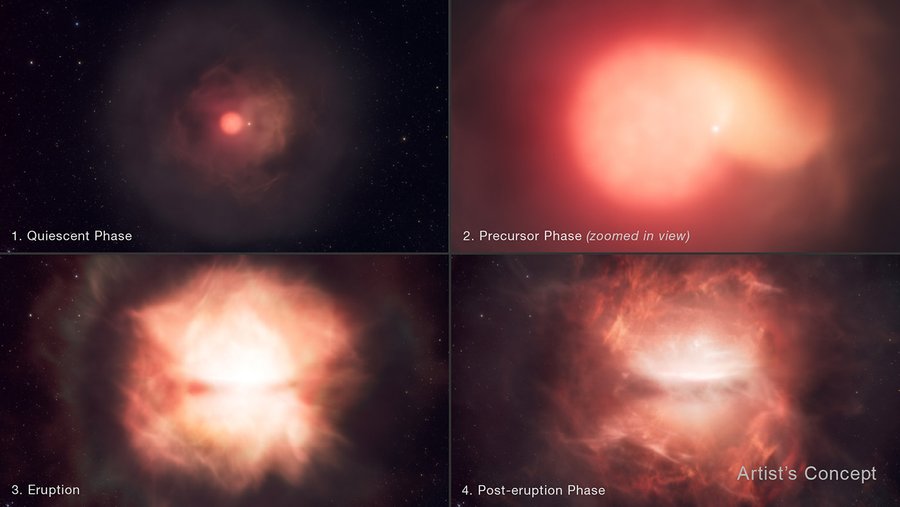
This is how the common envelope phase and merger of the binary star AT 2025abao could have happened: Initially, both stars are surrounded by a dust envelope. Then the smaller star enters the gas envelope of the red giant and is slowed down. The star cores merge and material is ejected. – © NASA/ESA/CSA, STScI, Leah Hustak (STScI); Science: Viraj Karambelkar (Columbia)
Exciting deviations from the models
This is the first time that astronomers have followed the common envelope phase of a binary star from its beginning to its explosive end. Their observations confirm classic models, but also show exciting deviations. Denn anders als in den Modellen vorhergesagt, zerstörte die explosive Verschmelzung der Sternenkerne die gemeinsame Hülle nicht. Nur rund zehn Prozent des Hüllenmaterials wurden ins All hinausgeschleudert.
“Our observations show that the energy instead went primarily into accelerating this small portion of the shell,” explains the team. “Thus, while the formalism provides a useful recipe for predicting common envelope evolutions, it does not capture all of the underlying physics.” There are still some open questions that future observations will have to clarify.