
by THORSTEN DAMBECK
It was a strangely dark lump that a lucky guy picked up in Morocco on June 6, 2024. The stone was located near the village of Abteh in the southern Oued Chebeika region. It was not of this world, but a meteorite. Although it only weighed a few dozen grams, shortly afterwards additional associated fragments were recovered near the first site. In total they weigh 418 grams. They appear deep black to dark brown, sometimes with a molten crust. Their dark, fine-grained interior also became apparent on fracture surfaces. Oued Chebeika 002, the official name of the cosmic invader, had broken up in mid-air as it fell into the desert.
Such a discovery in Morocco is not unusual. On the contrary: the Maghreb country is one of the most important regions for finding sky stones. The dry Sahara regions in particular offer the best conditions. There the stones stand out well against the lighter background, and because of the low rainfall they only weather slowly.
The same applies to deserts in Oman and Australia. Together with Antarctica, these few regions provide the majority of all new meteorite finds scientifically examined today.
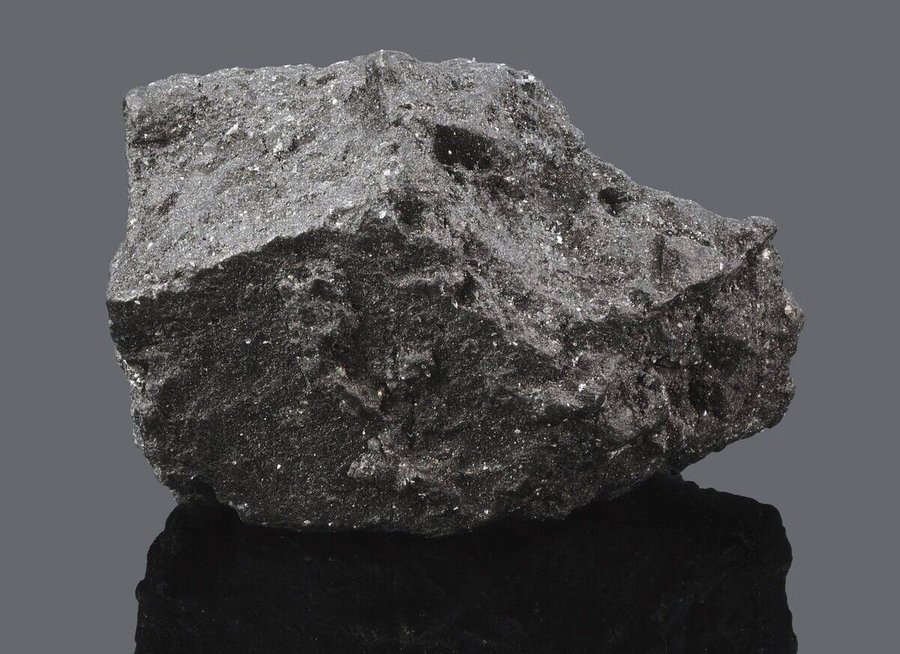
Out of this world: The first shard of the Oued Chebeika meteorite found in Morocco on June 6, 2024. · Photo: © mauritius images / Matteo Chinellato / Alamy Stock Photos
Traces in ancient sky stones
Parts of Oued Chebeika 002 also quickly fell into the hands of scientists through local meteorite dealers. What particularly electrified the researchers: The fragments had hardly been weathered by earthly influences, because they probably only fell from the sky after the last local rains.
It soon became clear: the find was significant. Scientific meteorite collections worldwide already contain over 80,000 stones. But as the analysis by a team led by Jerome Gattacceca from the European Center for Research and Teaching in Environmental Geosciences in Aix-en-Provence showed, Oued Chebeika 002 belongs to a rare class of very original meteorites.