

Dark energy is one of the greatest mysteries in cosmology. According to popular belief, it is the driving force behind the expansion of the cosmos and therefore a kind of opponent of gravity. But what it consists of, how continuous its effect is and whether it even exists is unknown – and the subject of ongoing debate. Some researchers attribute dark energy to as yet unknown particles or scalar fields such as “quintessence,” while others see it as an intrinsic property of space and its vacuum energy.
The problem of scale
According to the vacuum energy model, dark energy is due to a quantum physical peculiarity of seemingly empty space: In the vacuum of space, short-lived pairs of particles and their antimatter counterparts are constantly created due to quantum fluctuations. These immediately cancel each other out, but release energy in the process. Because this vacuum energy is a property of space itself, it increases as there is more space – and this could explain the accelerating expansion of the cosmos.
“These theoretical considerations offer the fascinating possibility of explaining accelerated cosmic expansion without having to introduce new fundamental fields,” explain Dong Ha Lee from the University of Sheffield and his colleagues. The catch, however, is that the vacuum energy derived from quantum field theory is around 120 orders of magnitude higher than all astronomically determined values for dark energy.
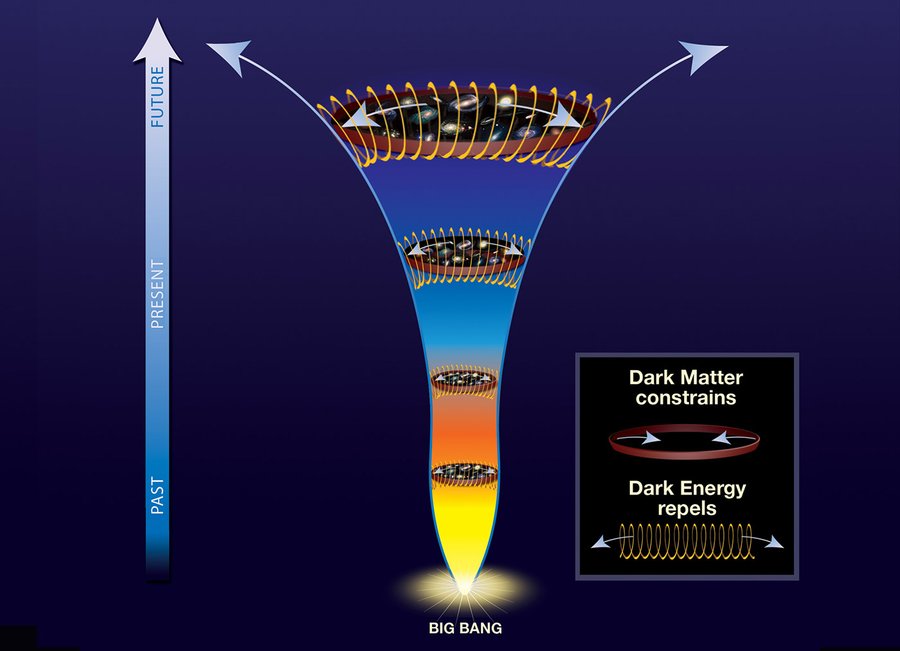
Cosmic expansion has accelerated since the early days of the cosmos. Dark energy increasingly counteracts the gravity of matter and dark matter. — © NASA/ESA, A. Feild (STScI)
What quantum chromodynamics has to do with vacuum energy
Lee and his team may now have found a solution to this problem of magnitude. Accordingly, dark energy could have its origins in the same fundamental force that holds atomic nuclei together. According to the established theory of quantum chromodynamics (QCD), the strong nuclear force acts on the quarks inside protons and neutrons, but also in other composite particles. The strong nuclear force is, in a sense, the “glue” that holds these particles together.
But quantum chromodynamics encompasses even more: it also describes physical mechanisms that affect the vacuum energy of space: “The calibration field of QCD allows various vacuum configurations that cannot be continuously converted into one another,” explain the physicists. Nevertheless, the quantum physics tunnel effect allows transitions between these configurations – the actually separate configurations can therefore mix. And depending on the extent of the quantum physical mixing, the resulting vacuum energy of the space changes.
Energy density is consistent with dark energy
The crucial thing is that this combination of vacuum energy and quantum chromodynamics brings the vacuum energy to a magnitude that corresponds to that of dark energy. “The characteristic energy scale resulting from the QCD vacuum and gravity is close to the energy scale of dark energy observed today – without having to introduce an artificial new field or additional parameter,” explains senior author Ariel Zhitnitsky from the University of British Columbia.
This was confirmed by comparisons of the theoretically determined values for the vacuum energy with measurements of dark energy and its effects based on astronomical observations. The team used measurement data of cosmic expansion based on supernovae, the distribution of galaxies and the cosmic background radiation. “Our data show broad agreement regarding various diagnostic parameters,” report Lee and his colleagues. “The dark energy resulting from the QCD model shows an energy density of the correct magnitude.”
Explanation also for accelerated expansion
And the new model can solve a second problem in explaining dark energy: why the effect of dark energy has not remained constant over time. Astronomical measurements show that the expansion of the universe has accelerated more recently than current cosmological models can explain. This could mean that dark energy has a less constant effect than long assumed.
At this point, the QCD model of vacuum energy comes into play again: “The central hypothesis of the QCD dark energy model states that this contribution caused by the tunneling effect depends on the large-scale geometry of space-time,” write the physicists. This means: The transitions between the vacuum configurations based on the effects of the strong nuclear force change as the cosmos expands. This creates an energy shift just strong enough to accelerate cosmic expansion.
“More coherent description than the standard cosmological model”
“It is very exciting that the quantum vacuum described by quantum chromodynamics has the right properties to explain the accelerated expansion of the universe,” says Lee. This was also confirmed by the comparison with astronomical data from the Dark Energy Survey (DES): “The QCD model successfully depicts the late temporal development favored by the DES and at the same time provides a more coherent and physically motivated description of the associated phenomenology than the cosmological standard model ΛCDM,” write the physicists.
Building on these findings, the research team plans to further refine its calculations and test the theoretical approach using data from the next generation of space telescopes.
Source: Dong Ha Lee (University of Sheffield, UK) et al., The Astrophysical Journal, 2026; doi: 10.3847/1538-4357/aeb9cc