

Our modern communication relies largely on electromagnetic waves: they provide the medium through which mobile communications, WiFi signals and radio waves are transmitted. Even optical signals are based on such waves. But electromagnetic signals can be blocked or disrupted – by natural effects such as a thick wall, but also by intentional interference. The same applies to communication using sound or particle streams.
Can you communicate via gravity?
This begs the question: Is there a communication method that works without photons, sound waves or particles? “The answer is yes: we can use gravity,” explain Andrew Groszek and his team from the University of Queensland. The idea behind it: Whenever masses move up, down or sideways, this influences the Earth’s local gravity field – even if only a tiny bit. But this effect is enough to be detected with a standard gravimeter.
Groszek and his team illustrate this with an example. In this one, Alice and Bob are separated by a wall. A mass weighing 100 kilograms lies about one meter away from Bob on Alice’s side of the wall. “If Alice moves this mass one meter away from Bob, this changes the acceleration due to gravity at Bob’s location by around five nanometers per square second,” explain the physicists. “This goes unnoticed by the normal observer, but Bob’s gravimeter can detect it.”
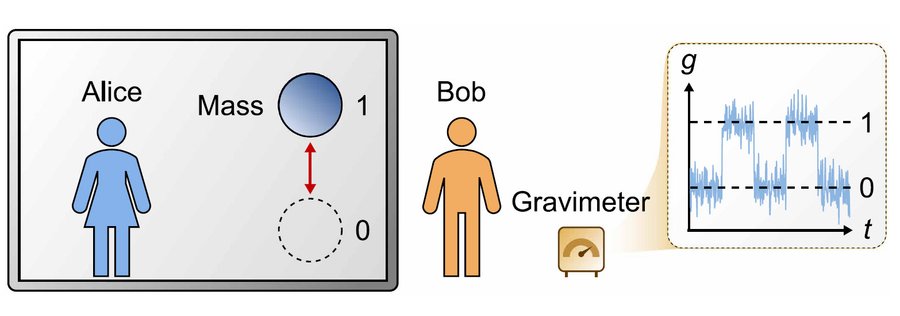
The principle of gravitational communication: When Alice shifts a mass, this changes the local gravity field. Bob can measure this using a gravimeter. — © Groszek et al./ Science Advances, CC by 4.0
Test message with elevator and gravimeter
But does this gravity communication also work in practice? To test this, Groszek and his team conducted an amazingly simple experiment. “We transmitted a gravitational message from an elevator shaft through a wall to an adjacent room,” report Groszek and his colleagues. The counterweight of the elevator, which weighs around 1,800 kilograms, served as the mass and the researchers allowed it to travel back and forth between two floors. A gravimeter on the wall of the neighboring room served as a receiver.
The physicists used the word “Gravity” in binary code as a test message: 1000111 1110010 1100001 1110110 1101001 1110100 1111001. The two positions of the elevator and its counterweight each corresponded to a zero or one. And indeed: The gravimeter in the adjacent room was able to receive the binary message and displayed the bits as jumps in the gravity field of around 25 nanometers per square second. “Despite minor fluctuations, the zero and one signals were clearly recognizable. The detected bit sequence exactly matched the original message,” reports the team.
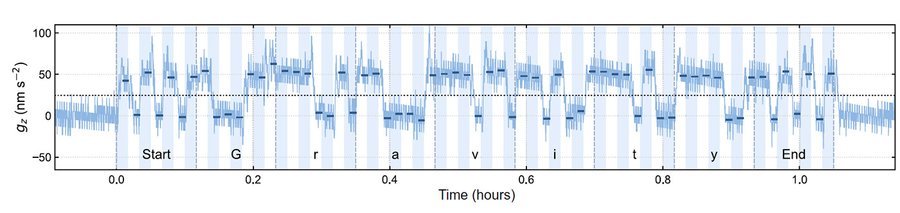
The message received in the elevator experiment using a gravimeter. The rashes represent zeros and ones and encode the word “Gravity”. — © Groszek et al./ Science Advances, CC by 4.0
Speed and range still limited…
This is the first time that a message has been transmitted using gravity. “It’s not often that you have the opportunity to demonstrate a completely new method of communication,” says senior author Matthew Davis. “We have shown experimentally that information can be encoded in the gravitational field and read out again at the other end.”
In the test, however, data transmission was still extremely slow and the range was limited: “Our elevator moved at a snail’s pace, so we could only transmit one bit per minute. This meant that the transmission of a single word took an hour,” explains co-author Andrew White. But this can still be optimized: If faster movements, larger masses and more sensitive gravimeters are used, the gravity messages could be transmitted at around 15 bits per minute and at ranges of up to 500 meters, according to the physicists.
…but it can hardly be blocked
According to physicists, despite these limitations, such gravimetric messages offer an alternative wherever common transmission routes do not work – for example, through thick bunker walls or from a Faraday cage. “Anyone who has ever lost cell phone reception in a tunnel or had trouble getting Wi-Fi through a solid wall will understand the benefits of this method,” says Charles Wofnden from the University of Queensland.
Another advantage: “In contrast to the electromagnetic signals of modern telecommunications, a gravitational signal cannot simply be shielded by placing shielding material in its propagation path,” explains Wofnden. A malicious actor could just try to mask the signal. To do this, he would have to move masses or generate strong vibrations that would disrupt the gravimeter measurements.
“Although the current system is still far from practical application, it demonstrates a communication method that cannot be blocked by normal physical barriers,” the physicists state. “If one of our readers ever finds themselves trapped in a soundproof, electromagnetically insulating elevator, our method offers an experimentally tested chance to send signals for help.”
Source: Andrew Groszek et al. (University of Queensland, St. Lucia), Science Advances, 2026; doi: 10.1126/sciadv.aee0802