

Our sun and most of the other stars in the Milky Way lie in the “thin disk” – the main plane of our galaxy. This is where the spiral arms and bar lie; this is where most star formation takes place. Above and below this flat disk of stars lies the thick disk – a more extensive area with predominantly older stars. But how did these two disks of our galaxy form? Which one came first?
Two scenarios for the Milky Way disks
So far there are two opposing scenarios: According to the first model, new stars were only formed in the thin disk from the start. Only later did turbulence throw these older stars into the thick disk. The thick disk therefore developed later than the thin one. The second scenario describes the reverse. After this, the first stars in our galaxy formed in a thick, highly turbulent disk of gas. As these gas turbulences gradually subsided, star formation became increasingly concentrated in the thin disk of stars.
Which scenario is correct is one of the great mysteries of our galaxy. “According to simulations, both models for the formation of the disks are possible,” explains lead author David Mirabal from the Canary Islands Institute for Astrophysics. “However, there was a lack of astronomical observation data to decide which scenario actually applies to the Milky Way.” The age estimates for stars in both galactic regions were not clear or precise enough to reconstruct the chronologies.
Star age reveals early shape of the galaxy
That has now changed: Mirabal and his team have developed a method to determine the age of stars with an accuracy of five percent. Even for very old stars, the deviations are a maximum of 500 million years. This was made possible thanks to data from the Gaia space telescope on the positions, motion, spectrum and brightness of more than a billion stars in our Milky Way. In the ChronoGal project, astronomers used this data to date different populations of stars in our galaxy more precisely than previously possible.
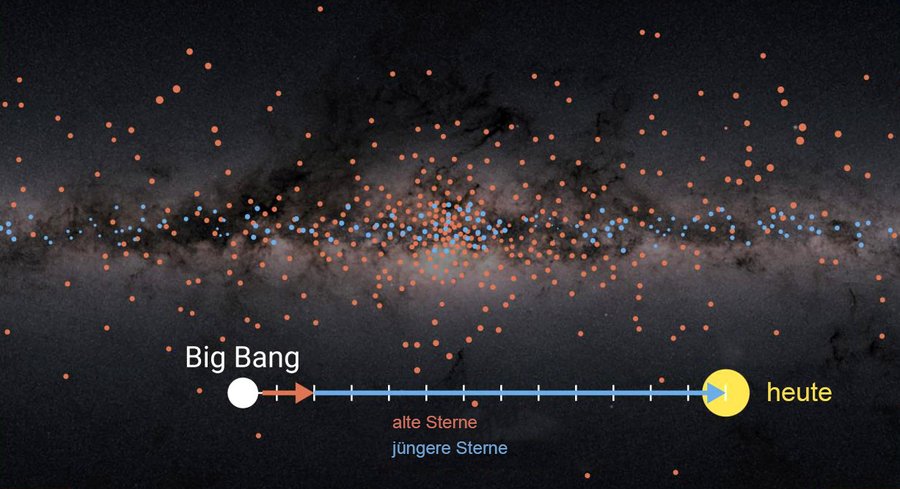
Distribution of stars of different ages in the Milky Way. — © Gabriel Pérez, SMM and Gaia.
The dating revealed that the closer the stars are to the main galactic plane, the younger they are. This suggests that star formation initially took place in a larger area, including the thick disk. There is also a second result: “Star populations that are more than 10.8 billion years old follow a significantly different, faster development than the younger ones,” report the astronomers. Within this very old group of stars, the distance to the central plane of the Milky Way changes more than for stars that formed later.
Upheaval 10.8 billion years ago
“Our results show two clearly defined, time-dependent phases for the evolution of the galactic disk,” write Mirabal and his colleagues. Until 10.8 billion years ago, the Milky Way’s star disk flattened very quickly: within just two billion years, its thickness decreased from more than 4,100 light-years to around 1,600 light-years. However, the further flattening of the stellar disk, which continues to this day, was much slower.
The timing of this change of pace may not be a coincidence, as around 10.8 billion years ago the Milky Way experienced its most dramatic collision: it collided with its then neighbor, the Gaia-Sausage-Enceladus dwarf galaxy, and merged with it. This event gave the Milky Way its central star bump, while at the same time its outer regions were severely deformed and possibly even tilted.
“Upside-down” scenario confirmed
More importantly, however, the two-step development of the Milky Way reveals which of the two educational scenarios applies. “This result is the first clear observational evidence that one of the two models better describes the early development phase of our galaxy,” says Mirabal. Accordingly, the observation data agree best with the “upside-down” model: star formation initially took place in a thick, turbulent disk of gas.
“This highly turbulent, star-forming gas cooled down more and more and came to rest within the first three billion years,” explain the astronomers. As a result, this gas increasingly settled in the main plane of the Milky Way. As a result, the star formation zone became flatter. Around 10.8 billion years ago, most of this gas movement was complete and evolution slowed.
“Our galaxy transitioned to a quieter state, gradually cooled, and the dynamically colder thin disk formed—the thin disk of stars we see today,” Mirabal and his colleagues write. “This result solves a classic problem in astrophysics.”
Source: David Mirabal (Instituto de Astrofísica de Canarias, Tenerife) et al., The Astrophysical Journal Letters, 2026; doi: 10.3847/2041-8213/aeb0a3