

The Mars moons Phobos and Deimos (“fear” and “terror”) pose puzzles for planetary scientists. Because these irregularly shaped chunks are unusually small, less than 30 kilometers in diameter. Phobos also orbits Mars at a distance of just 6,000 kilometers and loses two meters in height every year. The moon, which is only loosely held together anyway, is so close to the planet that it will inevitably be destroyed in several million years: either it falls or it is torn apart by Mars’ gravity.
This raises the question of how these moons of Mars were formed in the first place. Are these captured asteroids, as suspected for some small moons in the outer solar system? Were they thrown out of Mars in a massive impact? Or perhaps Phobos and Deimos are debris from an earlier, larger moon of Mars that was destroyed?
First visit to the Martian moon Phobos
The Japanese mission MMX (Martian Moons eXploration) should now provide answers to this. “The MMX mission will focus on Phobos – a moon that has never been explored before,” explains the Japanese space agency JAXA. “The mission will study the topography, internal structure, composition and gravity of the Martian moon for the first time and return samples of its regolith – a world first.”
The MMX mission is scheduled to launch this evening, October 19, at around 9:41 p.m. our time from Japan’s Tanegashima Cosmodrome. The start window lasts until November 7th. If the launch is successful, the mission will reach Mars in around a year and initially examine the Martian moons from orbit. Landing on Mars’ moon Phobos is planned for early 2029, followed by several months of on-site exploration. Samples from Phobos are scheduled to be brought to Earth in 2031.
A mission in three parts
The Japanese space agency has developed a combination solution for these demanding tasks: The MMX mission consists of three modules, each of which takes on certain parts of the mission. The propulsion module provides the thrust for the flight to Mars and takes over navigation and braking maneuvers in orbit around Mars and Phobos. Piggybacking on this unit is the exploration and landing module, which carries the eight scientific instruments.
One of the big challenges will be landing on Phobos. Because the small moon has less than a thousandth of Earth’s gravity, the space probe must not touch down with too much momentum – it would bounce off and be thrown straight back into space. “MMX is therefore equipped with landing legs that can be flexibly extended and retracted, which can absorb the momentum of the landing and also allow multiple landing attempts,” explains JAXA. The model for this technology is, among other things, the Hayabusa-2 probe, which landed on the asteroid Ryugu and brought samples back to Earth from there.
A German-French rover called Idefix
The German-French rover Idefix is also on board the MMX mission. The vehicle, which weighs only around 25 kilograms, was developed and built by the German Aerospace Center and the French space agency CNES. Before the MMX exploration and landing probe touches down on Phobos, it will first jettison the rover hanging between its legs. This falls from a height of around 40 meters in free fall onto the lunar surface – hopefully without serious consequences thanks to the low gravity and retracted wheels.
Once on Mars’ moon, the rover will explore the surface of Phobos for three months and, among other things, look for a good sampling location and thus also the cheapest landing site for the main MMX probe. “Idefix will make history – as the first rover to ever leave traces on a Martian moon,” says DLR project manager Markus Grebenstein. The rover will be the first to land and travel around a celestial body with such low gravity.
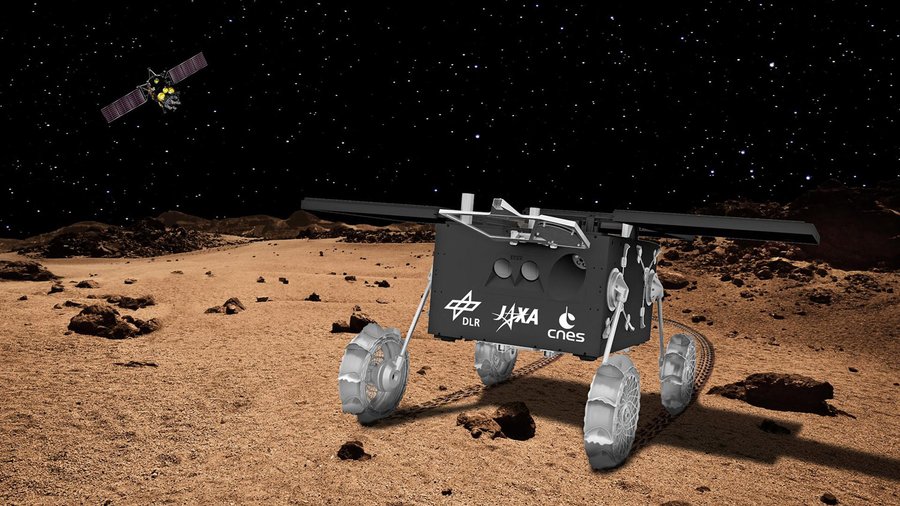
The German-French MMX rover will explore the surface of the Martian moon Phobos for three months. — © DLR /CC-by-nc-nd 3.0
The sampling and the return transport
When the MMX spacecraft lands on Phobos – expected in 2029 – its main goal will be to collect samples. To do this, the probe will touch down twice and take different material samples: its core drill, which is attached to a robot arm, can collect samples from a depth of up to two centimeters and store them in a sample tube. In addition, a pneumatic gas blast stirs up loose material from the surface of the Martian moon, which is captured by another sample container.
All samples – only around ten grams of material in total – are stored in the sample return capsule. Similar to the asteroid samples from Hayabusa-2, the MMX probe will return the capsule to Earth and drop it. The sample capsule then crosses the Earth’s atmosphere alone and lands. The return of the Mars moon samples is planned for 2031.
“The Martian moon Phobos is a still unexplored place. By bringing back samples from it, we will clarify how the Martian moons were formed, how the Martian system evolved, and also where water and organic material on the rocky planets in our solar system come from,” says Yasuhiro Kawakatsu, MMX project manager at JAXA.
Source: Japan Aerospace Exploration Agency (JAXA), German Aerospace Center (DLR)