

It was a dress rehearsal for an emergency: On September 26, 2022, the DART mission tested asteroid defense using a kinetic deflector for the first time. A heavy probe rams the asteroid to steer it out of its trajectory – and thus prevent a collision with Earth. The NASA DART probe, which weighs around half a ton, rammed the 150 meter large asteroid moon Dimorphos – with success: The impact shortened the orbital period of the chunk around its larger partner Didymos by 33 minutes – significantly more than expected.
But a crucial question remains unanswered: What exactly happened to Dimorphos during the impact? “There has been debate among scientists as to whether the impact caused Dimorphos to create a crater, change its shape, or largely retain its original appearance,” explains Patrick Michel, scientific director of the Hera mission from the Côte d’Azur Observatory.
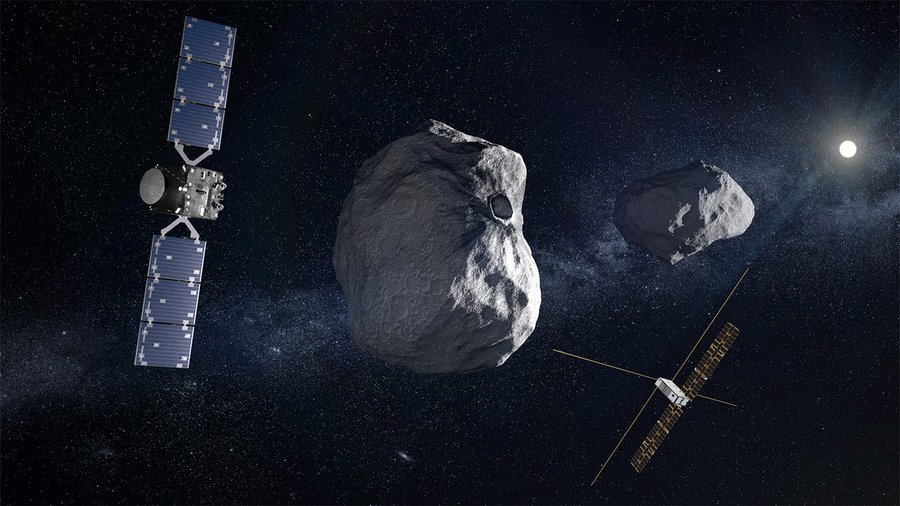
Hera space probe in front of the asteroid pair Dimorphos (front) and Didymos (illustration). It is supposed to investigate the consequences of the DART ram test. — © ESA
Huge impact crater and flattened side
The answers are now provided by the first images from ESA’s Hera space probe, which has now reached the asteroid pair Didymos and Dimorphos, around 193 million kilometers away from us. “To our great surprise, it turned out that all three possibilities were true at the same time,” reports Michel. “The side hit by DART has been flattened. There is now an impact crater the size of a sports stadium that runs the entire width of the asteroid.”
“A man-made impact crater on the distant asteroid Dimorphos, taken from close up – these images are much more than a scientific sensation. They are proof that we are no longer at the mercy of the dangers from space,” commented Anke Pagels-Kerp from the German Aerospace Center (DLR). Germany played a key role in the construction of the Hera probe.
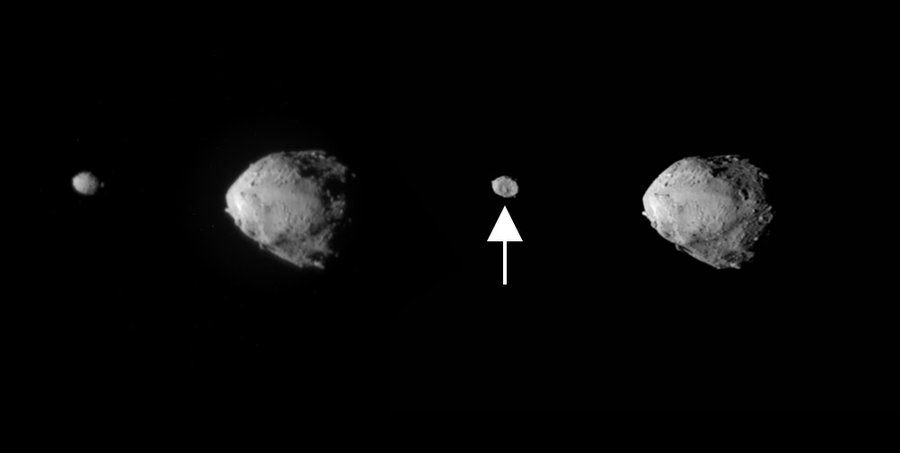
The binary system Didymos and Dimorphos before and after the impact of the DART ramming probe on Dimorphos. The large crater and the changed shape of the small asteroid moon can be clearly seen (arrow). — © ESA
Tumbling asteroid moon and hundreds of chunks
The Hera images also revealed that the impact of the DART probe changed the rotation of the asteroid moon Dimorphos – that was also unexpected. Previously, it circled its larger partner Didymos in a fixed rotation, always facing the same side. That has now changed: “With each additional image taken of Hera, it became clearer that the impact caused Dimorphos to go into a violent tumbling motion,” reports Michael Küppers from ESA.
“Another big surprise is the discovery of hundreds of boulders orbiting the asteroids. They are only a few meters large,” said Küppers. Where these chunks come from is still unclear. “Based on the information currently available to us, we cannot yet say whether these are debris from the DART impact or whether they have another origin,” said planetary scientist Naomi Murdoch from the University of Toulouse when presenting the images in Berlin last night.
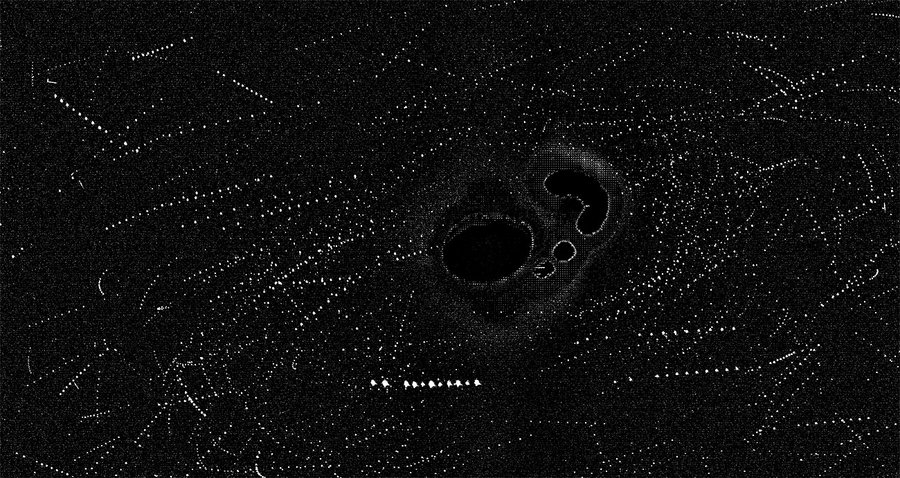
These multiple exposures show the orbits of numerous rocks around the asteroids Dimorphos (in the center) and Didymos. The asteroids themselves were retouched from the image to make the chunks more clearly visible. — © ESA
How the Hera mission continues
Further investigations during the Hera mission should now clarify this. The small car-sized space probe is currently orbiting Dimorphos and Didymos in a close orbit at a distance of 20 to 30 kilometers. In December, Hera is expected to approach the pair of asteroids to within about 13 kilometers and take even higher-resolution images.
In January 2027, the Hera spacecraft will deploy two shoebox-sized CubeSats that will get even closer to the asteroids. They will examine Dimorphos up close and later even land on the asteroid to measure its surface, internal structure and gravity. This information will allow planetary scientists to understand exactly how effective the DART deflection was. This in turn can help plan deflection missions of this type for other asteroids.
With Hera, the dress rehearsal for an asteroid deflection enters a new phase: “After NASA has proven that an asteroid can be deflected, ESA is now providing the detailed scientific studies necessary to understand how this deflection came about,” explains ESA Director General Josef Aschbacher. These findings are essential for developing planetary defense capabilities.
How great is the risk of an asteroid impact?
Earth’s history has repeatedly shown how dangerous asteroids can be for the Earth. 66 million years ago, the impact of the kilometer-sized Chicxulub asteroid triggered a global mass extinction and ended the era of dinosaurs. Craters like the Nördlinger Ries in southern Germany also bear witness to major impacts in the past. And in February 2013, the Chelyabinsk meteor demonstrated how much damage even a 20-meter chunk can cause when it explodes in the atmosphere.
There is no shortage of candidates for future impacts: astronomers know the orbits of more than 42,000 near-Earth objects. But new Earth orbit cruisers are discovered again and again – sometimes only shortly before they pass our planet. Some already known asteroids are also moving in orbits that could bring them dangerously close to Earth in the distant future, such as the 350 meter large asteroid Apophis.
Asteroid Apophis and the Ramses Mission
Apophis will pass Earth in 2029 at a distance of just 31,750 kilometers and will therefore fly within geostationary orbit. The Japanese-European space mission Ramses is supposed to investigate what happens to Apophis during this close flyby and whether Earth’s gravity may change its rotation, its surface or even its internal structure. She will accompany Apophis on his flyby and observe him up close.
“Hera helps us understand the consequences of a targeted impact on an asteroid,” explains Holger Krag from ESA. “Ramses will study how an asteroid responds to a planet’s gravitational forces. Together, these missions will significantly expand our scientific knowledge in the area of planetary defense.”
Source: European Space Agency (ESA), German Aerospace Center (DLR)